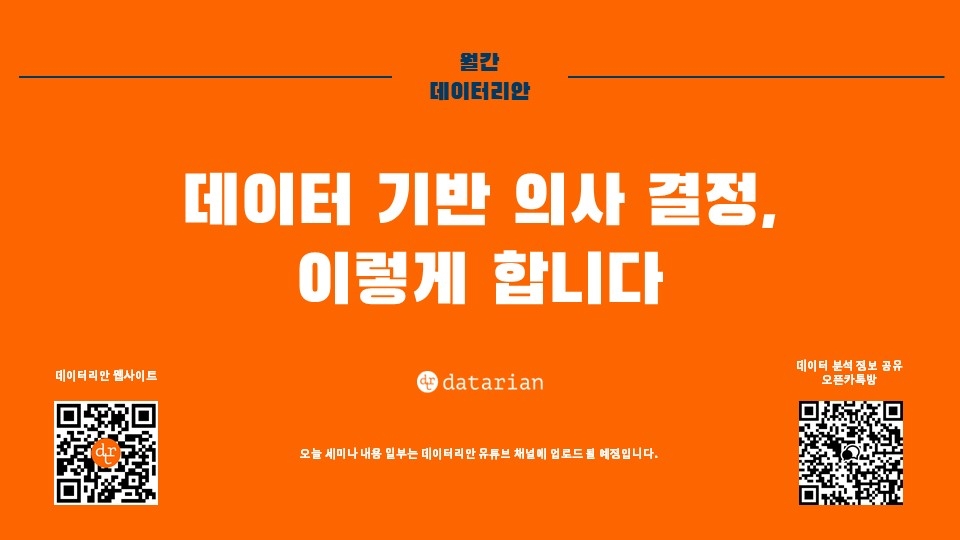
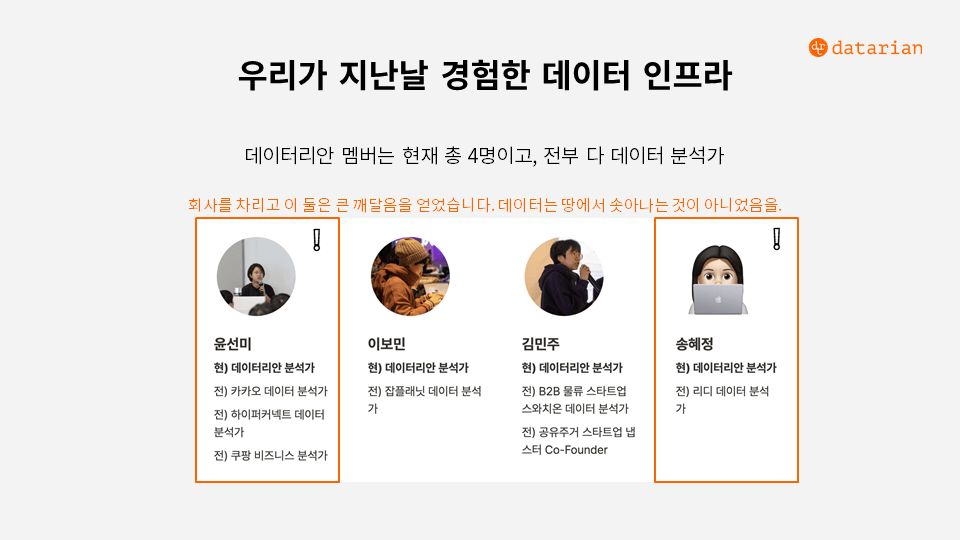
Datarian consists of four members, all of whom are data analysts. Two of them worked in well-established data infrastructure environments at companies like Kakao, Coupang, and Ridi, while the other two started from scratch, beginning with data logging. After founding Datarian, the former two had a major realization: data doesn't just spring from the ground. In a situation without data infrastructure, what kind of data do analysts analyze and reflect in their decision-making? If you are contemplating data analysis that leads to action, if you are a startup data analyst, if you need to analyze data in an environment without infrastructure, or if you are wondering, "Can I utilize data in my own work?" then this talk is for you.
2부에서 답하는 사전 질문 펼쳐보기
Ⅰ. Data Analysis Environment
Q1. How should data be stored in early-stage startups?
Q2. In an organization where the service is old and large in scale but has very little data, should we request to hire a data engineer first? Or should we first show that we can do something with the data we have, even if it's limited?
Q3. I believe analysis tools like Amplitude and GA have become very advanced recently, so I'm curious about how much actual querying or coding is still used in practice.
II. Getting Started with Data Analysis
Q4. What should I know first when starting to utilize data? It feels overwhelming to look at overall metrics and the big picture—how should I approach this?
Q5. In a company where people don't know how to extract and organize data, what should be the first step to start working with data?
Q6. There are many points made that presenting data and numbers in early-stage startups is meaningless due to reasons such as a lack of relevant materials. What are your thoughts on this?
III. Utilizing CS Data
Q7. What is the primary purpose of the CS team analyzing data?
Q8. Please let us know if there are any data collection methods for establishing CX KPIs.
Q9. What are the types of data used to judge customer experience?
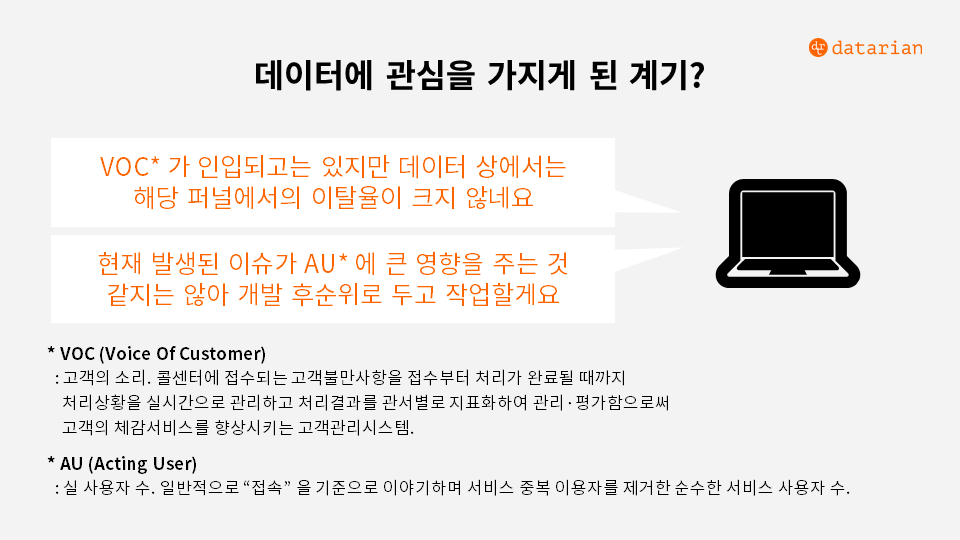
Q10. Since VOC data is collected from customers who have experienced problems, it is difficult to represent the entire customer base, and because the sample size itself is smaller than the total customer data, there are concerns regarding its reliability. As a result, even CX managers sometimes have doubts about VOC data. Is there a way to resolve this?
IV. How to make good data-driven decisions?
Q11. What are your thoughts on data being collected or analyzed in a biased way to support the organization's vision and goals during the data-driven decision-making process? I am curious about how this can be resolved.
Q12. I have experienced many companies where data is used only for reporting, and in practice, things only get approved and move forward if you do what the higher-ups want. Is changing jobs the only way to gain experience in making data-driven decisions?
Q13. I am curious about the communication skills needed to lead data-driven decision-making effectively. In particular, I think persuading decision-makers is both important and difficult; do you have any know-how on how to successfully persuade those in higher positions?
Q14. I am curious if you have any know-how for communicating effectively when persuading decision-makers with data analysis results.
Q15. I understand that organizational structure and data-driven decision-making are deeply related. I am curious about success stories of data-driven decision-making and the organizational structures behind them.
Q16. While data-driven decision-making is crucial, I've noticed that becoming overly obsessed with quantitative KPIs set through data can lead to problems during execution. I'm curious how to find the right balance in utilizing data effectively.



![[A hundred words are not as good as seeing once] Advanced SQL for data analysisCourse Thumbnail](https://cdn.inflearn.com/public/courses/324605/cover/141a32ce-69fe-42d9-9253-d2136e208464/sql_advanced.png?w=420)

![[A hundred words are not as good as seeing once] Basic SQL for data analysisCourse Thumbnail](https://cdn.inflearn.com/public/courses/324566/cover/aa1fac55-6e80-4506-9c92-f32c2b65f93a/sql_basic.png?w=420)

![Data-Driven Design Without a Data Analyst [Datarian Seminar Replay | November 2025]Course Thumbnail](https://cdn.inflearn.com/public/files/courses/339608/cover/01kbpcbn9gv7ysm630hkz313gd?w=420)
![Free GA4 Course for Beginners [Datarian Seminar Replay | July 2025]Course Thumbnail](https://cdn.inflearn.com/public/files/courses/338668/cover/01k38fk7pq2a3ht1pn7nwrk7s4?w=420)
![How are other companies doing funnel analysis? [Datalian Seminar Replay | March 2024]Course Thumbnail](https://cdn.inflearn.com/public/courses/333329/cover/9e7725db-639d-469a-adac-5089658875a6/333329.png?w=420)
![How to Create a Data Analysis Portfolio That Stands Out to Interviewers [Datarian Seminar Replay | May 2026]Course Thumbnail](https://cdn.inflearn.com/public/files/courses/342570/cover/01kttv90pd2czjrsqfgx59egvv?w=420)
![Effectively Persuading Marketing Plans Based on Data [Datalian Seminar Replay | October 2024]Course Thumbnail](https://cdn.inflearn.com/public/courses/335163/cover/af19c098-8652-462d-8533-939a23e1d5bd/335163.png?w=420)
![Data Analyst Resumes That Lead Straight to Interviews [Monthly Datarian Seminar Replay | February 2022]Course Thumbnail](https://cdn.inflearn.com/public/courses/328519/cover/9dcb604b-7dd6-464b-909c-686ed349a891/328519-eng.png?w=420)
![Senior Data Analyst's SQL Coding Test Know-how Revealed [Monthly Datalian Seminar Replay | December 2023]Course Thumbnail](https://cdn.inflearn.com/public/courses/332774/cover/a9900f25-50a4-46f1-930d-e6ef03ea88f1/332774.png?w=420)
![Data Analyst Career with Generative AI [Datalian Seminar Replay | May 2024]Course Thumbnail](https://cdn.inflearn.com/public/courses/333839/cover/8abc6cdd-25bd-4a69-9527-16b9fc9cb460/333839.png?w=420)
![How did a non-major become a data analyst? [Datalian Seminar Replay | January 2024]Course Thumbnail](https://cdn.inflearn.com/public/courses/332976/cover/1c20f1ed-fb65-4c32-9624-4cedc370ed5b/332976.png?w=420)
![Beyond SNS Marketing to Offline Advertising with Data [Monthly Datarian Seminar Replay | October 2023]Course Thumbnail](https://cdn.inflearn.com/public/courses/332241/cover/5d548964-3f42-4b6b-9e46-67cf2e1f670f/332241-eng.png?w=420)
![Data-Driven Content Marketing That Drives Business Growth [Monthly Datarian Seminar Replay | May 2023]Course Thumbnail](https://cdn.inflearn.com/public/courses/331081/cover/b10ce0eb-8a35-4653-a3f5-488a06981d60/331081-eng.png?w=420)
![Practice! Startup Data-Driven Decision Making [Monthly Datarian Seminar Replay | April 2023]Course Thumbnail](https://cdn.inflearn.com/public/courses/330863/cover/313b64e2-ed51-42ef-8501-176e94ed6534/330863-eng.png?w=420)
![How Should You Prepare to Become a Data Analyst? [Monthly Datarian Seminar Replay | February 2023]Course Thumbnail](https://cdn.inflearn.com/public/courses/330276/cover/19ca276d-b62f-4d60-a5c6-9650ed6dfe92/330276-eng.png?w=420)
![Creating an Environment Where Data Quickly Leads to Action [Monthly Datarian Seminar Replay | October 2022]Course Thumbnail](https://cdn.inflearn.com/public/courses/329327/cover/580d4b52-b72f-435a-9739-a4e4953ee2ed/329327-eng.png?w=420)
![Data Analysis Portfolio That Takes You Straight to an Interview [Datarian Seminar Replay | January 2025]Course Thumbnail](https://cdn.inflearn.com/public/courses/336048/cover/c90f7e08-0953-41b6-9892-236f20b110ec/336048.png?w=420)
![The Core of Data Experimentation Culture: A/B Testing [Monthly Datarian Seminar Replay | November 2022]Course Thumbnail](https://cdn.inflearn.com/public/courses/329680/cover/13a4e12e-374a-445b-bf3e-a4282e2ead29/329680-eng.png?w=420)
![Data Analysis Skills for Immediate Use in Practice [Monthly Datarian Seminar Replay | April 2022]Course Thumbnail](https://cdn.inflearn.com/public/courses/328708/cover/75cd40e3-b22d-42fb-a613-572707875ab4/328708-eng.png?w=420)