




Complete Mastery of Practical SQL in 49 Sessions I - Basic Course (Including Practice Materials and Problem Solving)
'Complete Mastery of Practical SQL in 49 Sessions I - Basic Course' contains essential content that you must know for SQL. By learning using a practical database, you can apply it right away in the field, and it is structured so that you can fully learn the learning content through theoretical explanations, practice, and solving a total of 200 application problems. For intuitive understanding, practice is conducted using a database written in Korean.
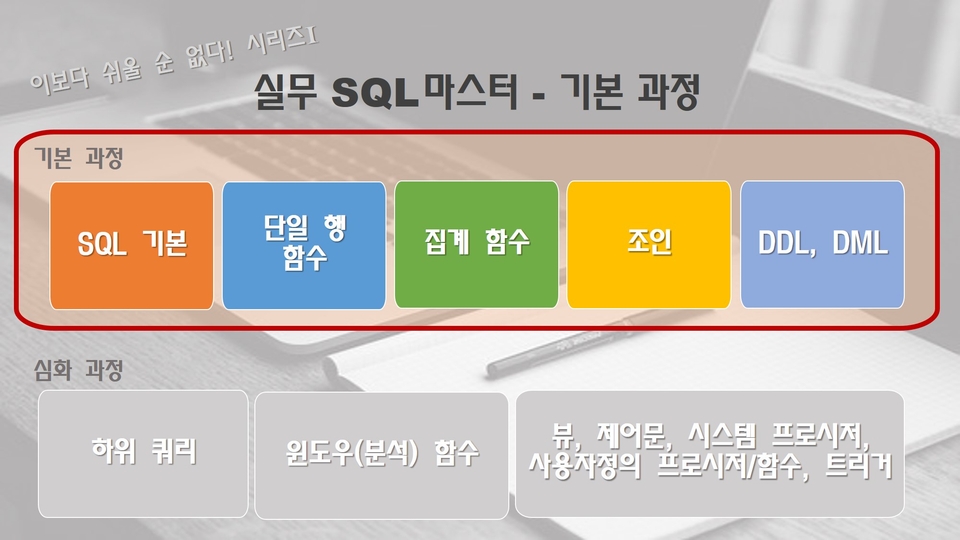
SQL single row functions (string functions, numeric functions, date functions, etc.)
Aggregate function
signature
Data manipulation language, data definition language
SQL, from beginner to expert! Fundamentals + Application + Problem Solving all at once.
📣 Please check before taking the class!
The new SQL Mastery Series, available in just 49 lessons, consists of two lectures (Basic and Advanced). This course is a basic course. It covers approximately 49 SQL topics across two lectures.
Attention, these people !
Starting from the basics I want to learn SQL thoroughly.
It is difficult to understand with just general textbooks I want to learn intermediate to advanced skills easily.
SQLD, SQLP, data analysis expert, etc. I would like help in obtaining a certificate .
SQL in the field of data handling I want to develop capabilities that I can utilize .
For learning SQL Transfer of optimal know-how.
✅ If you are working on data-related tasks or want to use SQL in your work,
✅ If you want to start from the beginner level of data and advance to the advanced level,
✅ If you want to use SQL freely as a developer ,
✅ If you are preparing for a data-related certification (SQLD, SQLP, Data Analysis Specialist, etc.)
✅ If you are interested in data science
The "From Beginner to Expert in 49 Sessions! Master Practical SQL" course covers the essential fundamentals of SQL and provides hands-on practice with databases based on real-world applications . Solving practical practice problems not found in any textbook will help you rapidly improve your skills, and the goal is to immediately apply SQL in real-world situations.
We've compiled the best know-how we've accumulated over many years of practical experience and training at universities, companies, and educational institutions. Starting with the basics, anyone can learn, we'll help you build a solid foundation in SQL!
SQL Basics You Must Know We handle it carefully.
The structure of the entire learning process is as follows:
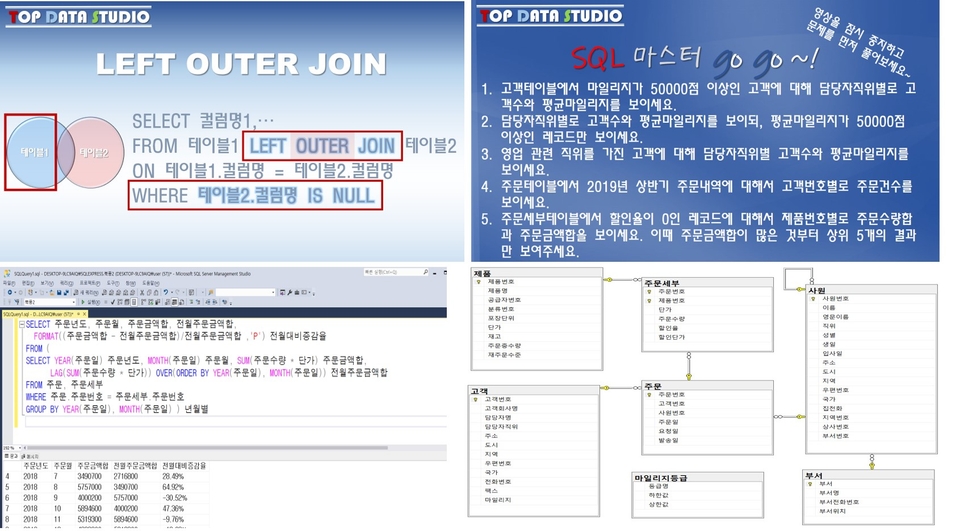
The class uses a practice-based database and consists of theory and practice problem solving.
Fully packed with 3-step structure
The course progresses through three stages: theoretical explanation, practical training, and application problem solving. After completing the entire course, you'll be able to write SQL fluently, and you can also choose to study selectively based on your efficiency.
I think about how to utilize it
This course not only prepares you for data qualifications using SQL, but also helps you develop your ability to utilize public data. Furthermore, it focuses on writing intermediate to advanced SQL statements necessary for program development.
Vivid hands-on experience with a practical DB
We use external data used in the field to enable practical training in an environment similar to actual work. Specifically, we've structured the program with Korean table and column names for intuitive understanding.
Solutions to over 200 application problems
By solving over 200 application problems of various difficulty levels and types, ranging from beginner to intermediate to advanced, you will develop the ability to solve problems using SQL according to the situation.
Complete Mastery of Practical SQL in 49 Sessions
In each section You will learn these things :
Section 0: SQL basic grammar
SQL Overview, Installing SQL-Server Express 2019
Install SSMS (SQL-Server Management System)
Importing data from outside Excel
Introduction to the Korean Language Database Dataset
SQL basic query syntax, conditional clauses, and operators
Sort data and remove duplicates
Section 1: single row functions
Single-row functions used in SQL Server: string functions, numeric functions, date functions, and system functions.
FOREIGN KEY Attributes - ON DELETE, UPDATE CASCADE, SET NULL, SET DEFAULT, NO ACTION Comparison
Comparing Column-Level and Table-Level Constraint Settings
How to add/change/delete columns, add/delete constraints, and delete tables
Setting Constraints on the North Wind Database and Creating an ERD in SSMS
Q&A 💬
Q. Why should I learn SQL?
They say data is the oil of the 21st century. It's virtually impossible to find an industry that doesn't utilize data. Therefore, data-handling skills are essential these days, and SQL is considered one of the most common means of accessing data. Furthermore, cloud-based machine learning services are increasingly utilizing SQL. Furthermore, SQL skills are increasingly required for IT recruitment.
Q. Can non-IT majors learn it too?
Of course. Data itself isn't limited to IT majors. Data handling skills are essential for a wide range of talents across all industries, regardless of their major.
Q. What are the main features of the class?
This course aims to teach skills that can be immediately applied in the workplace. Therefore, we use a database similar to those used in the field as our practice database. Furthermore, to enhance students' intuitive understanding, we use Korean for table and column names. Solving approximately 200 application problems on your own and working together to solve them will also be of great help.
Q. Who uses SQL and where?
It will primarily be used by IT developers. It's also essential for those who specialize in data analysis, visualization, and other data-intensive tasks. Anyone who handles any type of data in the workplace will find a solid understanding of SQL very helpful.
Q. What is the level of the class?
The entire course consists of eight sections, including both basic and advanced sections. Section 0 is the introductory course . As the course progresses, it gradually covers intermediate and advanced skills .
Q. Is it very different from ORACLE or MySQL?
Standard SQL is the same. Depending on the DBMS, some features, such as functions, may differ. Therefore, even if you learn with MS-SQL, Microsoft's DBMS with its excellent accessibility and online help, you'll have no trouble using SQL in ORACLE, MySQL, or other relational databases.
Recommended for these people
Who is this course right for?
People who want to apply and apply SQL directly to their field of work
People who want to analyze or utilize data in the field
IT Developer
People preparing for data-related certifications such as SQLD, SQLP, and data analysis specialist
People interested in data science
Need to know before starting?
Section 0 is an introductory course and requires no prior knowledge.
Hello This is
209
Learners
15
Reviews
1
Answers
4.8
Rating
2
Courses
강의 분야)
-데이터베이스 및 데이터 분석 분야: 데이터베이스, 데이터베이스 설계 및 구축, 데이터베이스 실습(SQL-Server, ORACLE, MySQL), 파이썬과 R을 활용한 데이터 분석, 엑셀을 활용한 데이터 분석 및 시각화
-데이터 시각화 분야 : POWER BI
-프로그래밍 언어 분야: 파이썬, 비주얼베이직 닷넷, 자바스크립트, VueJS, C#, 웹프로그래밍실습, 모바일프로그래밍, 자바 등