Microservice Application (MSA) Development with Spring Cloud
This is a course on developing microservice applications using the Spring Cloud suite from the Spring framework. You will learn how to use and configure Spring Cloud as a Cloud Native Application.
I have taken many lectures on various lecture platforms such as fastcampus and inflearn, but this is the best lecture.
It is a lecture that is surprising to listen to.
The instructor's diction, the flow of explanation, and the big picture.. It is perfect, apart from MSA.
5.0
thghu
28% enrolled
I think the quality of the lecture is really high. It has a lot of practical and detailed information, more than the materials I had to gather from the internet for weeks, and the explanations were good, so I could easily apply them. I need more information about API gateway, but I am looking forward to the rest of the lectures and will have to finish them.
5.0
Cho
39% enrolled
Thank you, instructor, for creating such a great lecture.
Before taking this lecture, I read books and heard countless stories about cloud, microservices, etc., and even tried making them, but my head was full of fragmented knowledge.
The more I listen to this lecture, the more my head feels organized. I've only heard 30% of it, but I keep wondering what's next, so I listen until dawn.
The lecture is structured in such a way that it clearly explains why, how, and what to do for each chapter at the beginning, and then implements it with actual code.
They extract only the necessary extracts and do it, and the video length is appropriate. Even after implementation, they intentionally make small modifications and guide us to repeat important parts.
I've only heard 30% of it, but as a follow-up to this lecture,
I earnestly ask you to prepare CI/CD, Cluster (Kubernetes), and monitoring as the picture you drew at the beginning. Thank you.
What you will gain after the course
Spring Cloud
Spring Boot
Cloud Native Application
Microservice Architecture
MSA Application
Spring Boot
Spring Cloud
Microservices
Build a cloud native architecture, Take on the challenge of developing microservice apps! 🚧
In IT systems, numerous technologies emerge and disappear every year. It takes a long time for newly released concepts, technologies, and methodologies to become established as stable systems through numerous references.
1960s~1980s
The 1960s to 1980s were the mainframe era, when hardware was the center. It was a time when services were built according to hardware specifications or characteristics rather than software, and because the hardware and systems themselves were quite expensive, it was quite difficult to modify or change the functions of the service. In this period, called Fragile, changing a system once it was built was not an easy task, and it required a lot of money and time.
1990s~2000s
The 1990s and 2000s were a time when the keyword was distribution. This period was called Robust and Distributed. Thanks to the system being stabilized/distributed, it was possible to build a system that could maintain stability and performance even when there was a certain degree of uncertainty or change in the service.
From 2010 to present
Since 2010, the system has been built with Resilient, Anti-Fragile, which is the opposite of Fragile, and Cloud Native. Virtualization technology has been introduced, and the IT environment and system of the company have been moved to the cloud, and scalability and stability have been further strengthened. Even if there are continuous improvements and changes from customers, the systems have been built to be processed quickly and operated flexibly.
Currently
Cloud technology is considered essential to the IT environment. Building IT systems in this Cloud environment can be called Cloud Native Architecture, and applications that run in the Cloud environment can be called Cloud Native Applications.
Suitable for cloud environment Why IT system construction is necessary.
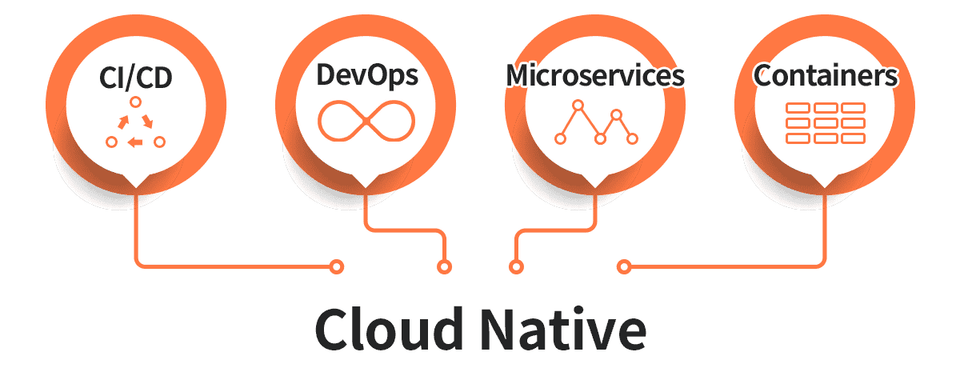
CNCF (Cloud Native Computing Foundation), a Linux-affiliated organization, has mentioned the following four key components of Cloud Native Applications:
• CI/CD • DevOps • Microservices • Containers
Among these, Microservice is the core of Cloud Native Application and implements the service logic of the business domain. Microservice Architecture is a development method that is different from the monolithic method that deploys all components such as Front-end, Back-end, and Database in a single system environment. It refers to an architecture that develops and operates services by separating them by the well-divided boundaries that the application constitutes. For applications developed based on Microservice Architecture, Java, Spring Framework, and Spring Cloud can be used.
Spring Cloud is a development tool and development platform that provides the development environment and services required to develop distributed system configurations and applications, as well as development and configuration-related patterns, to enable rapid development of microservice applications for Cloud Native Architecture.
It provides basic boilerplate patterns to easily use technologies such as configuration management, service discovery, circuit breakers, intelligent routing, micro-proxy, control bus, one-time token, global locking, leadership election, distribution, etc. for microservice applications, and the developed applications and services maintain excellent compatibility so that they can work well in any distributed environment including the developer's local environment's laptop, bare metal data center, and management platform such as Cloud Foundry.
Objectives of this lecture
What is our ultimate goal ?
Using Spring Boot + Spring Cloud App designed with microservice architecture It's about designing and developing.
In this lecture, you will learn how to develop a Microservice application with Spring Cloud's products (subprojects) and how to build an operating environment. You will also learn how to configure the Gateway, Service Mesh, and Runtime that make up the Microservice Architecture, and the process of building and deploying for operation.
Those who take this course will be able to understand the basic Microservice Architecture and develop Spring Boot and Spring Cloud applications using IntelliJ, an integrated development environment for Java. They will also be able to practice deploying and operating them in local environments and container virtualization.
You can check out the practical examples used in the lecture below.
I am an IT engineer. There was a time when I wondered which word I should choose for the occupation field: "office worker?", "developer?", or "instructor?" Then I came to think that “IT engineer” was the job title that suited me best, so I have continued to write "IT engineer" in the occupation field.
A profession represents the work you do, and I believe that work should be enjoyable and useful. Although no one can live by doing exactly the work they want, I am someone who likes the work I do and wants to do it well. Having worked as a developer, instructor, and consultant, I am constantly struggling to keep up with newly released and ever-changing IT technologies. Even so, I am one of those people who wants to encounter, share, and use them even a little earlier than others.
The field I have recently become interested in is online education consulting. The technologies I am interested in include Cloud Native Architecture, Blockchain, Machine Learning, Kafka, and Kuberbetes. I actually teach courses on these technologies and apply them in my work as well. However, since they are such vast topics, I am still continuously studying them.
They say that what you keep in your head is not true knowledge. I intend to share my knowledge and experience in various ways. And I will continue to be an IT engineer who takes on new challenges in new fields and with new technologies.
Current) CEO of NJ One Company
Current) Adjunct Professor, Department of Information Security, Graduate School of International Information, Dongguk University
Former) JP Morgan Chase AMJ Tech consultant (Japan)
Former) Samsung SDS CMS Business Division Lead Engineer
I have taken many lectures on various lecture platforms such as fastcampus and inflearn, but this is the best lecture.
It is a lecture that is surprising to listen to.
The instructor's diction, the flow of explanation, and the big picture.. It is perfect, apart from MSA.
This is a very informative lecture that will allow you to experience the overall content of Spring and Docker container-based microservices.
I think this lecture is much more informative than looking at the Spring microservice-related books that are sold on the market.
I wish there were lectures on building and using private docker repositories in clouds such as AWS, GCP, and AZURE, and Kubernetes.
Thank you for creating a great lecture.
This is a great lecture that I really want to praise.
I was a new developer who was given the task of building MSA alone without a mentor, and I was struggling for 2-3 days even with a simple and small problem, so my progress was very slow.
However, with this one lecture, I was able to solve 30 or 50 problems that I was struggling with at once.
I really want to thank the instructor. From my perspective, it was worth more than 1 million won.
Thank you, instructor, for creating such a great lecture.
Before taking this lecture, I read books and heard countless stories about cloud, microservices, etc., and even tried making them, but my head was full of fragmented knowledge.
The more I listen to this lecture, the more my head feels organized. I've only heard 30% of it, but I keep wondering what's next, so I listen until dawn.
The lecture is structured in such a way that it clearly explains why, how, and what to do for each chapter at the beginning, and then implements it with actual code.
They extract only the necessary extracts and do it, and the video length is appropriate. Even after implementation, they intentionally make small modifications and guide us to repeat important parts.
I've only heard 30% of it, but as a follow-up to this lecture,
I earnestly ask you to prepare CI/CD, Cluster (Kubernetes), and monitoring as the picture you drew at the beginning. Thank you.
I think the quality of the lecture is really high. It has a lot of practical and detailed information, more than the materials I had to gather from the internet for weeks, and the explanations were good, so I could easily apply them. I need more information about API gateway, but I am looking forward to the rest of the lectures and will have to finish them.









![[Revised Edition] Setting up IntelliJ IDEA for web application developmentCourse Thumbnail](https://cdn.inflearn.com/public/courses/331621/cover/3c440a92-fca5-4ce0-a950-d5865d534892/331621-eng.png?w=420)

![[Revised 2023-11-27] Developing RESTful Web Services using Spring Boot 3.xCourse Thumbnail](https://cdn.inflearn.com/public/courses/325065/cover/43d3072a-4402-45a6-b5ee-332f53a4b75f/325065-eng-b.png?w=420)
![[Old version] Setting up IntelliJ IDEA for web application development (2020 ver.)Course Thumbnail](https://cdn.inflearn.com/public/courses/324954/course_cover/53636a00-6da7-4661-b3ee-52f2359cd1f3/web-app-intellij-eng-2.png?w=420)



![[Apache Kafka Application Programming] From concepts to consumers, producers, connects, and streams!Course Thumbnail](https://cdn.inflearn.com/public/courses/327041/cover/d1e15d56-83e2-464d-866d-09cd80bee4a2/327041-eng-original.png?w=420)
![[Java Advanced Practical Project] Spring Core + H2 Based Food Truck Kiosk System DevelopmentCourse Thumbnail](https://cdn.inflearn.com/public/files/courses/336594/cover/01k8hetsq20rg69zw5ve0q5729?w=420)