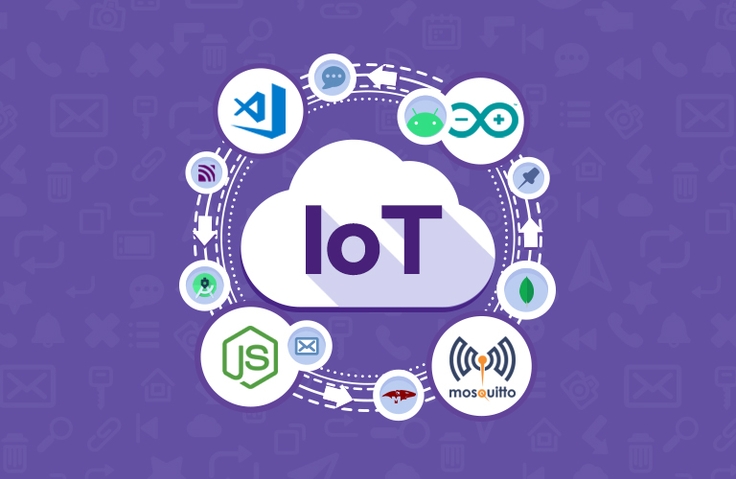
Internet of Things Communication in My Hands (Arduino, MQTT, Nodejs, MongoDB, Android, VS Code)
Learn the most important communication part of the Internet of Things (IoT). You can learn the core contents of the overall communication that transmits, collects, processes, and monitors center data. Through this course, you can design an IoT communication prototype before making a prototype, and use it for various projects and competitions.
Thank you for always giving me easy and informative lectures. I keep listening to your lectures and they are very helpful. Please give me other lectures.
What you will gain after the course
You can configure an Arduino (WeMos) circuit and build a development environment.
WiFi communication is possible.
Data can be relayed using MQTT Broker.
You can build an IoT server with Node.js.
You can install and utilize Cloud MongoDB.
Sensor data can be collected, stored, and monitored.
Communication is possible using sockets and REST services.
You can integrate Android and Node.js.
Java and MQTT can be integrated.
Communication technology, the core of the Internet of Things (IoT)! Design your own Internet of Things communication prototype.
📣 Please note before taking the class! • The audio volume for this lecture is a bit low. Please turn up your speaker volume a little. Before taking the lecture, please refer to the lecture [Preview].
🗒 Course Introduction
The educational course planned this time is an Internet of Things (IoT) communication project using the MQTT protocol .
Among the trends of the 4th industrial revolution, the Internet of Things (IoT) is developing rapidly, and various IoT-related education programs are being conducted at universities and educational institutions.
I think the core of the Internet of Things (IoT) is the communication part . Many students find the communication part somewhat more difficult than the hardware part, and I think they find it difficult because they have to implement communication in software.
In this course, you will build the entire communication process required for an Internet of Things (IoT) application. We planned this course to provide a method to create a prototype for a future project or prototype by learning the series of processes for collecting and monitoring sensor data from a software perspective.
Learning Objectives
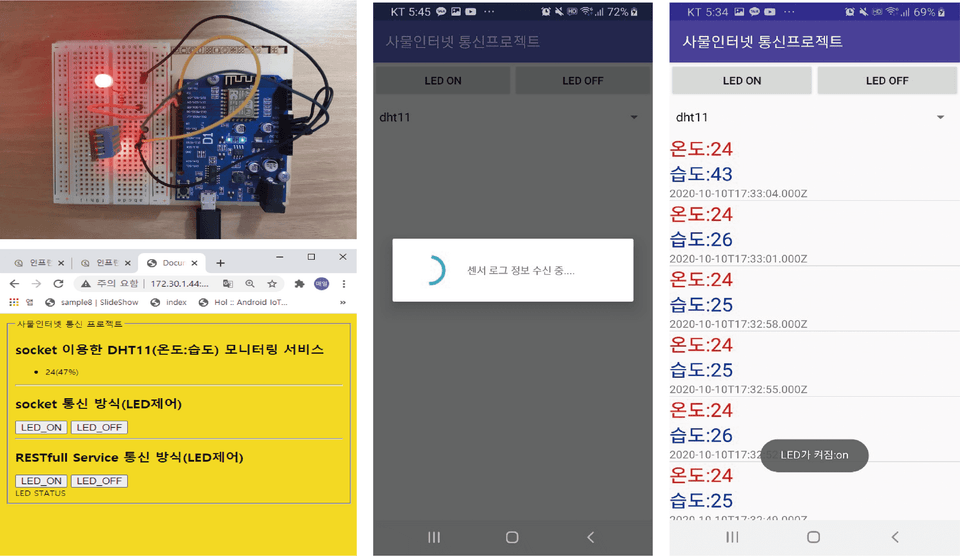
① We will implement a communication process to monitor and control (LED) sensor (DHT11) data using the web, Java, and smartphone (Android) based on the Internet.
② You can prepare for contests and competitions, and design an IoT communication prototype before developing a prototype.
③ You can learn about the basic technologies that can collect and analyze various sensor data required for processing Internet of Things big data.
Project subtopics
① Controlling LED using Web and Android ② Monitoring DHT11 temperature and humidity using Web and Android ③ DHT11 temperature, humidity monitoring and LED control in Java
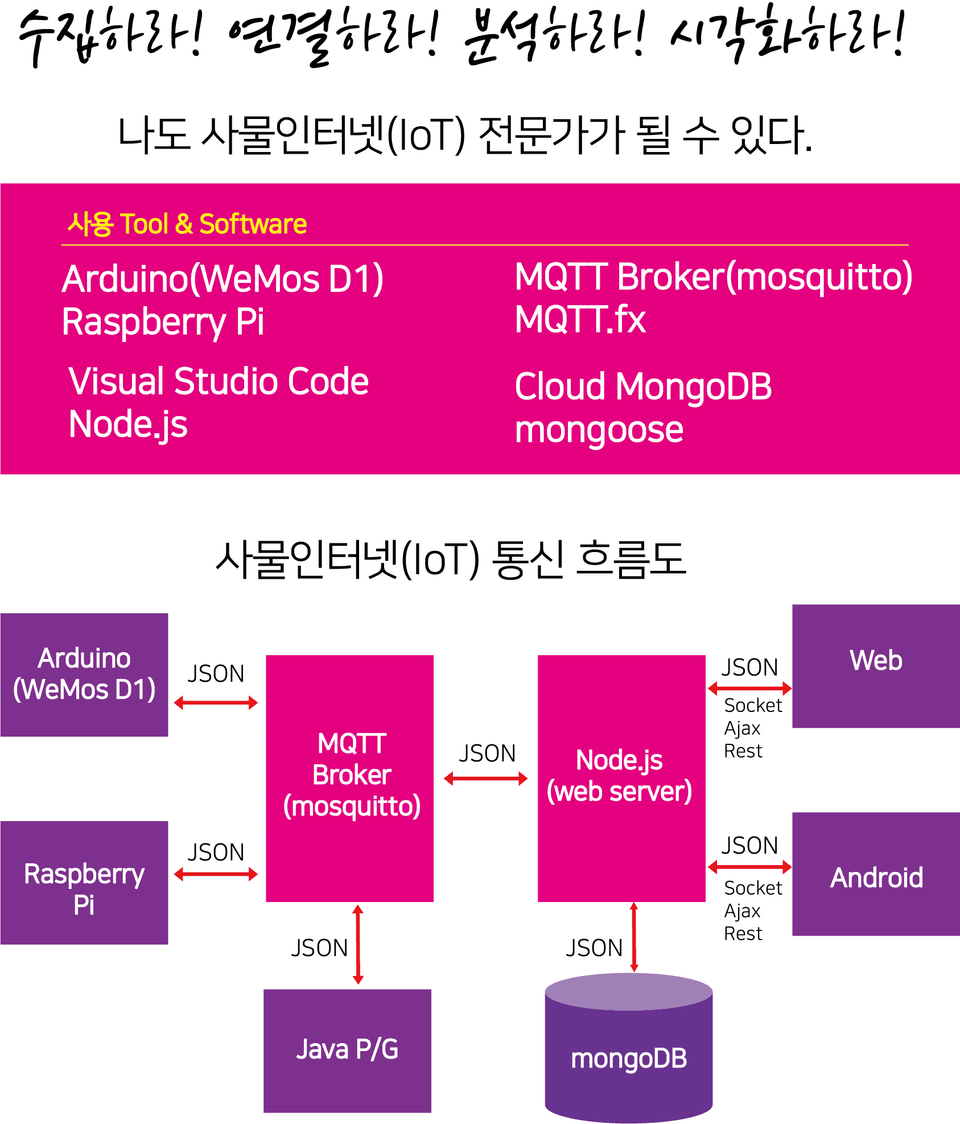
WeMos - MQTT(mosquitto) - node.js - mongoDB - Web - Android communication
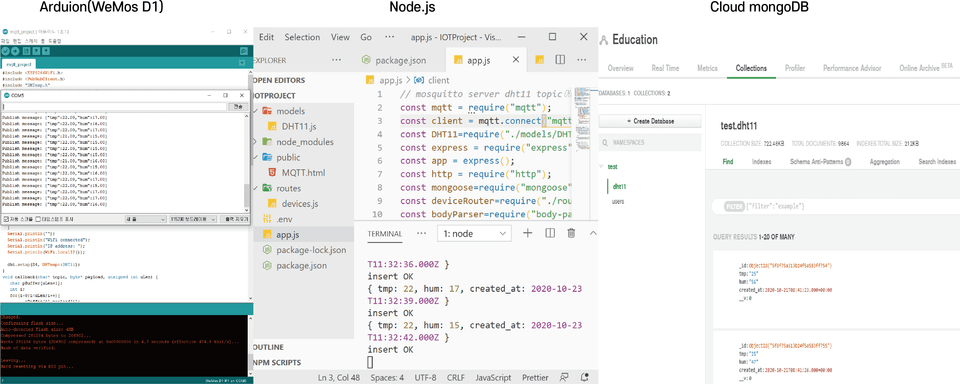
Arduino(WeMos D1) → MQTT(mosquitto)→Node.js→Cloud mongoDB data transfer
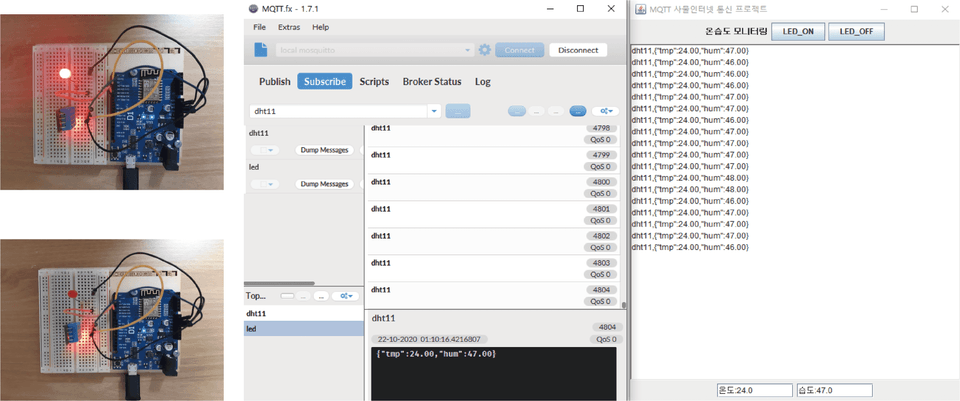
WeMos - MQTT - Java Communication
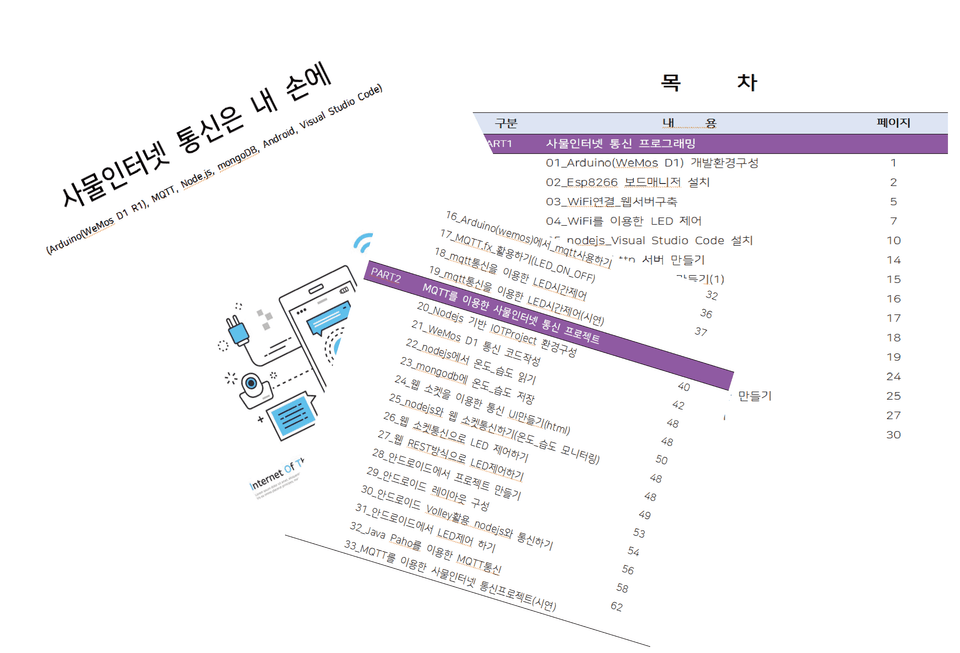
"Internet of Things Communication in My Hands" Self-study material provided (70 pages)
🙌 Tools covered here
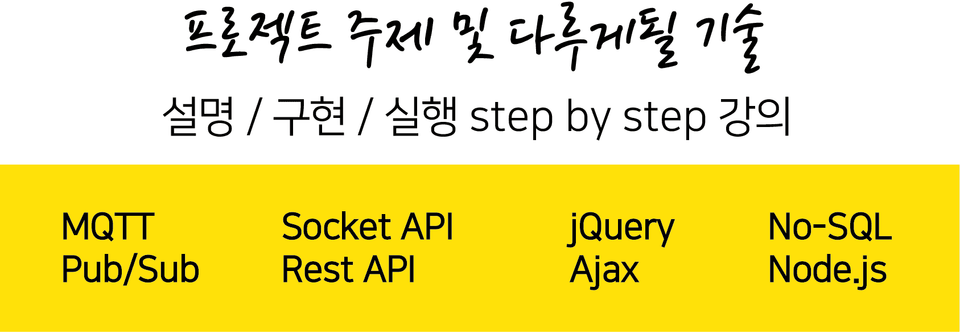
Arduino Sketch / MQTT/ Node.js/ MongoDB/ Android Studio/ VS Code
🙋🏻♂️ Expected questions related to the lecture
Q. Are there any special advantages to this course? A. Rather than using just one technology, we designed it to integrate various functions and enable comprehensive thinking. B. You can create an IoT communication prototype and use it directly for contests or projects. C. You can set up a practice environment with low parts cost (12,000 to 15,000 won).
Q. Can non-majors also take the course? A. It may be a little difficult for non-majors, but we provide a 70-page self-produced textbook and source code, so even non-majors can follow along. B. This course is designed to help non-majors become interested in the Internet of Things.
Q.Why should I take this lecture, “Internet of Things Communication in My Hands”? A. To become a leading workforce in the 4th industrial revolution, you must acquire communication technology. B. Big data and artificial intelligence also need to use communications to be released as products. As such, the importance of communications technology is growing. C. Non-face-to-face IoT products will boom due to the spread of COVID-19.
Recommended for these people
Who is this course right for?
People interested in the Internet of Things
People preparing for IoT related contests
People interested in data processing using Internet of Things communication
Anyone who wants to create an IoT development prototype
People who want to apply data communication to various systems
Hello, I am instructor Park Mae-il. I run an SW education center and provide consulting and commissioned SW training for universities, government offices, and corporations.
📄 Major teaching experience and many others
- Goorm Specialized High School Major Camp Lectures (Full Stack Course) - Software Meister High School Industry-Academic Cooperation Teacher - Gwangju Artificial Intelligence Academy Lectures - Fast Campus Backend Bootcamp Lectures - Smart Human Resources Development Center Education Director and Lecturer - Korea Electric Power Corporation (KEPCO) In-House Coding Entrusted Education - Hanyang University ERICA Online Lectures - Bit Software Education Center Operation (Overseas Employment, Government-funded Education) - SW Recruitment Training Project (Ministry of Science, ICT and Future Planning) - Vocational Skills Development Training Teacher for AI, IT Development, etc. * Education Inquiries and Partnerships (KakaoTalk Channel) * Ongoing Lectures: https://itscoding.kr 🎤 Online Educational Content Provider Inflearn: Java, DB, MVC, Spring, Spring AI & Agent, IoT Fast Campus: Java, Spring Boot
I think this is the most useful and tremendous material among IoT lectures.
Thank you very much.
In the middle, there was a bit of an environment setting problem due to Windows Firewall in MQTT Broker settings, but it was easy after changing MQTT Broker to Raspberry Pi. Thank you.
Thank you for the informative lecture.^^
It seems that you can try to work by releasing the MQTT firewall on Windows.
I left an article about the firewall in the news (modifying the location of downloading mqttfx and an example of how to receive messages sent from other PCs), so you can refer to it.
I will come back again with a good lecture in the future.
Thank you for always giving me easy and informative lectures. I keep listening to your lectures and they are very helpful. Please give me other lectures.
Yes, thank you~~
I applaud your various challenges.
Since IoT is a communication class, I hope you listen carefully, install the related programs well, and complete the course^^
Yes, thank you.
There must have been some parts where the online lecture was interrupted, but I think you finished it well.
I hope you can apply it to various services.^^
IoT is hard to follow while practicing, but you did a good job finishing it~~
Now that you understand the overall flow of IoT communication, I hope you can apply it in various ways. Thank you.^^





![[Spring AI in Practice] Creating Your Own 24-Hour Code Reviewer & Automatic Grading AgentCourse Thumbnail](https://cdn.inflearn.com/public/files/courses/340163/cover/01kd87fc1wdcg20nnkcngd9wap?w=420)
![[Season 2] Spring AI in Practice: Developing Multi-AI Agent SystemsCourse Thumbnail](https://cdn.inflearn.com/public/files/courses/339915/cover/01kbqgcec3hb576vxxdf9ch76y?w=420)
![[Season 1] Spring AI in Practice: Developing a Premium Reservation AI AgentCourse Thumbnail](https://cdn.inflearn.com/public/files/courses/339732/cover/01kb2qr7zw5gf0724jvv4rndns?w=420)
![[7-day completion] Thinking database modelingCourse Thumbnail](https://cdn.inflearn.com/public/courses/332784/cover/6cc9552a-5e06-454f-a8ac-3dd5396b5204/332784.png?w=420)
![Spring Framework in my hands [Spring 2]Course Thumbnail](https://cdn.inflearn.com/public/courses/329630/cover/e05f1532-5d1d-440e-be03-c21c42cd5566/329630-eng.png?w=420)

![Spring Framework is in my hands [Spring Shot 1]Course Thumbnail](https://cdn.inflearn.com/public/courses/327065/cover/7bbf404a-452e-40b8-b5f6-ade169a104fc/327065-eng.png?w=420)
![[NarP Series] MVC Framework in My Hands [NarP 2nd Edition]Course Thumbnail](https://cdn.inflearn.com/public/courses/327005/cover/e4ddde65-0f6b-4626-b745-6ce2d892d6b3/327005-eng.png?w=420)
![[NarP Series] MVC Framework in My Hands [NarP 1]Course Thumbnail](https://cdn.inflearn.com/public/courses/326624/cover/a47f727f-a67b-476b-9d23-fefb0db9a954?w=420)