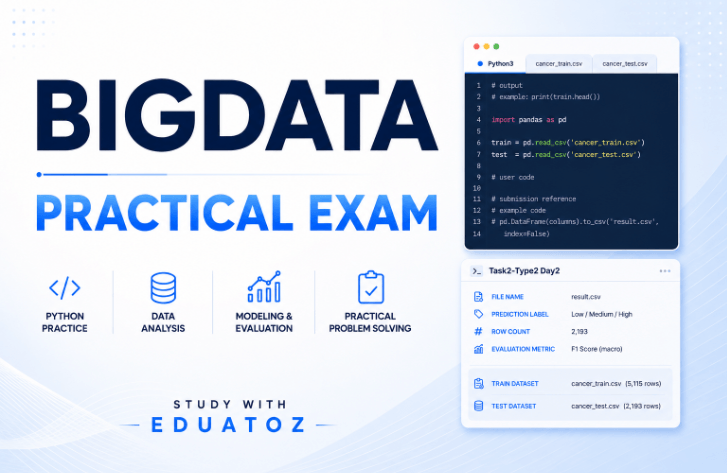
[2026 Edition] Big Data Analysis Certification Practical Exam (with Python)
The Big Data Analysis Certification is a nationally recognized certification exam held twice a year. For those preparing for the practical exam, we have provided detailed lectures covering everything from the basics to core concepts. As the exam difficulty increases with each session, we have included various essential contents starting from the fundamentals to help improve your chances of passing.
I am currently watching the lectures with the June 20th exam as my target, and I'm suddenly writing this review because I love how the course starts with Python basics instead of jumping straight into exam types or problem-solving. It feels like a course that gathers everything one fundamentally needs to know for data analysis, not just for the Big Data Analysis Certification practical exam. I will finish the rest of the lectures and leave another review then.
5.0
sungjin
100% enrolled
Thank you. Thanks to you, I passed!
5.0
go06533
30% enrolled
Even though it takes a lot of time,
since I am using a new language, I am taking the course from the basics.
If I study diligently, I expect there will be good results.
What you will gain after the course
Big Data Analysis Engineer Practical Exam - Descriptive Type
Big Data Analysis Certification Practical Exam Task Type
Machine Learning
Python Data Analysis (Pandas)
National Certified Big Data Analysis Practitioner Practical Exam, make sure to pass this year!
Data Analysis Professional Take the challenge for the national technical qualification! 🏆
Big Data Analysis Certification?
It is a certification to verify practitioners who perform big data analysis planning, big data collection, storage, processing, analysis, and visualization based on an understanding of big data.
To secure national and corporate competitiveness, the demand for big data analysis experts is increasing. However, due to a shortage of supply relative to demand, there are difficulties in securing personnel. Consequently, at the government level, the Big Data Analysis Certification—a national technical qualification—was launched to foster big data analysis experts and systematically verify their capabilities.
In 2025, the 10th and 11th regular exams will be held, and as the difficulty level increases with each session, in-depth study is required. This course summarizes the basics to core content of a total of three subjects: Python and Pandas, data processing, and machine learning.
Only the essential content for passing the exam!! 👌
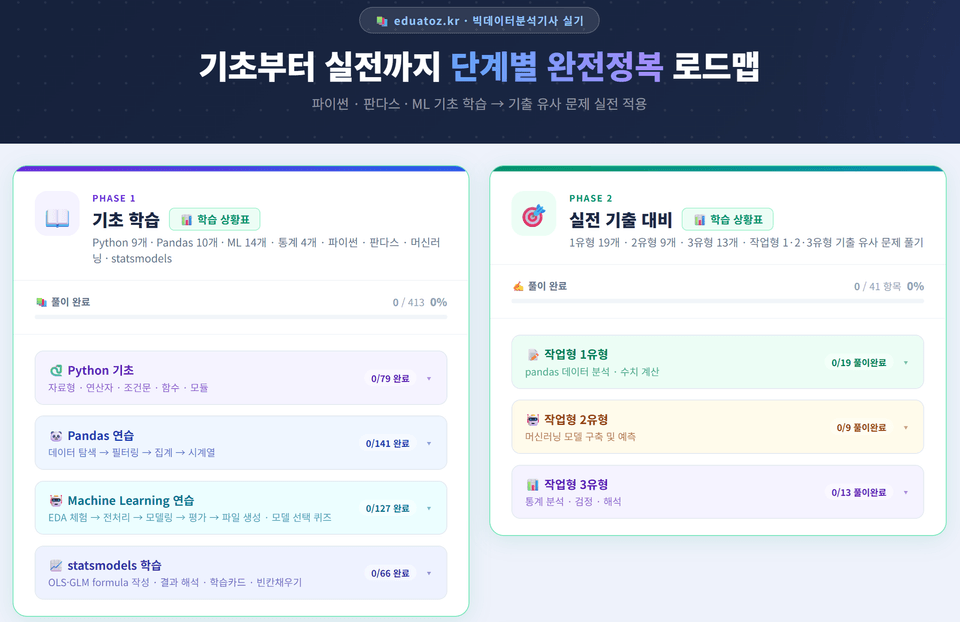
This course covers the programming language Python and the Pandas, Scikit-Learn, statsmodels, and scipy libraries, and is designed to prepare you for Task Types 1, 2, and 3 of the Big Data Analysis Certification practical exam. Since the practical exam cannot be solved through simple memorization alone, the course provides example-oriented explanations to help with various applications.
Pandas
You can learn by following the process of loading, preprocessing, and analyzing data using four different files.
The content is structured so that explanations are repeated according to the difficulty level, allowing for natural learning.
It covers various data preprocessing techniques required for machine learning.
Scikit-Learn, statsmodels
Understand the concepts of machine learning by directly using simple training data and performing basic modeling.
We cover modeling examples using past exam questions for the Big Data Analysis Certification and data sourced from Kaggle.
✅ Learn the memorization methods and workflow so you can prepare only for the types that appear on the exam for Task Types 2 and 3.
✅ You can practice by solving past exam questions to ensure you receive a high score.
📖 Big Data Analysis Certification Exam Guide
Integrated type (Short-answer, Performance-based) 180-minute exam
Big Data Analysis Practice: Data Collection, Data Preprocessing, Data Model Construction/Evaluation
Pass with a score of 60 or higher out of 100 points.
Please refer to the Korea Data Agency website for detailed eligibility requirements and passing criteria.
Learning Support 📚
* We are operating a regular Quiz site for the 13th exam. * We provide a Q&A open KakaoTalk chat room to help you resolve any difficulties during practice.
Learning Content 📚
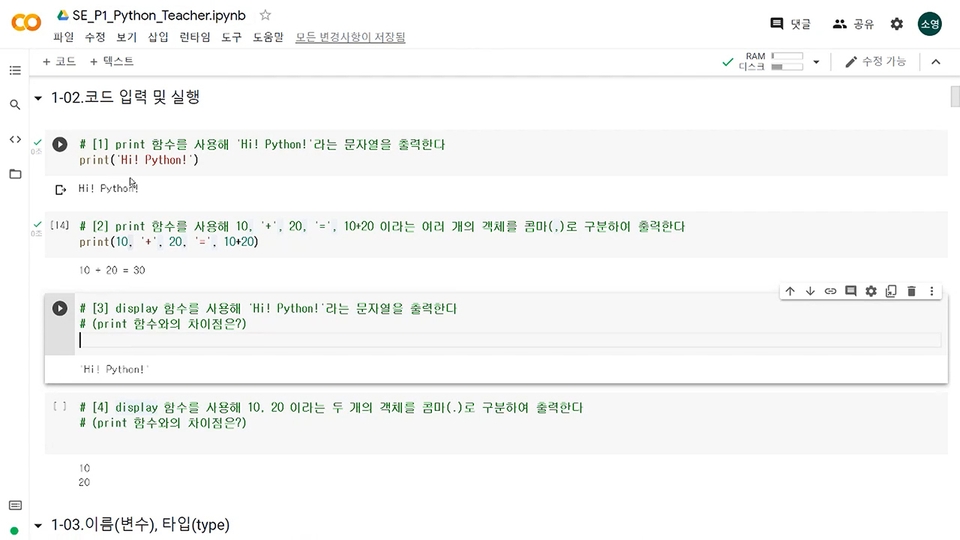
STEP 1. Getting to Know Python
This course is designed for beginners who are unfamiliar with Python, focusing on acquiring Python language skills by learning only the essential content at a level necessary for exam preparation.
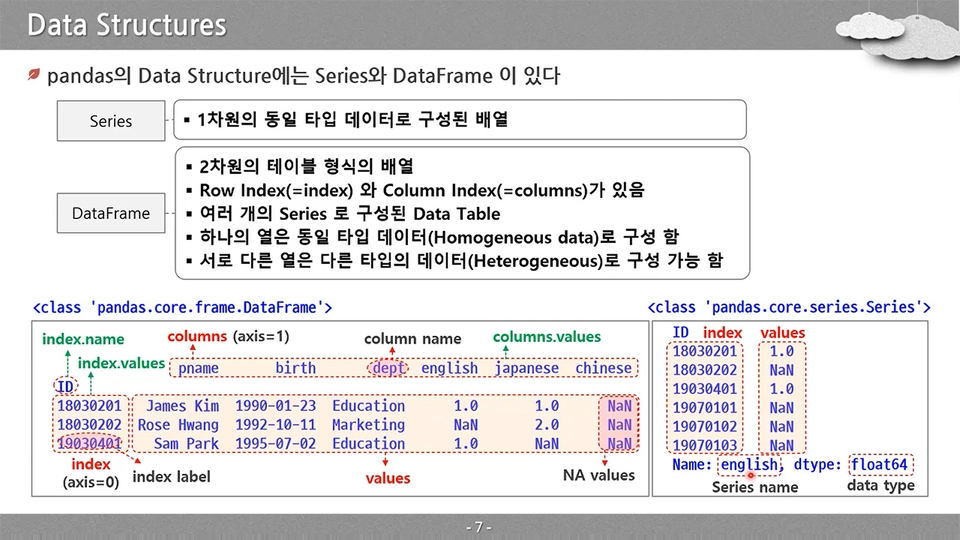
STEP 2. Pandas and Data Processing
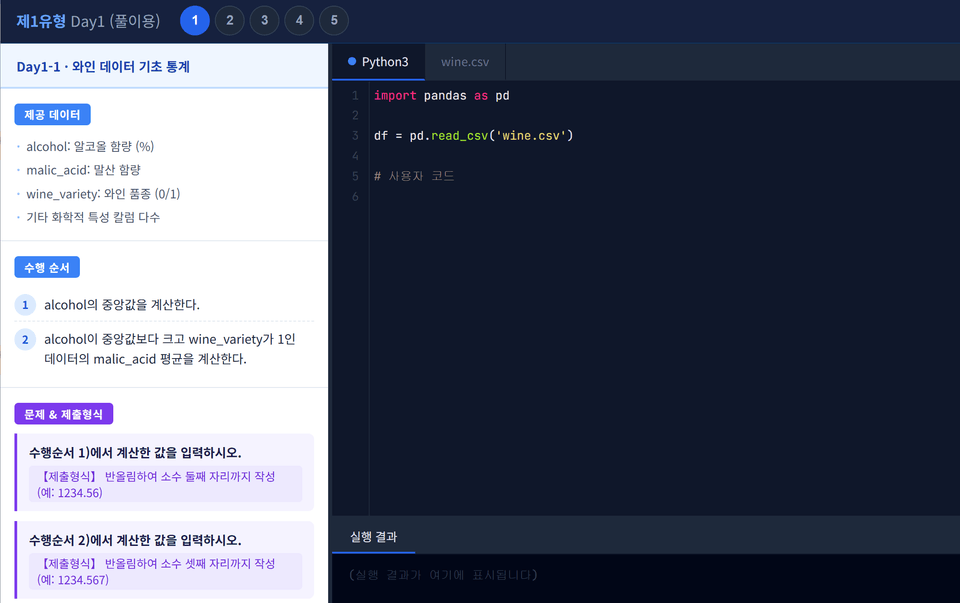
Learn the basics of Pandas, a Python library for data manipulation. For Task Type 1, understand various data processing types that may appear in the exam and learn data handling methods by following along with problem-solving exercises.
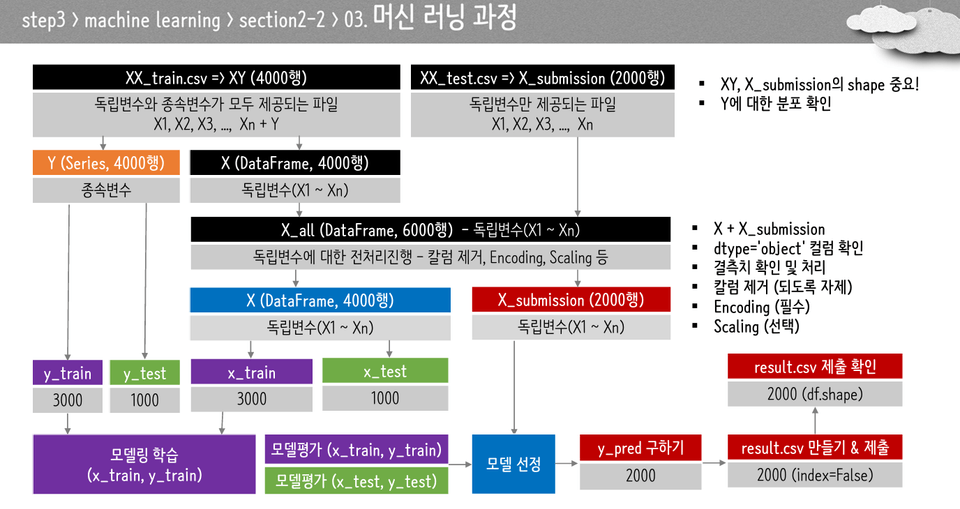
STEP 3. Machine Learning
To prepare for the Type 2 practical exam, you will learn the overall structure and techniques of machine learning using sklearn. You will learn how to create and evaluate machine learning regression and classification models, and practice solving past exam questions as well as problems with a high probability of appearing on the test.
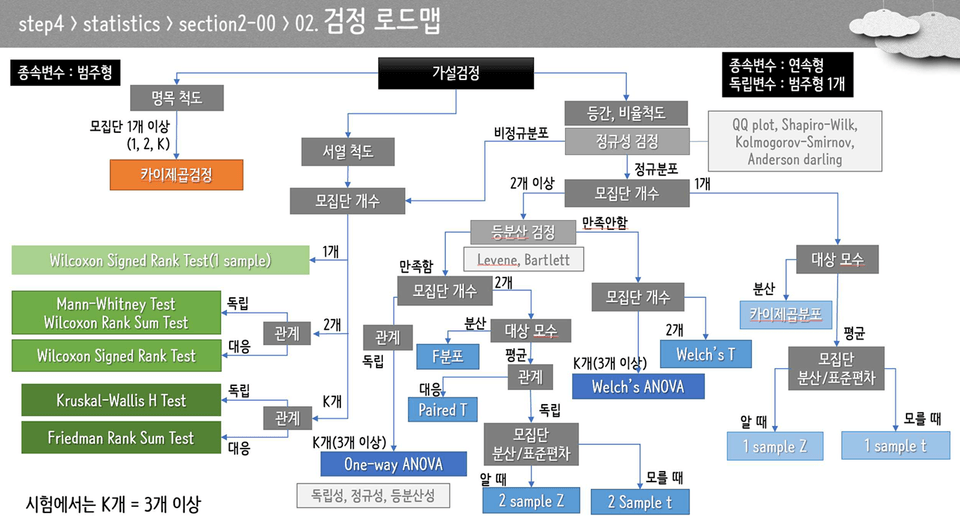
STEP 4. Statistical Testing
To prepare for the Type 3 practical exam, we will learn how to interpret linear models and perform parametric/non-parametric tests using statsmodels and scipy.
STEP 5. Past Exam Questions
Prepare for the actual exam by solving past exam questions from the 2nd to the 11th sessions. The 12th session is scheduled to be uploaded one month before the exam.
Q&A 💬
Q. How many times can I take the practical exam after passing the written exam?
After passing the written exam, you have the opportunity to take the practical exam for two years. Since the exam is held twice a year, there are a total of four opportunities to take it. Please note that this is a national technical qualification, and there are eligibility requirements, so you must check if you qualify.
Q. How long should I set the study period for?
I believe the learning period will vary greatly depending on the individual. Furthermore, if you are learning without any prior understanding of programming concepts, it will likely take more time. I recommend setting a period of about 2 to 3 months and making time every day to repeatedly type and interpret code. In particular, you may feel that the content for Pandas and ML is extensive, as it has been prepared to a level where it can be practically applied. It would be good to learn as you ask questions, and you will also need to memorize the practical exam code right before the test.
About the Instructor ✒️
Soyoung Yoon (CEO of EduAtoZ)
Instructor Soyoung Yoon is an IT professional who has been teaching software for 24 years.
Lecture History
SW lectures for new employees and current staff at Samsung and LG
Jungang IT Training Center
Incheon Girls' Commercial High School (Industry-Academic Adjunct)
Korea Chamber of Commerce and Industry
Gimcheon University, Sungkyunkwan University (Suwon), Soongsil University, Seoul National University, etc.
Multicampus and many others
Certifications Held
Information Processing Engineer Level 1
Vocational Training Teacher License (Information Processing Level 2)
ADSP (Advanced Data Analytics Semi-Professional), ADP (Advanced Data Analytics Professional)
Big Data Analysis Engineer
Main Lecture Courses
[Certifications] Engineer Information Processing, Industrial Engineer Information Processing, Advanced Data Analytics Semi-Professional (ADsP), Big Data Analysis Engineer
[Algorithm] Data Structures (Beginner, Intermediate), Algorithms (Samsung Employees and New Hires, LG Employees)
[Programming] C Language, JAVA, HTML/CSS/JavaScript, Android Application, Python (Basics, Data Processing, Data Analysis)
Institutions or companies in need of instructor dispatch for Big Data Analysis Certification practical lectures (in-person & non-face-to-face), please contact us.
Lecture contents are provided as a PDF. If you wish to purchase a bound textbook, please contact imbgirl@naver.com!
Recommended for these people
Who is this course right for?
Those who wish to take the Big Data Analysis Certification exam
Those who wish to learn the Python data analysis library, Pandas
Those who are interested in big data analysis
Need to know before starting?
Big Data Analysis Certification Written Exam Passers
I am currently watching the lectures with the June 20th exam as my target, and I'm suddenly writing this review because I love how the course starts with Python basics instead of jumping straight into exam types or problem-solving. It feels like a course that gathers everything one fundamentally needs to know for data analysis, not just for the Big Data Analysis Certification practical exam. I will finish the rest of the lectures and leave another review then.
~^^ Have you applied to use the quiz site yet?
It is a great tool for checking if you understood the material and for reviewing what you've learned.
If you haven't applied yet, please be sure to try it out. I spent over a month putting it together with great care!
You can do it!
Even though it takes a lot of time,
since I am using a new language, I am taking the course from the basics.
If I study diligently, I expect there will be good results.
Hello! ^^
Thank you for the great review!
Are you preparing for the June 20th exam? We are planning to run the 2nd session of the daily quiz starting May 5th to help you pass in 10 attempts. You should have studied up to Pandas.
If you are interested, please apply! (If you join the open chat room, you can also receive updates.)
빅분기 실기 매일 퀴즈 신청: https://forms.gle/oqQ9UZh6T3XoHwMQA
Have a great day!
Congratulations on passing~^^
The previous exam was difficult, so I had prepared challenging problems as quizzes, but I hope that the difficult studying you did will also help you in actual use^^






![[2026 New] Advanced Data Analytics Semi-Professional (ADsP) CertificationCourse Thumbnail](https://cdn.inflearn.com/public/files/courses/327635/cover/01m0krhcc3w7vcn5zy0fcqvyxr?w=420)


![[2026 Revised Edition][EduAtoZ] Big Data Analyst Written ExamCourse Thumbnail](https://cdn.inflearn.com/public/files/courses/336408/cover/01m0kra7w1chzjqgfzwja9dnzf?w=420)
![[EduAtoZ] Python Utilization & Cos Pro Level 2Course Thumbnail](https://cdn.inflearn.com/public/files/courses/328418/cover/01jqgn286x9z2ewrx8w1aa8nvy?w=420)
![[EduAtoZ] Python CosPro Level 1 Practice Problem Solutions (40 Problems)Course Thumbnail](https://cdn.inflearn.com/public/files/courses/328114/cover/01jqg4rpge3f3tbhcswsr5tv2s?w=420)
![[2026] SQLD Part1: Pass on Your First Try Even as a Non-MajorCourse Thumbnail](https://cdn.inflearn.com/public/files/courses/335958/cover/01kfq6ehdjxssqqgdd7tm8kqj1?w=420)
![[2026 Big Data Analysis Certification Practical Exam Preparation] 100% Pass the Big Data Analysis Practical Exam! See the patterns in previous exam questions!Course Thumbnail](https://cdn.inflearn.com/public/courses/335192/cover/99e36628-6e8d-4403-bfe3-7f5d5844aa9a/335192.jpg?w=420)
![[2026] SQLD All-in-One: Pass in One Go, Even for Non-MajorsCourse Thumbnail](https://cdn.inflearn.com/public/files/courses/336953/cover/01kfq68bzb04w1mydc92ysfads?w=420)

![[Marketing Archive] Big Data-Driven Marketing StrategyCourse Thumbnail](https://cdn.inflearn.com/public/files/courses/339225/cover/01k7e89h4d1fkmcr1bwfh1j33h?w=420)

![[Management Course #3] DE, DBA (SSIS, SSAS, MachineLearning, BI, ETL)Course Thumbnail](https://cdn.inflearn.com/public/courses/329784/cover/c5e6543b-72c3-4471-b43f-15b9002e65ed/329784-eng.png?w=420)