I felt that the class was structured in a way that I could learn a lot, and the practical learning was good. Thank you.
5.0
endymion cheon
100% enrolled
It was a great lecture! I had some basic knowledge of grammar and numpy, but it was very helpful to learn various methods that can be used in relation to deep learning. In particular, I think I was able to understand it more deeply by implementing Data Generation, Convolutional Layer, K-Nearest Neighbor, and K-means Clustering myself. I plan to take follow-up lectures. Thank you for the great lecture!
5.0
lym930920
100% enrolled
Thank you so much, it's really helpful!
What you will gain after the course
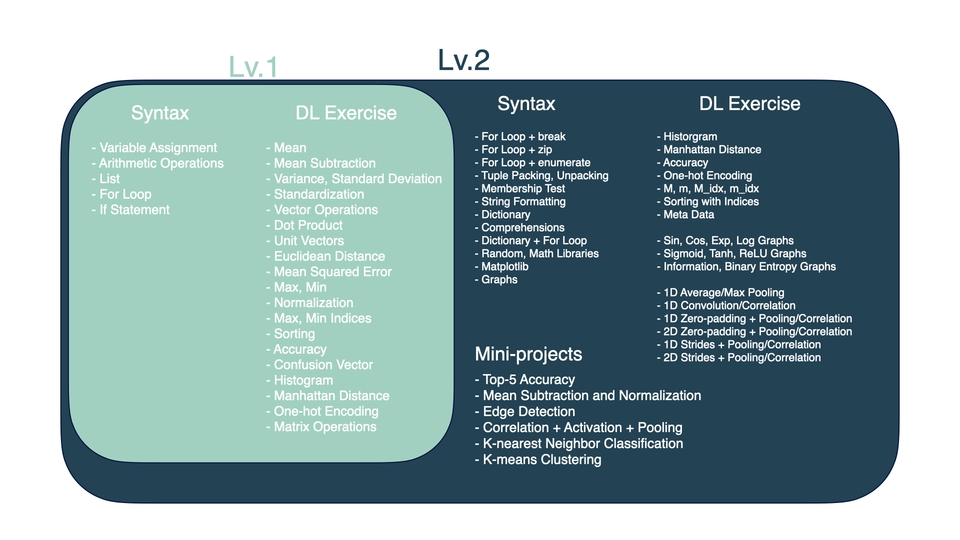
Python Basics
Deep Learning Basics Items
How CNN related modules work
Problem solving skills
Solve mini-projects on your own and develop the implementation skills needed to learn deep learning!
In this course, [Python for Deep Learning Level 1] , you'll expand on Python syntax and implement more complex conceptsused in deep learning. Furthermore, through six mini-projects, you'll significantly improve your implementation skills, not just lectures.
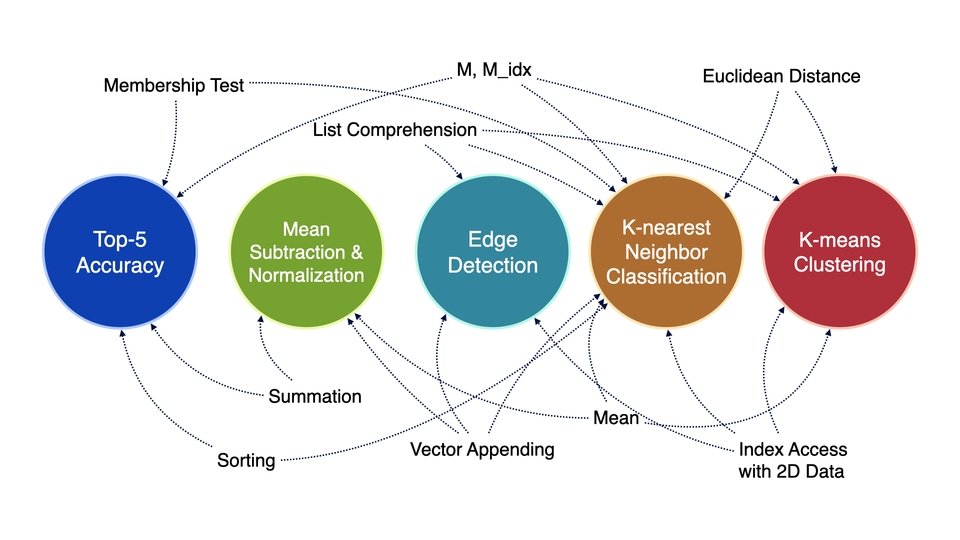
6 Mini-pojects
Top-5 Accuracy
Edge Detection
Convolutional Layer
K-Nearest Neighbor Classification
K-means Clustering
Mini-projects aren't just about listening to programming lectures; they're designed to cultivate implementation skills . Instead, they first provide time to listen to a problem situation and then try to solve it on your own . Afterward, they receive an explanation and then review the problem.
Programming skills are determined by how well you can translate your thoughts into programs. Through these projects, you will be able to:Practice the implementation skillsneeded to learn deep learning .
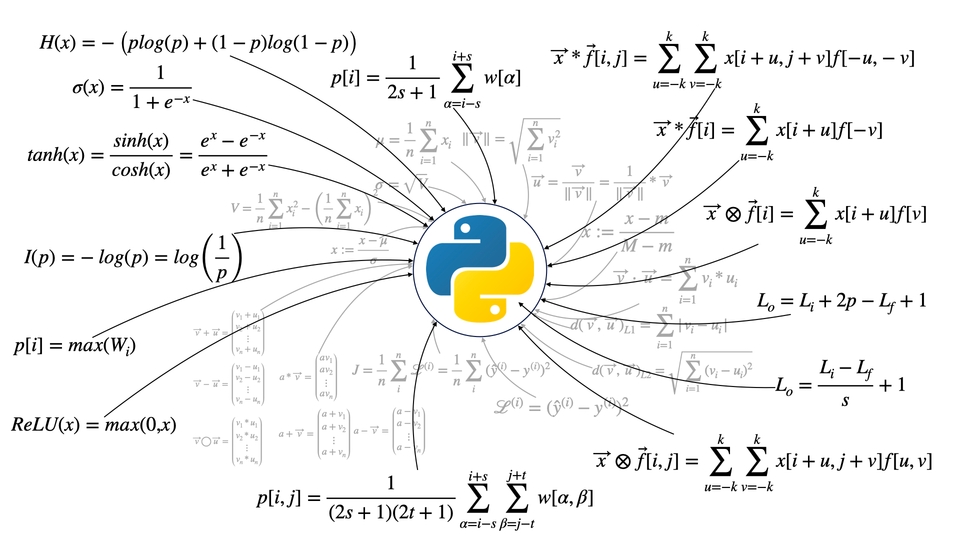
Advanced Equations
In Level 2, you'll learn slightly more complex formulas than in Level 1. These formulas are actively used in deep learning .
Through this course, you will be able to greatly improve the following abilities:
Ability to understand formulas
Ability to implement formulas into programs
You can gain the following knowledge:
The operating principles of items you will learn in deep learning in the future
The Need for Vectorization
Assembling Building Blocks
If you break down any program into small modules, those small modules are made up of basic operations .
In mini-projects, we will combine the small modules we have learned sofar to directly implement machine learning algorithms such as K-nearest neighbor classification and K-means clustering, as well as deep learning-related topics such as convolutional layers and edge detection.
Lecture Materials
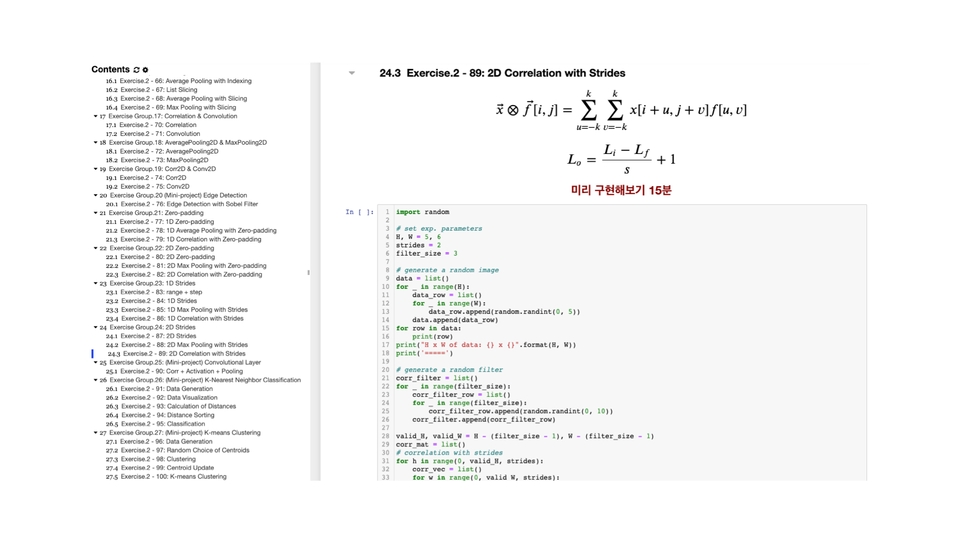
All source code and brief explanations covered in this lecture are provided as Jupyter Notebook files.
Recommended for these people
Who is this course right for?
For those who are new to deep learning
For those who are learning Python for the first time
People who lack program implementation skills
For those who want to start learning deep learning and Python together
Anyone who wants to join the deep learning specialized course
[National Institute of Meteorological Sciences] 2022, 2023, 2025 Meteorological AI Boost Camp
[Samsung Electro-Mechanics] Advanced Software Course for New Employees
[Korea Institute of Human Resources Development in Science and Technology] Long-term Mentoring for Strengthening R&D Implementation Capabilities
[Korea Institute of Human Resources Development in Science and Technology] E-learning content production for R&D professional courses
[Korea Institute of Human Resources Development in Science and Technology] Research Data Visualization Course for Postdoctoral Researchers
[Wonkwang University] Wonkwang University AI Collective Training and AI Short/Long-term Courses
[National Information Society Agency] SW Education for Women Professionals
[SK m&service] Data-Driven Decision Making
[Korea IT Business Promotion Association] ICT COG Academy
[Seoul Metropolitan Office of Education] Training in New Technology Fields
[KT] KT AI Competency Enhancement Course
[K-ICT] Data Safe Zone Analysis Camp
[Gyeonggi-do Business & Science Accelerator] Vision AI for Beginners
[Gyeonggi Business & Science Accelerator] Introduction to Data Analysis with Python
[Seoul National University of Science and Technology] Advanced AI Utilization Training
[Seoul National University] AI Utilization Capacity Building Training
[HD Korea Shipbuilding & Offshore Engineering] AIC AI Research Position Competency Assessment Development
[Multicampus] Mastering Core Machine Learning Algorithms: From Principles to Implementation
[Fast Campus] A Mathematical Approach to Deep Learning
[패스트캠퍼스] Machine Learning and Data Analysis A-Z: All-in-One Master Class
[Fast Campus] Byte Degree Lv.2 Deep Learning Essentials
[Fast Campus] Deep Learning & AI Super Gap
[Fast Campus] Computer Science Super Gap VER.2
Analysis A-Z [Fast Campus] Byte Degree Lv.2 Deep Learning Essentials [Fast Campus] Deep Learning AI Super Gap [Fast Campus] Computer Science Super Gap VER.2
It was a great lecture! I had some basic knowledge of grammar and numpy, but it was very helpful to learn various methods that can be used in relation to deep learning. In particular, I think I was able to understand it more deeply by implementing Data Generation, Convolutional Layer, K-Nearest Neighbor, and K-means Clustering myself. I plan to take follow-up lectures. Thank you for the great lecture!





![[PY 0201] Python Level 1 for Artificial IntelligenceCourse Thumbnail](https://cdn.inflearn.com/public/courses/332643/cover/db98c954-be00-44ca-bd33-3cd69e290fff/Untitled.001.png?f=avif&w=420)


![[PL 0303] Python for Data Visualization - Matplotlib Master ClassCourse Thumbnail](https://cdn.inflearn.com/public/courses/336172/cover/80fa86e7-dcb6-4b0f-b15b-323b6fa32809/336172.png?f=avif&w=420)
![[PL 0302] Python for Data Manipulation - NumPy MasterclassCourse Thumbnail](https://cdn.inflearn.com/public/courses/334756/cover/a4cbdc80-53da-4422-9b8d-67362b68a9fa/334756.png?f=avif&w=420)
![[PL 0301] Python Virtual Environment and AnacondaCourse Thumbnail](https://cdn.inflearn.com/public/courses/334755/cover/9d8ca8fb-2031-4dba-aa31-efb43963dba7/334755.png?f=avif&w=420)
![[PY 0205] Python Level 4 for Artificial Intelligence - Objects and ClassesCourse Thumbnail](https://cdn.inflearn.com/public/courses/334425/cover/d595b571-3e0c-4a63-9d5f-f2195736de2b/334425.png?f=avif&w=420)
![[PY 0204] Python Level 3 for Artificial Intelligence - FunctionsCourse Thumbnail](https://cdn.inflearn.com/public/courses/333279/cover/eb80d90b-0359-4c7d-b9ee-f4997c35171d/333279.png?f=avif&w=420)
![[PY 0203] Debugging FundamentalsCourse Thumbnail](https://cdn.inflearn.com/public/courses/333278/cover/1c14834a-9ab7-4973-b8f0-e8f6f24bffc8/333278.png?f=avif&w=420)
![[PY 0202] Python Level 2 for Artificial IntelligenceCourse Thumbnail](https://cdn.inflearn.com/public/courses/332825/cover/af1a2083-d1ee-4b72-8ce9-55281cb89c9a/332825.png?f=avif&w=420)
