![Coding Test [ ALL IN ONE ]Course Thumbnail](https://cdn.inflearn.com/public/courses/328689/cover/6ef42916-2254-4b56-b03a-5c6afa1b13d8/Thumbnail.png?w=420)
Coding Test [ ALL IN ONE ]
nossi
Coding Test [ALL IN ONE] ✔️ Complete with one lecture
Basic
Python, Algorithm, Coding Test

Analysis of CS major interview questions [Operating system/data structure/algorithm/database/network]!
2,221 learners
Level Basic
Course period Unlimited


Reviews from Early Learners
5.0
던킨도나츠
I'm a YouTube subscriber!!! It's been about a year since I started job hunting, but even though I passed the coding test, I kept failing the interviews. How should I prepare for job hunting this year.. I was worried, but thank you so much for providing such great lectures and e-books!
5.0
앞으로
I was wondering how to study CS. The articles related to technical interviews were fragmented and difficult, but this is perfect! Thank you so much for creating such a great lecture.
5.0
ghlim909
I'm still taking the class, but it's the best because it explains in detail the things that come up often in interviews and that I absolutely need to know.
Actual interview questions from companies like N, K, and S Electronics
Operating system
Data Structure & Algorithm
Database
network
We've distilled down just the essentials! 📌
Prepare confidently for your CS major interview now.
Companies want developers , not coders.
The easiest way to tell the difference between a coder and a developer is to ask them about their CS background .

The answer lies in the CS major interview .

Never try to read every book and lecture.
If you get the direction right, you can significantly reduce the period of job hunting/job-changing!
now
Studying mainly with the latest frequently asked questions
It requires some skill .
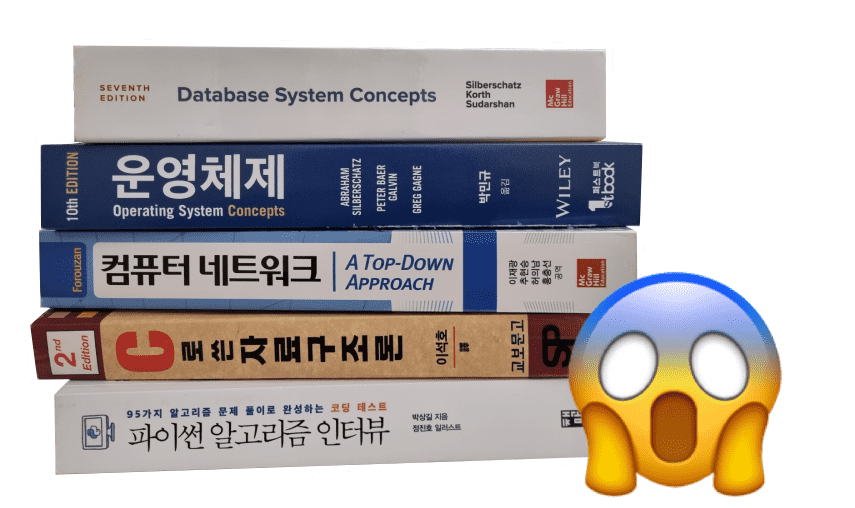
A superficial understanding alone won't get you through the interview. We delve into data structures like dynamic arrays, linked lists, and BSTs , from the memory level onward .
Operating systems are the most difficult for developers to learn. Understand the differences between multiprocessing and multithreading, and delve deeper into virtual memory .
From basic database terminology to transactions, deadlocks, and indexes , you'll gain a detailed understanding of the B+tree structure that makes up indexes.
No developer can avoid networking questions. Learn how to answer them clearly, covering common topics like HTTP, cookies, sessions, and TCP/UDP .
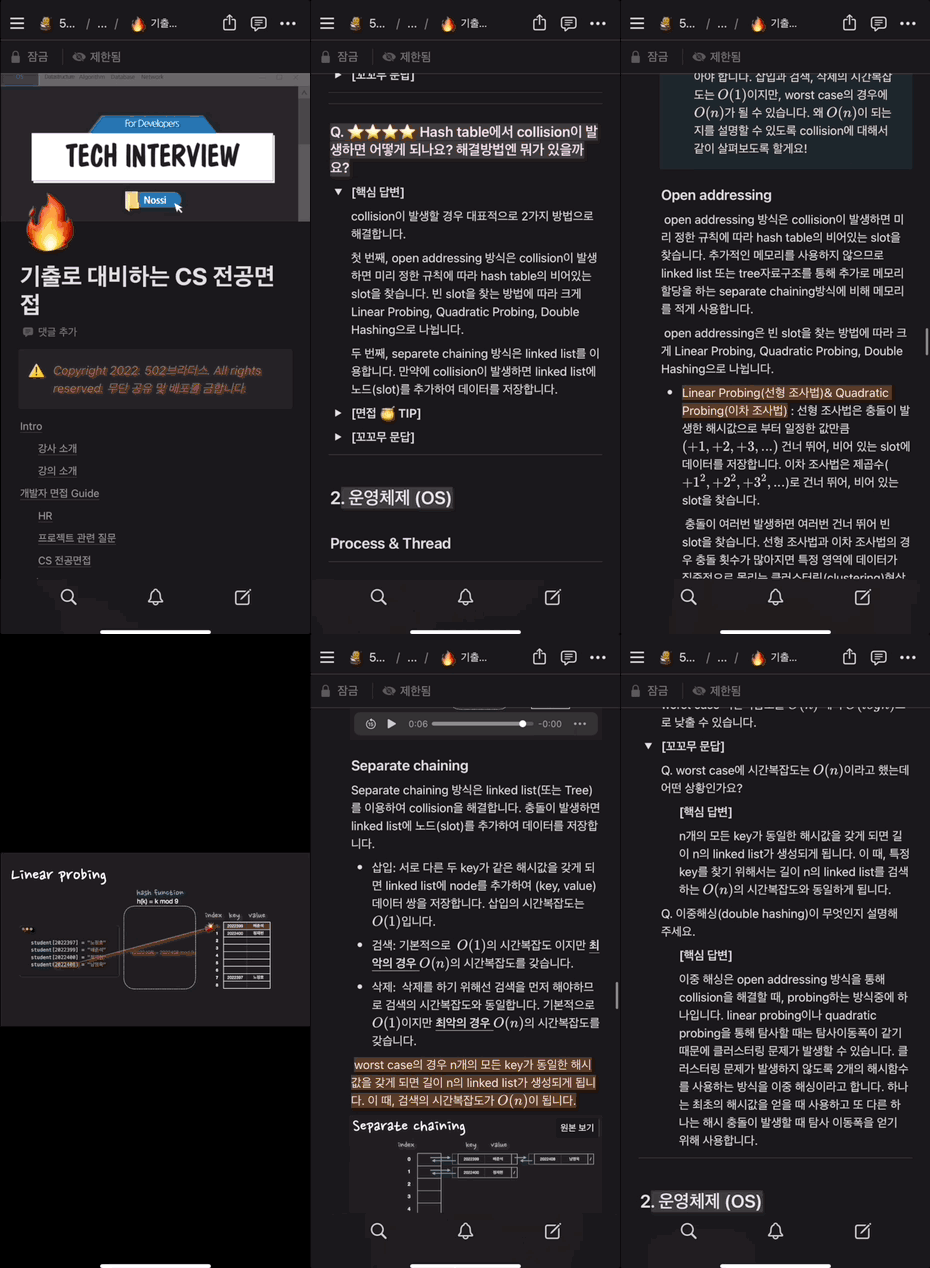
[CS Major Interview Secrets eBook] will be shared via Notion when you take this course.
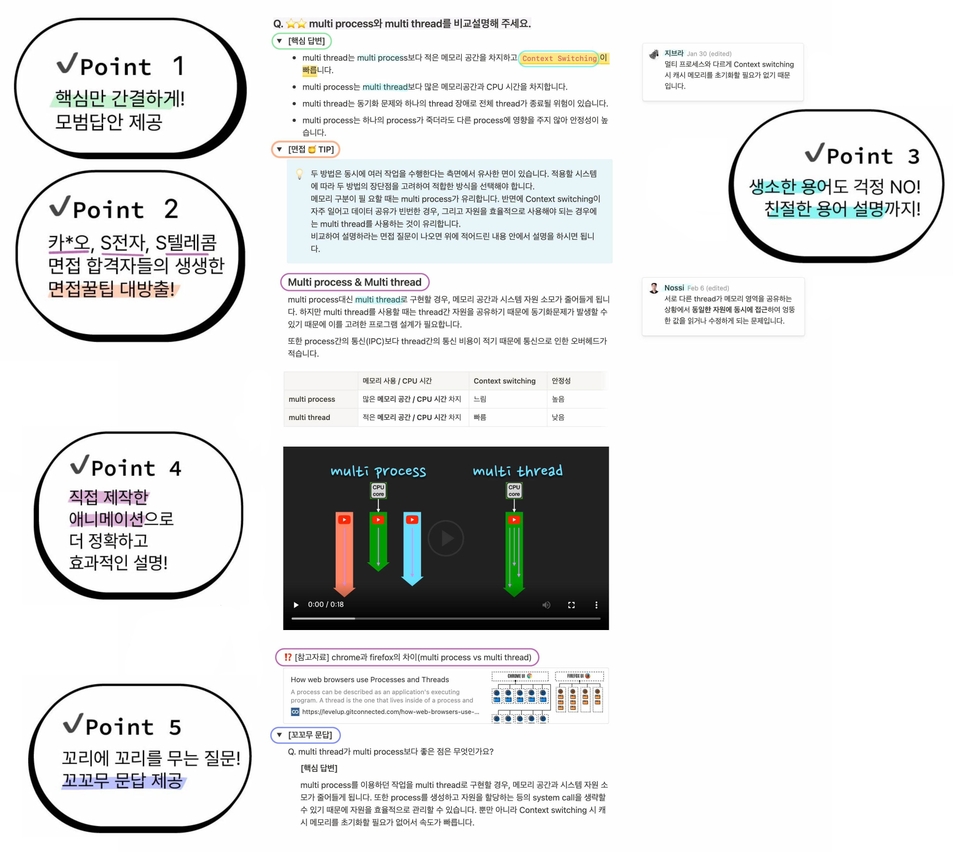
There are clear answers to major interview questions.
A concise answer that only addresses the key points will clear the interviewer's doubts and prevent follow-up questions.
Please read the model answer written with the author's expertise the day before the interview.
When interview experts are asked CS questions, what do they think about and answer?
I answer based on the thought, "This question is being asked with this intention!"
Take a peek into the thoughts of successful interviewees and see what to think about during a stressful interview!
All the IT terms that make our CS studies difficult...
Don't waste your time searching for it separately anymore.
I will personally and kindly explain any unfamiliar terms.
We actively utilize self-produced animations and illustrations for effective explanations.
Don't be afraid of the background knowledge you need for your CS interview!
We'll help you understand it all in one place with Kind lectures and e-books.
The thing that job seekers fear most in interviews is the follow-up question.
Don't worry! The follow-up questions in CS interviews are quite predictable .
We provide Kokomu and key answers hand-picked by interview expert authors.
📢 Please check before taking the class!
⭐️Starred⭐️ We recommend that you focus on studying the content and understanding/memorizing the key answers and Kokomu .
We recommend that you go into the interview with a clear understanding of the concepts through interview tips and concept lectures .

Who is this course right for?
A CS major who studied but doesn't know much about interviews
Non-major who has never learned CS specialized knowledge
A job seeker who is frustrated with the interview coming up a few days ago
Experienced developer preparing for a career change
Inflearn Verified
5,703
Learners
317
Reviews
345
Answers
4.9
Rating
6
Courses
Current CEO of a developer career consulting firm
Guest lecturer for Samsung Electronics employee training
Special lectures for universities, corporations, and government-funded programs
Currently writing a book on interviews (Gilbut Publishing)
Operating the 'Gaebalnam Nossi' YouTube channel
Former Kakao Enterprise
Bachelor's degree in Electronic and Electrical Engineering, Sungkyunkwan University
All
65 lectures ∙ (6hr 9min)
All
114 reviews
4.9
114 reviews
Reviews 1
∙
Average Rating 5.0
5
I'm a 4th year computer science student who's just starting to prepare for a job, but I forgot everything I learned. I was so lost, but thank you so much for condensing the information based on past exam questions!! I'll definitely get a job!!
Thank you for your first review!!! I will cheer you on to get into the company you want!! Fighting!
Reviews 5
∙
Average Rating 5.0
5
There are too many incorrect contents Since there are too many incorrect contents from the beginning, from then on, I have to separately verify whether the lecture contents are true, and I get to the point where I get confused whether I am listening to the lecture or checking for errors. In particular, Array shows off its power in the part where memory allocation occurs during the compile stage. It is also funny that it is allocated in the Stack memory area. I would like to express my deepest condolences to the many students who listened to this lecture and made the interviewers laugh out loud, and I hope that there will be no additional victims like me. Additional. The instructor left the following comment. I would like to inform you that the contents of this Notion are also incorrect. https://midi-mandolin-36f.notion.site/Array-33d866e5193f49789dd2079c75412f96?pvs=4 In "C language", "Static Array" can be stored anywhere in the process's data area (Stack, Data, Heap), and it depends on the developer's development intention (code). // The code is as follows. int[5]; // Stored in the Data area int main() { int[5]; // Stored in the Stack area int* arr = (int*)malloc(5 * sizeof(int)); // Stored in the Heap area // Memory is dynamically allocated, but the array itself is a Static Array. } If the proposition "Static arrays in the C language are allocated to stack memory during the compile phase." is true, "int type variables in the C language are allocated to stack memory during the compile phase." is also true because it is the same mechanism. "If you roll a dice, you get a 3. 1, 2, 4, 5, and 6 are exceptions." Is the explanation correct? "When you roll a dice, the number that comes out is a random number between 1 and 6." Students can decide whether the explanation is correct. Addition. The instructor has already modified Notion again. According to the logic of the Notion content, in Java, not only Arrays but all data structures are stored in the Heap. As for the professor's answer below... I don't know what you are trying to say. [Specific data structures and build stages, process memory area allocation are not related] is correct. Based on the C language, you wrote 1, 2, and 3 well, but I don't know why the conclusion is suddenly [Based on the C language, arrays are allocated in the stack area during the compile stage]. Anyway, thank you for your hard work.
Hello, jordy. I sincerely thank you for leaving a long and honest review to help students. However, there is no error in the content that arrays are allocated to the stack area during the compile stage based on the C language. However, it may be different from the JAVA perspective, so it may be confusing. I will explain the content in detail at this link [https://midi-mandolin-36f.notion.site/Array-33d866e5193f49789dd2079c75412f96?pvs=4]. It will be very helpful for everyone if you take a look!! I apologize for not saying that it was based on the C language in class, because it would have been less confusing. I thought you would naturally accept it as based on the C language because it was mentioned right after I explained static arrays, dynamic arrays, and linked lists based on the C language. Nevertheless, I feel bad that my lecture hurt jordy's feelings a lot. Looking at your course history, you took 3 lectures, excluding the intro part. If you want a refund, you can do so by contacting Infraon. Even if we don't have a connection, I hope you always do well in what you do. :) Fighting!
Hello. Instructor Even in the C language, the proposition that "Array is allocated memory in the stack area during the compile stage" is not always true. Of course, if you create an array like int x[100] in a "function" such as main, it is true because the local variable is stored in the stack area. However, this is because the C language compiler stores the local variable in the stack area, not because of the characteristics of the data structure Array. And if you create it in the global variable area outside the main function or use alloc (malloc) for dynamic allocation, Array can also be created in an area other than the Stack. There is bound to be confusion because you are explaining it by mixing data structure characteristics and language characteristics. The proposition that "A certain data structure is created in a certain memory area" cannot always be true. As you said, it can be different for each language, and even in the same language, it can be stored in different memory areas depending on the developer's intention. In the Notion link you gave, you said, "In this lecture, Array means Static array in C language." In the "C language", when there is the following code, the memory allocation area of "Static Array" is as in the comment. int a[10000][10000]; // Allocated to an area other than Stack int main() { int b[10000][10000]; // Allocated to Stack area }
Thank you for your good answer. Yes, that's right. The proposition that "arrays are allocated to the stack area during the compile phase" is not always true. Thanks to your mention, I've linked the exceptions to the lecture community (question) so that others can see them. Thank you. Data structures, algorithms, networks, databases, and operating systems are broad and very deep subjects that you learn over 3-4 years at a 4-year university. In fact, even the things you learn from professors over 4 years don't cover all the questions you'll be asked during an interview. When I was preparing for an interview, I also looked through thick books in original format one by one and prepared in depth. That suited my study style. However, after going through dozens of interviews and finally getting hired at the company I wanted, I looked back and felt regretful. I thought, 'If only someone had guided me from the beginning, I could have saved my precious time.' So when I created this lecture, the thing I focused on the most was 'reducing learning time.' For example, I explained the resizing process of a dynamic array as doubling, but if you look at the actual implementation in each language, it doesn't do exactly double. However, the reason I couldn't mention all of this in the lecture is because I thought it would be an excessive explanation. In fact, as I was making the lecture, I realized that it was more difficult to summarize the 'key content' and reduce the time than to explain 'all the content' and increase the time. I think I caused confusion in the process. It gave me a chance to think about the lecture again. Thank you.
Thank you for your answer. That's right. Resizing of Dynamic Array is also implemented in Java as a 50% increase. As someone who has taught lectures as a job, I know very well that it is difficult to explain everything perfectly in one go. I sincerely apologize for using somewhat harsh expressions in my first review, and I will not delete or edit my course review as a reflection. The reason I reacted this way is because, as a senior who has taught many juniors, it is a considerable amount of lecture cost for job seekers, but I think there were some parts of the lecture that were a bit disappointing. Still, I am grateful that you gave a good lecture in most of the content except for the few parts that I was disappointed in, and I learned a lot. Thank you.
Reviews 5
∙
Average Rating 5.0
5
I'm still taking the class, but it's the best because it explains in detail the things that come up often in interviews and that I absolutely need to know.
You're listening to the lectures carefully without missing a single one~!!! I hope you do your best to complete the remaining lectures and get good results in your interview!!
Reviews 1
∙
Average Rating 5.0
5
I'm a YouTube subscriber!!! It's been about a year since I started job hunting, but even though I passed the coding test, I kept failing the interviews. How should I prepare for job hunting this year.. I was worried, but thank you so much for providing such great lectures and e-books!
You've worked hard for a year ㅜ Still, there is a positive signal that you passed the coding test, so let's work hard together and pass the interview!! You will definitely pass this year. Fighting!
Check out other courses by the instructor!
Explore other courses in the same field!