
inflearn logo

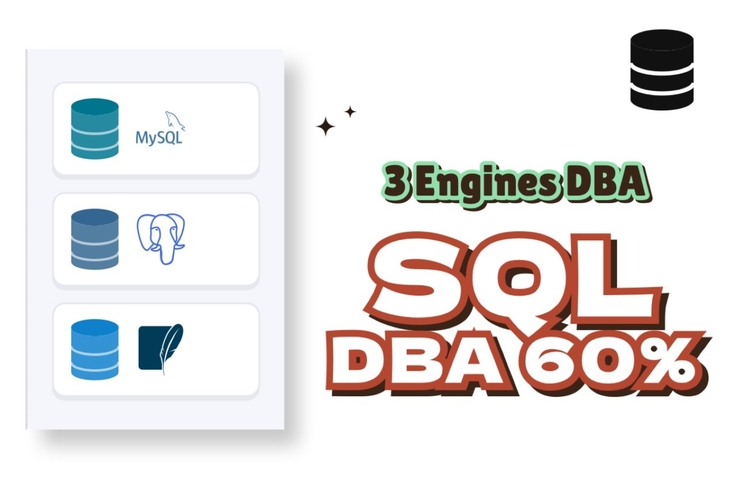
SQL DBA 60%: Hands-On Operations of Three Database Engines

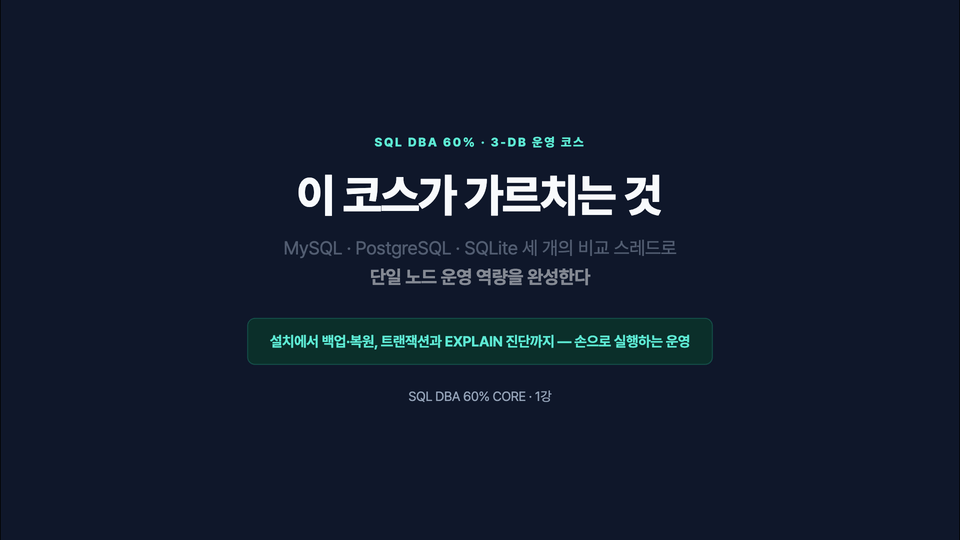
Practice side by side across three engines: the DBA operational skills needed to manage a single server independently (CORE, 20 lessons), and replication, PITR, and security, which require a second node (SPECIALIST, 18 lessons).

1 learners are taking this course

Level Basic

Course period Unlimited

MySQL
MySQL
PostgreSQL
PostgreSQL
SQLite
SQLite
MySQL
MySQL
PostgreSQL
PostgreSQL
SQLite
SQLite

What you will gain after the course

  • Use SELECT, JOIN, subqueries, CTEs, and window functions to compare solutions to the same problems in MySQL, PostgreSQL, and SQLite.

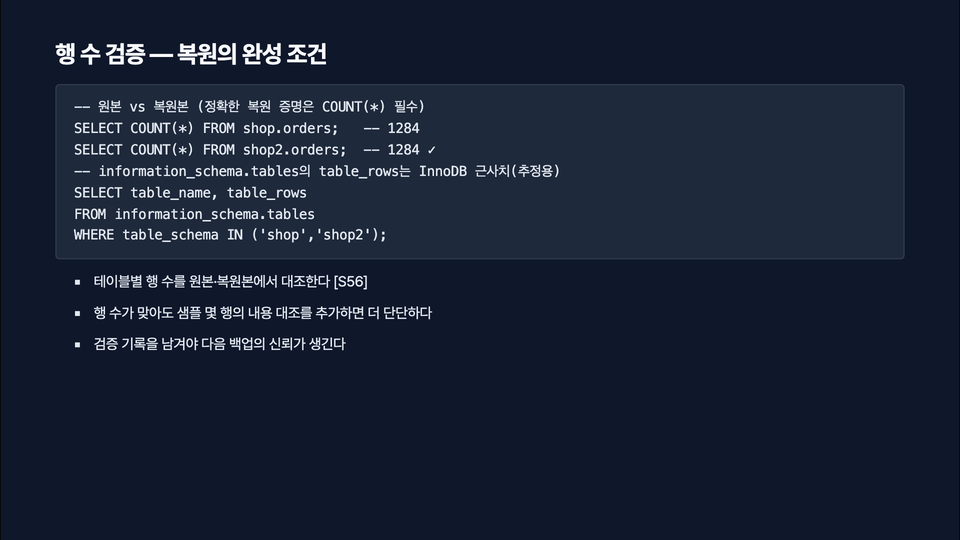
  • Back up and restore using mysqldump, pg backup, and SQLite .backup, then verify the row counts as well.

  • Directly experiment with transactions, deadlock retries, and differences in isolation levels.

  • Design the indexes and read the EXPLAIN output in three engines

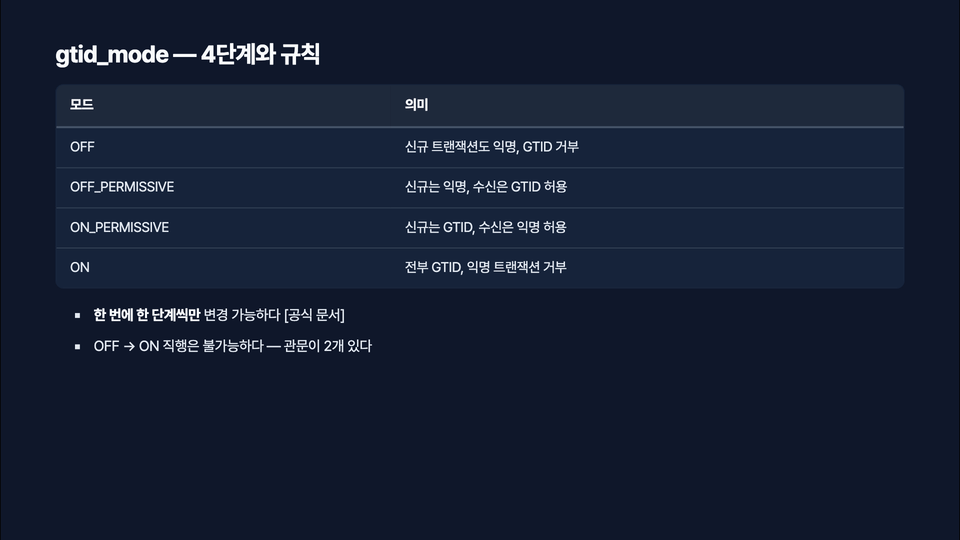
  • Understand the operating principles and procedures of GTID replication, streaming replication, and PITR (point-in-time recovery).

  • Learn security operations such as enforcing TLS, TDE/KMS, RLS, LDAP integration, and audit logs.

"DBA 60%" is not a measurement but a name referring to the scope of this course. We divide it into CORE (approximately 60%), which covers areas that can be operated independently on a single server, and SPECIALIST (approximately 40%), which covers areas requiring a second node or disaster recovery design.

Curriculum
- CORE 20 lessons: SQLite operations basics, types and keys, JOINs and aggregation, subqueries and CTEs, transactions and deadlocks, window functions, indexes and EXPLAIN, isolation levels, 3NF schemas, integrated backup and restore drills across three engines, performance improvement projects
- SPECIALIST 18 lessons: GTID replication, PostgreSQL streaming replication, HA and failover, buffer pool and autovacuum tuning, planner statistics, RLS, mandatory TLS, TDE and KMS, LDAP and audit logs, MySQL and PostgreSQL PITR, backup automation and DR, InnoDB and PostgreSQL internals, SQLite C-API and VFS

Course features
- We compare the three engines side by side starting in week 1. You will run the same SELECT statements to see firsthand where they work almost unchanged and where they differ.
- We consider a backup complete only when it has been restored and the row counts have been compared. Every backup lesson ends with restore verification.
- Each lesson uses settings and commands verified against the official documentation.

Before enrolling, please note
- The hands-on environment is based on Docker Compose (mysql 8.4, postgres 16) and local sqlite3. If you cannot use containers, you can use a local installation instead.
- The SPECIALIST course requires at least two nodes to be running, so your PC needs sufficient resources.

Why you need this course
The ability to write queries and the ability to operate a database are different. When a failure occurs, what you need is not syntax but procedures for checking whether backups can actually be restored, whether the current slowdown is caused by an index or a lock, and whether the second node is keeping up. In this course, you will learn these procedures by performing them firsthand on three database engines.

What this course does not cover
- Products outside these three engines, such as Oracle and SQL Server
- How to use the consoles of specific cloud-managed services
- Large-scale sharding and distributed database design

What you will be able to do after the course
After completing CORE, you will be able to independently perform backups, restores, permission configuration, index checks, and slow query investigation on a single server. After completing SPECIALIST, you will be able to explain the principles of replication configuration, point-in-time recovery procedures, and the criteria for making decisions about connection encryption and audit settings.

Recommended for
these people

Who is this course right for?

  • A developer who has done development work but has never personally handled DB backup, recovery, or performance checks

  • For those who have only used one of MySQL, PostgreSQL, or SQLite and are curious about how it differs from the others

  • Those who want to organize replication and recovery procedures from the ground up as operations personnel

Need to know before starting?

  • You can get started if you have experience using the terminal. SQL syntax is covered starting from CORE Lesson 2 (SELECT Basics), but the exercises require Docker or a local installation of each database.

Hello
This is devbull

Career Verified

170

Learners

15

Reviews

3

Answers

4.3

Rating

5

Courses

Rustacean & Pythonista

Curriculum

All

38 lectures ∙ (5hr 34min)

Published: 
Last updated: 

Reviews

Not enough reviews.
Please write a valuable review that helps everyone!

devbull's other courses

Check out other courses by the instructor!

Similar courses

Explore other courses in the same field!

25% off for new members

$28.50

25%

$38.50