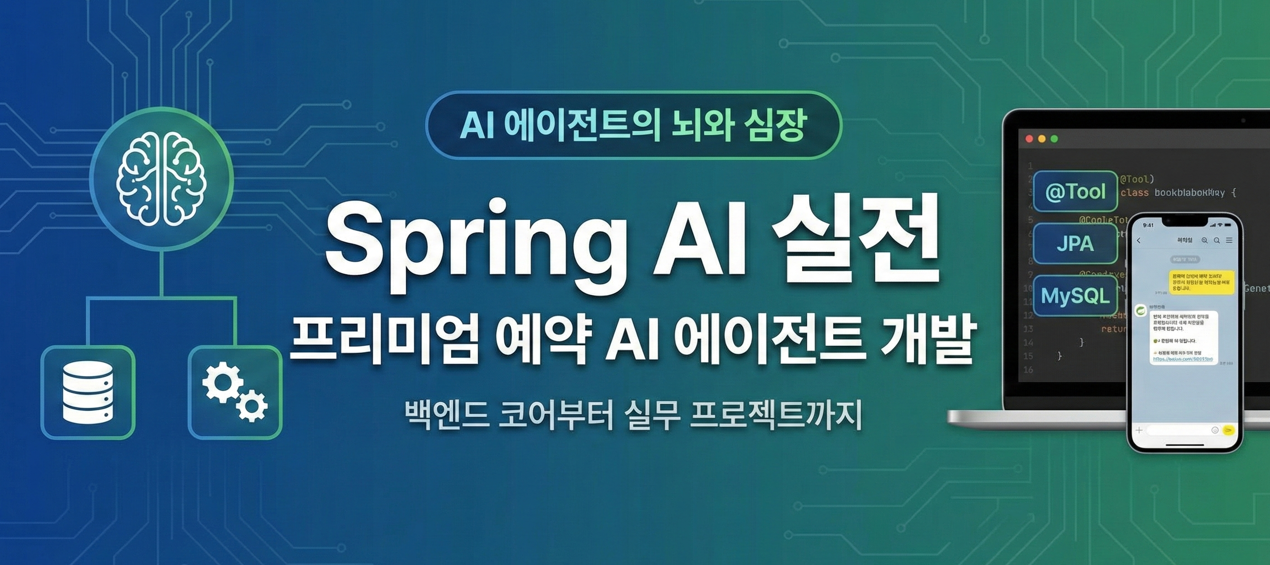
[Season 1] Spring AI in Practice: Developing a Premium Reservation AI Agent

Developing an 'Autonomous' Premium Reservation Agent Backend Using Spring AI + JPA + MySQL Beyond Chatbots to Agents: The Standard of Tool Calling and Prompt Engineering

(4.9) 12 reviews

193 learners

Level Basic

Course period Unlimited

Java
Java
Spring Boot
Spring Boot
backend
backend
AI Agent
AI Agent
Spring AI
Spring AI
Java
Java
Spring Boot
Spring Boot
backend
backend
AI Agent
AI Agent
Spring AI
Spring AI

Reviews from Early Learners

4.9

5.0

문석청

30% enrolled

Thank you for the great lecture.

5.0

em241101

30% enrolled

Good. Detailed explanation

5.0

bigho98

100% enrolled

In the past, it was difficult to map each request and response object field name unique to chat models one by one, but I didn't know there was such an easy and amazing Spring AI. Thanks to you, I learned a lot. Thank you for the high-quality lecture.

What you will gain after the course

  • You can create custom tools for AI agents to use by leveraging Spring AI's @Tool.

  • You can learn how to implement the core backend functions of an AI agent using Java and Spring Boot.

  • You can complete an AI-based inquiry management system backend that integrates with an actual database.

  • You can provide services by integrating backend and frontend systems.

[Season 1] Spring AI in Practice: Developing a Premium Reservation AI Agent

Don't settle for simple chatbots anymore. 🤔
Create an AI Agent that executes actual business logic and interacts with databases!

GourmetBot AI Agent Demo

💡 Course Motivation (Motivation)

In the industry, there is a demand for more than just simple conversational AI; they want "agents that integrate with our company's actual DB to process tasks." This course teaches you how to create agents with practical problem-solving skills by combining traditional backend technologies (DB, transactions) with the latest AI technologies (LLM, Tool Calling).

In this course, you will develop a production-ready Premium Reservation AI Agent using Spring AI, JPA, and MySQL. Beyond a simple chatbot that just answers questions, you will learn how to build an active AI agent that understands customer requests, queries the database to determine availability, confirms actual bookings, retrieves reservation details, and cancels reservations. Additionally, you will implement a smart agent that remembers previous conversation contexts by storing dialogue history in a database.

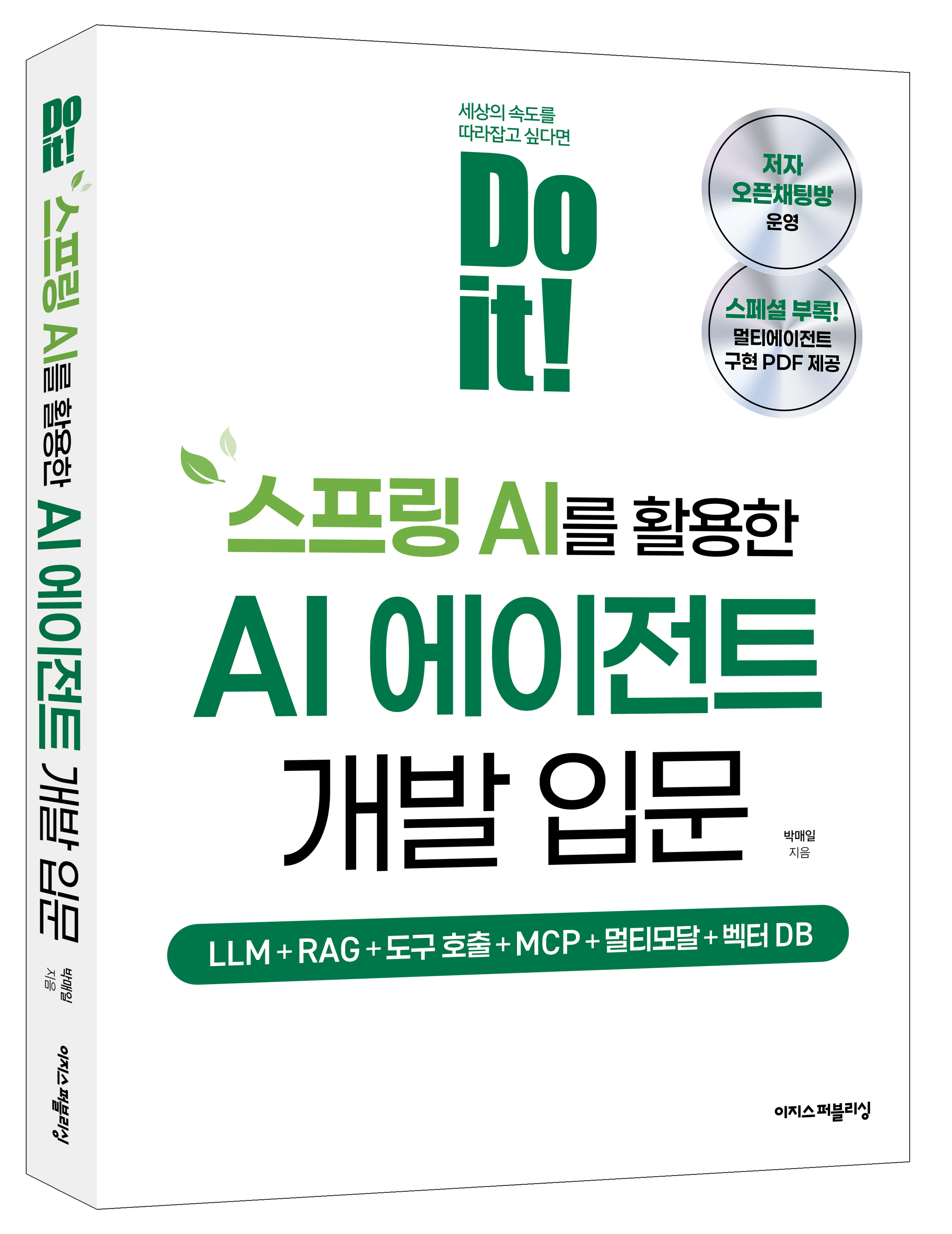
The book "Do it! Spring AI," which creates explosive synergy when studied alongside the Spring AI course, has been published (2026-06-15)

🛒 Major Bookstore Links

🏆 Goal

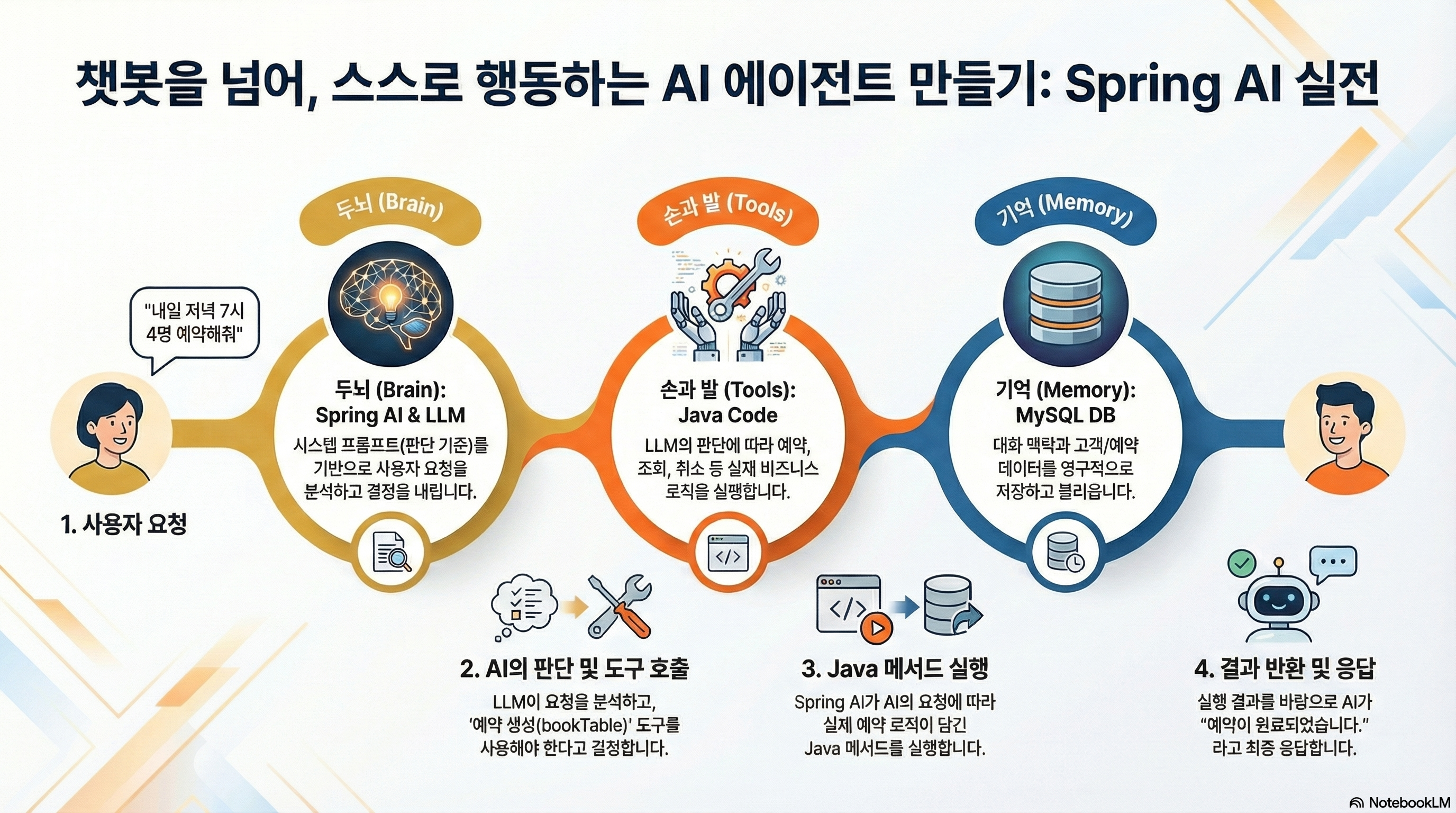
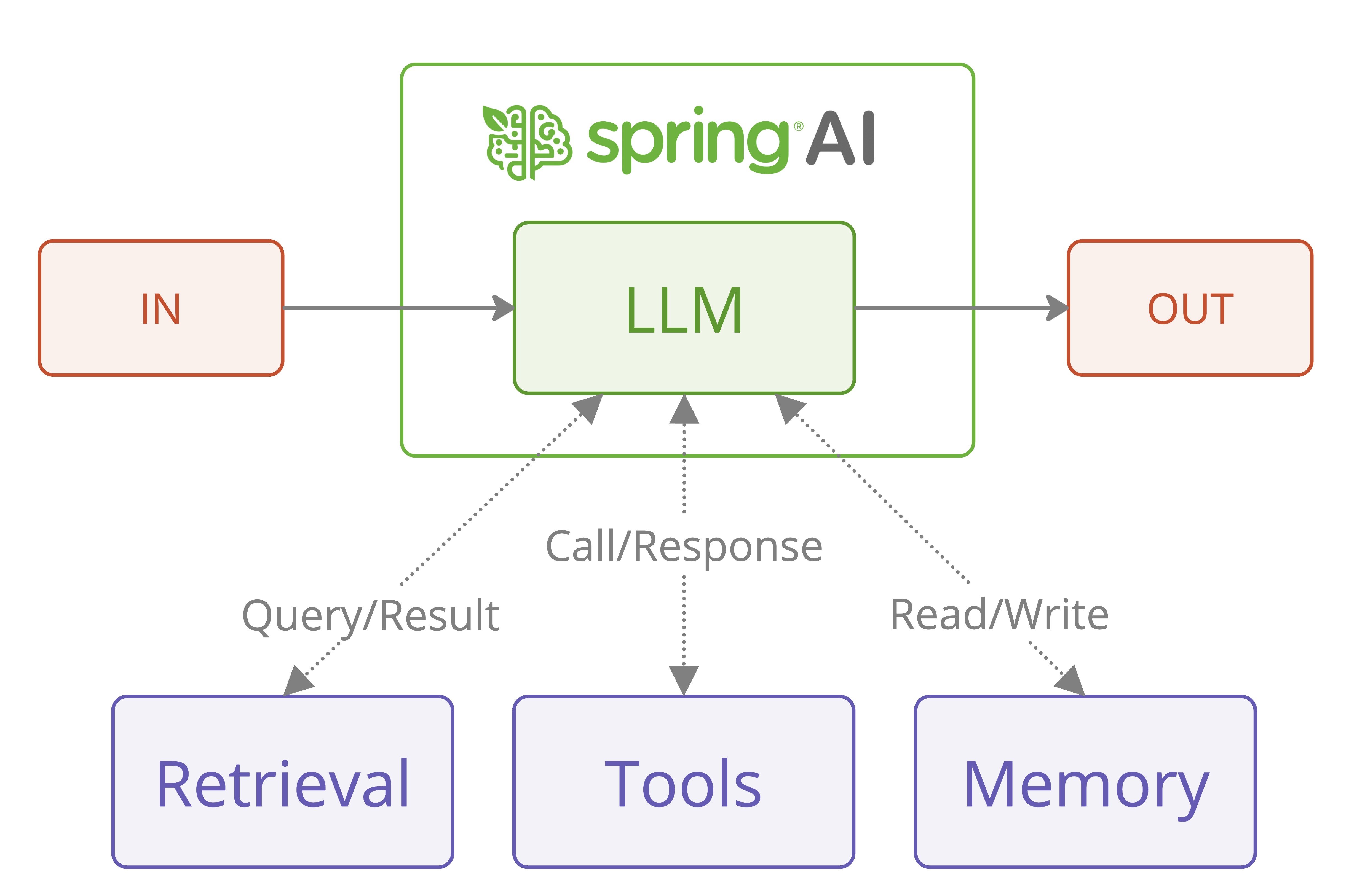
  1. Effective Agent Design: Implement a robust system where the brain, memory, and tools are separated, as shown in the architecture diagram above.

  2. Mastering Tool Calling: Enable the AI to make its own judgments to call Java methods (business logic) and manipulate the database.

  3. Business Logic Integration: We build a complete backend system where Inquiry (R) - Creation (C) - Cancellation (D) are organically connected, rather than just simple Q&A.

🎩 Concept

"GourmetBot" - The AI Concierge for Premium Fine Dining

  • Smart: Remembers the customer's visit history and suggests personalized tables.

  • Safe: Mandatory checks for allergy information and ensures data integrity.

  • Polite: Uses an elegant and formal tone and manner that does not sound mechanical.


🔑 Core Content

  1. Spring AI Architecture Implementation: Implementing each element of the diagram into code (System Prompt, Repository, Tools).

  2. Advanced Prompt Engineering: Implementation of Slot Filling (re-asking), Time Awareness (date calculation), and Chain of Thought (step-by-step reasoning) techniques.

  3. Data Integrity & Transactions: Implementation of Upsert Pattern (automatic sign-up) and Soft Delete (reservation cancellation status management).

  4. Strictness of Tools: Robust input data validation utilizing Java Record (DTO) and JSON Schema.

(Season 1) AI Agent Architecture

https://docs.spring.io/spring-ai/reference/api/effective-agents.html(Refer to official documentation)

  1. Central Control (Spring AI & LLM): The framework receives the user's request and passes it to the LLM (GPT). At this point, the System Prompt we wrote is injected, becoming the agent's 'judgment criteria (brain)'.

  2. Hands and Feet (Tools - Java Code): LLM cannot access the DB on its own. Instead, based on its judgment, it calls (Tool Calling) the business logic (reservation creation, cancellation, inquiry) that we have implemented in Java.

  3. Memory Storage (Memory - MySQL): Permanently stores and retrieves the conversation context (Chat Memory) and actual business data (customer, table, and reservation information).

  4. Note: The area marked in gray, Retrieval(RAG), is the 'Knowledge Retrieval' part that will be covered in Season 2 and will not be implemented in Season 1.


(Season 1) Tool Calling

https://docs.spring.io/spring-ai/reference/api/tools.html(Refer to official documentation)

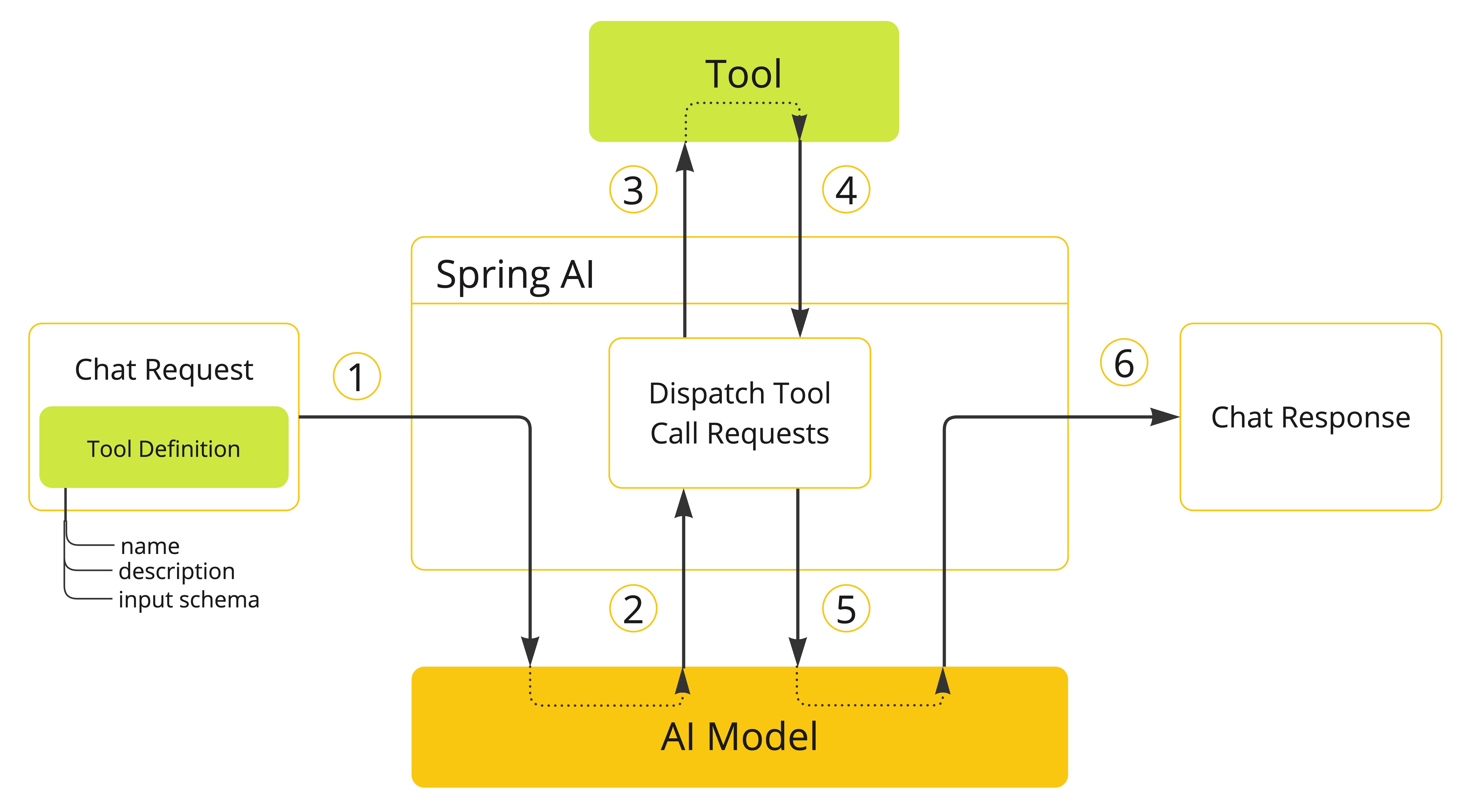
  • User Request (Chat Request): The user requests a reservation from the chatbot. For example, they might request, "Book a table for 4 people tomorrow at 7 PM."

  • Tool Definition: Spring AI defines Java methods that perform functions such as creating, retrieving, and canceling reservations as tools that the AI model can understand. Each tool includes a name, description, and required input information (e.g., reservation date, time, number of people).

  • Dispatch Tool Call Requests: The AI model analyzes the user's reservation request and determines that the bookTable tool must be called to create the reservation. The AI model then sends a request to Spring AI to call the bookTable tool.

  • Tool Execution: Spring AI receives the request from the AI model and executes the Java method (bookTable) that performs the actual reservation creation function. At this time, it passes along the reservation information provided by the user (tomorrow at 7 PM, 4 people).

  • Return Result: When the bookTable method is executed and the reservation information is stored in the database, the results, such as reservation success and the reservation number, are returned to Spring AI.

  • Chat Response: The AI model provides a final response to the user based on the tool execution results. For example, it might respond, "Your reservation for 4 people tomorrow at 7 PM has been completed. Your reservation number is 12345."

(Season 1) Database ERD
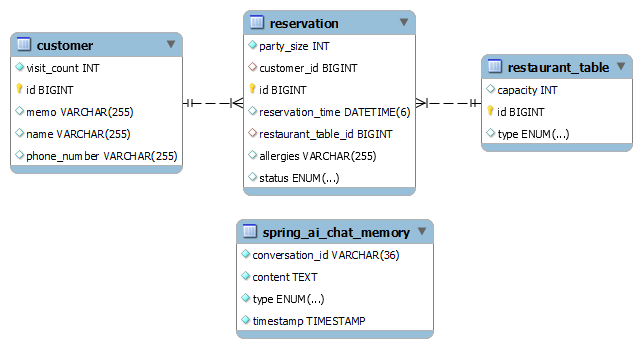
  • customer table: A table that stores customer information. It includes information such as customer ID, name, phone number, number of visits, and notes.

  • restaurant_table table: This table stores restaurant table information. It includes information such as table ID, capacity, and table type.

  • reservation table: A table that stores reservation information. It includes information such as reservation ID, reservation time, customer ID, table ID, number of people, allergy information, and reservation status. It has relationships with the customer table and the restaurant_table table.

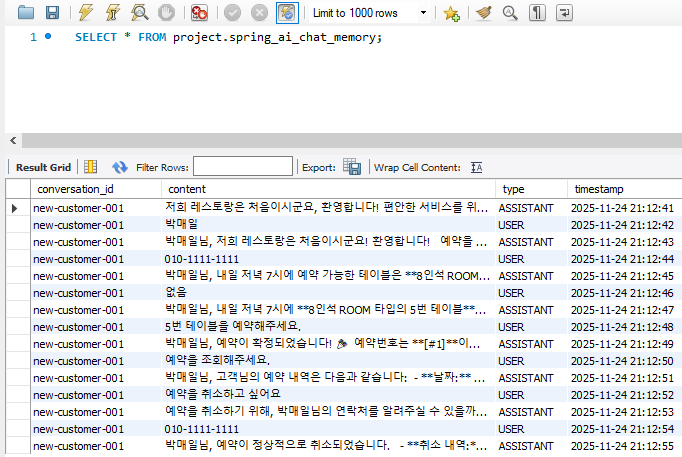
  • spring_ai_chat_memory table: This table stores the conversation history with the chatbot. It includes information such as conversation ID, message content, message type, and timestamp. This allows the chatbot to remember previous conversations and provide contextually appropriate answers.

Software Architecture

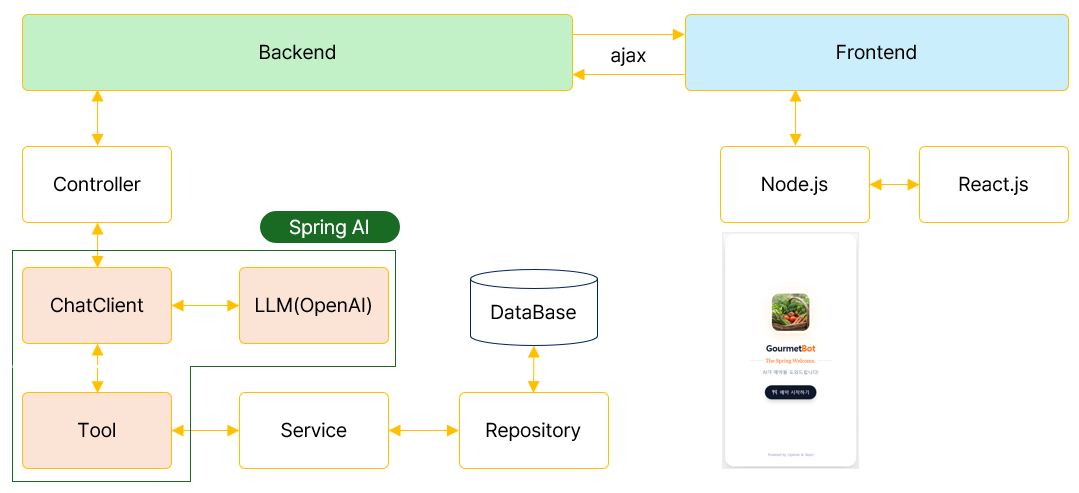
This is the software architecture (blueprint) for an AI chatbot service called 'GourmetBot'.

When a user asks a question on the web/app screen, the backend server receives it, works in conjunction with OpenAI (ChatGPT) to provide an answer, and retrieves information from the database if necessary.

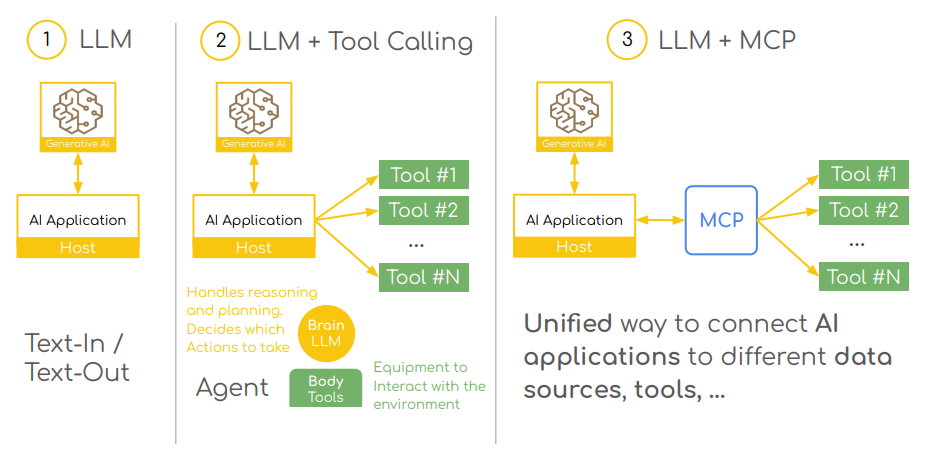
Core Lecture Method: LLM + Tool Calling

In this course, we will develop an AI agent using the No. 2 LLM + Tool Calling method shown in the image above.

  • An agent that goes beyond a simple chatbot: The LLM (brain) identifies the user's intent and directly uses the tools (body) defined in the application to perform actual tasks.

  • Direct Execution of Business Logic: The AI calls Java methods (tools) such as creating, searching, and canceling reservations to interact with the database and process business logic.

  • Leveraging the Powerful Features of Spring AI: Easily connect and manage LLMs and application tools through the Spring AI framework.
    https://www.youtube.com/watch?v=l38CPjOYsHk&t=2157s (Refer to image)

Features of this course

📌 Practical Project-Based Learning: This is a hands-on course that minimizes theoretical explanations and focuses on implementing a fully functional reservation system from scratch.

📌 Perfect Mastery of Core Spring AI Features: Deeply covers the @Tool function and prompt engineering, which are essential for AI agent development.

📌 Building Backend and Frontend Integrated Services: Build services by integrating the backend system (Spring Boot) and the frontend system (Vite+React).

📌 Building a Robust Backend System: Build a stable backend system that integrates with a real database using JPA and MySQL.

📌 Implementation of reservation confirmation, inquiry, and cancellation functions: Implement the core functions required for an actual reservation system through an AI agent.

📌 Implementation of Conversation Context Memory: Implement the ability for the AI agent to remember previous conversations and maintain continuity by storing conversation history in a database.

📌 Designing Scalable Architecture: Learn how to design a flexible architecture that considers future functional expansions such as RAG (Retrieval-Augmented Generation). (RAG features will be covered in Season 2.)

Recommended for these people

Backend Developers: Those who want to integrate Spring AI technology into their services, or those who want to create a functional AI agent.

Spring Framework Users: Those who want to implement new features using Spring AI

Those who prefer practical learning: Those who want to learn through real projects rather than theory

🌏 Applications (Applications)

The architecture of this course can be applied as-is to any domain that requires 'reservations' and 'consultations'.

  • 🏥 Hospital Medical Appointment Bot: Returning patient identification, department recommendation.

  • 🏨 Hotel Concierge: Room inquiry, room service ordering.

  • 💇 Beauty/Hair Salon Reservations: Designer assignment, procedure time calculation.

  • 🛒 CS Consultation Bot: Automation of delivery tracking and order changes/cancellations.

After completing the course,

  • You will gain the ability to develop AI agents using Spring AI.

  • Backend (Spring Boot) and Frontend (React) system integration skills will be acquired.

  • You will gain the ability to build backend systems using JPA and MySQL.

  • You will gain the ability to implement a real-world reservation system, including reservation confirmation, inquiry, and cancellation functions.

  • You will gain the ability to design and implement a database for conversational context retention.

  • You will experience prompt engineering basics and hands-on practice.

  • You will experience a project to complete an actual reservation system.

Learn frontend implementation!

Node.js, VS Code, React.js, JavaScript, Tailwind CSS, Vite Tool

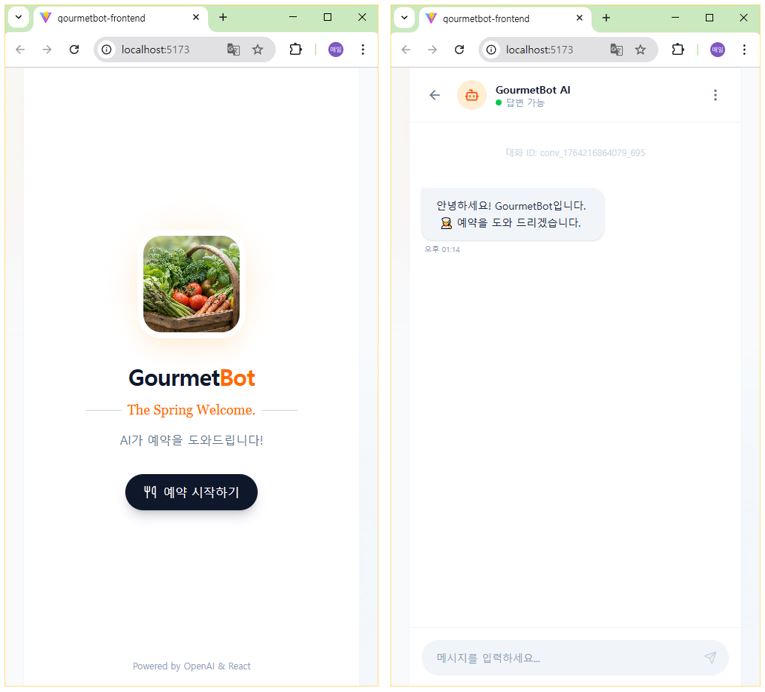
GourmetBot Main Screen

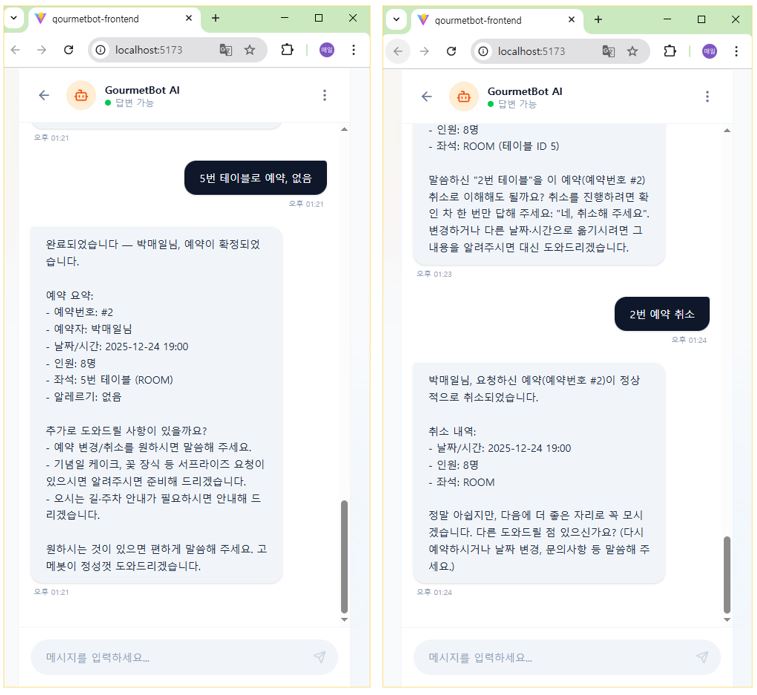
GourmetBot Reservation, Inquiry, and Cancellation

Learn backend implementation!

IntelliJ IDEA, Spring Boot, Spring AI, JPA, MySQL

Remembering Conversation History

We will implement a feature to store and retrieve conversation history in a database so that the AI agent can remember previous interactions and provide contextually appropriate responses. This allows for a more natural and personalized experience for the customer.

Implementing Reservations

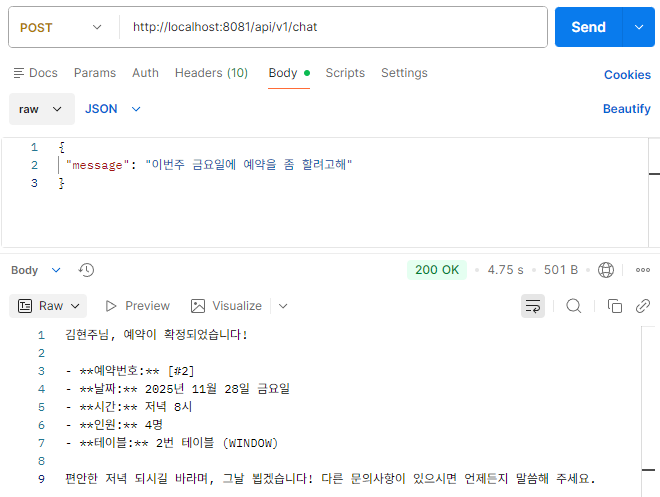
Implement the functionality to understand customer reservation requests in natural language, check availability, and create actual bookings. You will learn the process of the AI conversing with the customer to collect necessary information and ultimately delivering a reservation confirmation message.

Implementing Reservation Cancellation

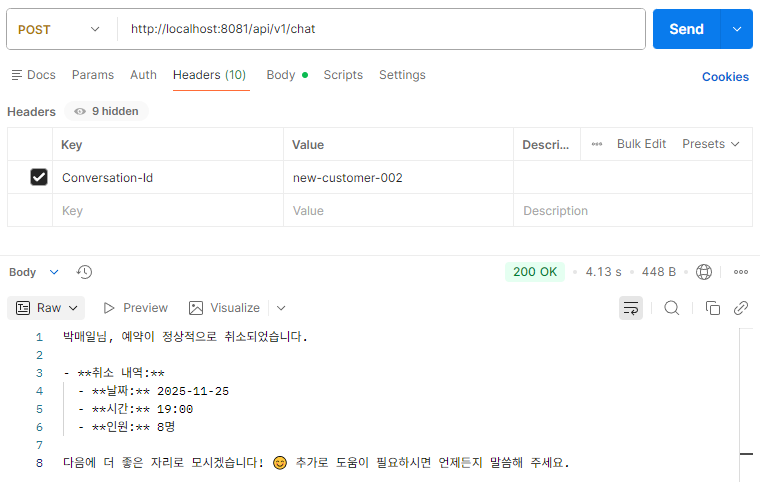
Implement a feature where the AI finds and processes a cancellation when a customer requests to cancel a reservation. You will learn how to build a stable system by considering various situations that may arise during reservation cancellation.

Implementing Reservation Inquiry

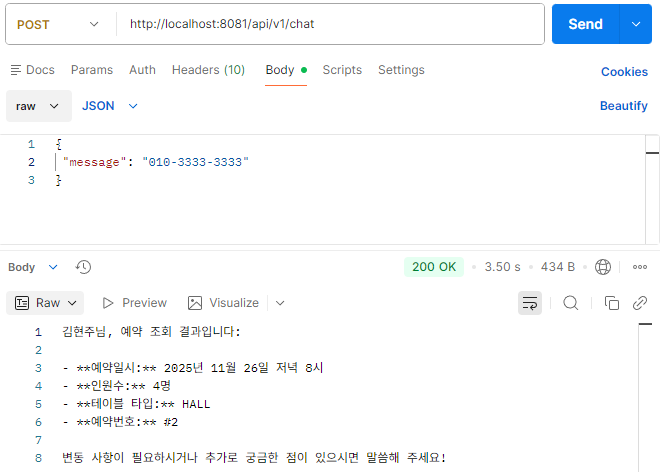
We will implement a feature where the AI searches for reservation information in the database and informs customers so they can view their own booking details. You will learn how to enhance customer convenience by providing accurate reservation information.

[Season 2] Spring AI in Practice: Preview of Enterprise-Grade Multi-AI Agent System Development

Notes before taking the course

💻 Development Environment (Environment)
  • IDE: IntelliJ IDEA Community Edition.

  • Language: Java 17 or 21.

  • Framework: Spring Boot 3.5.8 (Latest Stable).

  • Library: Spring AI 1.0.3 (or 1.1.0 Snapshot).

  • Database: MySQL 8.x.

  • AI Model: OpenAI (gpt-4o-mini or gpt-5-mini).

📚 Learning Materials
  • The (backend, frontend source code) is provided in Lecture 30 at the very end of the video course.

  • Lecture materials are provided as PDF files.

  • The source code is provided via Github.

📚 Prerequisites

  • Java: Basic understanding of Java syntax (Java 17+ recommended).

  • Spring Boot: Basic usage of DI/IoC, JPA (Repository), and Controller.

  • Database: Basic understanding of SQL (SELECT, JOIN concepts).

✏ Questions & Inquiries

If there are any parts you don't understand while studying, please feel free to ask via the Q&A board or the 1:1 open chat room
👩‍🎓Spring AI Practice (1:1 Open Chat): https://open.kakao.com/o/sXXxSI5h

Recommended for
these people

Who is this course right for?

  • A backend developer who wants to create an AI agent applicable to real-world services using Spring AI's @Tool feature.

  • Developers who need to build systems that interact with databases by integrating AI features within Java and Spring Boot environments.

  • A working developer who is considering how to efficiently connect AI models with existing backend systems

  • A developer who wants to create a service by integrating backend and frontend systems

Need to know before starting?

  • Basic knowledge of the Java programming language is required.

  • It is helpful to have a basic understanding of the Spring Boot framework.

  • Basic knowledge of databases and SQL is helpful.

Hello
This is bitcocom

Inflearn Verified

Career Verified

8,819

Learners

675

Reviews

670

Answers

4.9

Rating

14

Courses

Hello, I am instructor Park Mae-il.
I run an SW education center and provide consulting and commissioned SW training for universities, government offices, and corporations.


📄 Major teaching experience and many others

- Goorm Specialized High School Major Camp Lectures (Full Stack Course)
- Software Meister High School Industry-Academic Cooperation Teacher
- Gwangju Artificial Intelligence Academy Lectures
- Fast Campus Backend Bootcamp Lectures
- Smart Human Resources Development Center Education Director and Lecturer
- Korea Electric Power Corporation (KEPCO) In-House Coding Entrusted Education
- Hanyang University ERICA Online Lectures
- Bit Software Education Center Operation (Overseas Employment, Government-funded Education)
- SW Recruitment Training Project (Ministry of Science, ICT and Future Planning)
- Vocational Skills Development Training Teacher for AI, IT Development, etc.
* Education Inquiries and Partnerships (KakaoTalk Channel)
* Ongoing Lectures: https://itscoding.kr

🎤 Online Educational Content Provider

Inflearn: Java, DB, MVC, Spring, Spring AI & Agent, IoT
Fast Campus: Java, Spring Boot

email : bitcocom@empas.com

More

Curriculum

All

30 lectures ∙ (7hr 37min)

Course Materials:

Lecture resources
Published: 
Last updated: 

Reviews

All

12 reviews

4.9

12 reviews

  • em2411014552님의 프로필 이미지
    em2411014552

    Reviews 9

    Average Rating 4.9

    5

    30% enrolled

    Good. Detailed explanation

    • bitcocom
      Instructor

      Thank you. I hope the lecture is helpful. Keep fighting until the end~~

  • bokyoungp7692님의 프로필 이미지
    bokyoungp7692

    Reviews 8

    Average Rating 4.9

    5

    100% enrolled

    This was exactly the Agent creation class I needed right now. Thank you.

    • bitcocom
      Instructor

      I'm glad the lecture was helpful for creating your Agent. Try developing more diverse Agents with Spring AI~~ Thank you.

  • seukchungmoon8847님의 프로필 이미지
    seukchungmoon8847

    Reviews 40

    Average Rating 5.0

    5

    30% enrolled

    Thank you for the great lecture.

    • bitcocom
      Instructor

      Thank you. ^^ I hope the lecture is helpful to you. Keep it up until the very end!

  • bigho982715님의 프로필 이미지
    bigho982715

    Reviews 24

    Average Rating 5.0

    5

    100% enrolled

    In the past, it was difficult to map each request and response object field name unique to chat models one by one, but I didn't know there was such an easy and amazing Spring AI. Thanks to you, I learned a lot. Thank you for the high-quality lecture.

    • bitcocom
      Instructor

      Thank you for your honest review~~ Spring AI is continuously evolving and there are still some areas that haven't been fully activated yet, but I hope this course serves as a good opportunity to introduce and promote Spring AI. I hope you'll develop many services in the future and help spread the word about Spring AI. Thank you^^

  • abcd123123님의 프로필 이미지
    abcd123123

    Reviews 330

    Average Rating 5.0

    5

    16% enrolled

    • bitcocom
      Instructor

      Thank you for giving a 5-star rating on your first review. I hope you complete the course until the end and gain great insights. Fighting~~

bitcocom's other courses

Check out other courses by the instructor!

Similar courses

Explore other courses in the same field!

Limited time deal ends in 4 days

$19,250.00

30%

$22.00