
inflearn logo

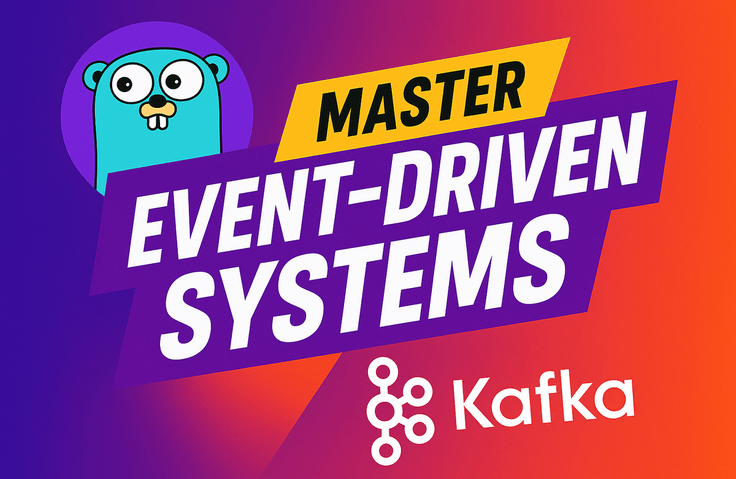
Master Event-Driven Systems with Golang & Kafka: Build Scalable Microservices

Master building scalable, fault-tolerant, event-driven applications using Go and Apache Kafka. Learn production-ready distributed system architecture used by modern companies for microservices, financial platforms, and real-time analytics. Gain hands-on experience with Kafka components and Go concurrency patterns to handle high-throughput workloads.

5 learners are taking this course

Level Intermediate

Course period Unlimited

Go
Go
Reactive Programming
Kafka
Kafka
MSA
MSA
system-design
system-design
Go
Go
Reactive Programming
Kafka
Kafka
MSA
MSA
system-design
system-design

What you will gain after the course

  • Design and implement production-ready distributed systems using Apache Kafka and Go

  • Master Go concurrency patterns including goroutines, channels, and worker pools for high-throughput processing

  • Build fault-tolerant event-driven architectures with Kafka brokers, partitions, and consumer groups

Course Description

Modern software systems demand speed, scalability, resilience, and the ability to process millions of events in real time. Traditional monolithic applications often struggle to meet these requirements, making event-driven architecture and distributed messaging essential skills for today's backend developers. This comprehensive course teaches you how to build production-ready distributed systems using Golang and Apache Kafka, two of the most powerful technologies used by organizations worldwide.

Whether you're developing financial platforms, e-commerce systems, IoT applications, cloud-native services, logistics platforms, streaming solutions, or enterprise microservices, this course provides the practical knowledge needed to build reliable, high-performance backend applications that scale with growing business demands.

Unlike courses that only introduce Kafka commands or demonstrate simple messaging examples, this masterclass focuses on designing complete enterprise-grade systems. You'll learn not only how Kafka works, but also why event-driven architecture has become the foundation of modern software engineering and how to implement these concepts using clean, maintainable Go code.

The course begins by establishing a strong understanding of distributed systems, messaging patterns, asynchronous communication, and the challenges developers face when building applications across multiple services. You'll discover how Apache Kafka solves these problems through durable event streaming, partitioning, replication, consumer groups, and fault-tolerant messaging.

As you progress, you'll build robust applications with Golang while mastering the language's powerful concurrency model. You'll use goroutines, channels, worker pools, synchronization primitives, and efficient memory management to create applications capable of processing thousands of events simultaneously with excellent performance and reliability.

Through hands-on development, you'll build complete projects that simulate real business environments. These include event-driven APIs, order management systems, inventory synchronization services, payment processing pipelines, notification platforms, log aggregation systems, streaming analytics, background job processing, and distributed task queues. Each project demonstrates how multiple microservices communicate efficiently through Kafka while remaining loosely coupled and independently scalable.

The course goes far beyond basic producers and consumers. You'll explore advanced Kafka concepts such as partitions, replication strategies, consumer group balancing, offset management, delivery guarantees, retry policies, dead-letter queues, message ordering, idempotent producers, schema evolution, event versioning, stream processing, and high-availability architectures. These are the same concepts used in enterprise systems that must remain operational under heavy traffic and unexpected failures.

Equally important, you'll learn how to structure professional Go applications using clean architecture principles, modular design, dependency injection, configuration management, environment-based deployments, logging, error handling, and automated testing. These practices make your applications easier to maintain, extend, and deploy throughout their lifecycle.

You'll also discover how to integrate Kafka into modern cloud-native development workflows using Docker containers, multi-service environments, API gateways, RESTful services, monitoring tools, and deployment pipelines. The course demonstrates practical debugging techniques, performance optimization, load testing, and observability so you can confidently diagnose and improve distributed applications running in production.

Throughout the training, you'll gain insight into the architectural decisions behind scalable systems. Rather than simply copying code, you'll understand why particular messaging patterns are chosen, when to use asynchronous communication, how to minimize service dependencies, and how to design applications that continue operating even when individual components fail.


What You’ll Learn

Section (1): Golang

As you progress, you'll build robust applications with Golang while mastering the language's powerful concurrency model. You'll use goroutines, channels, worker pools, synchronization primitives, and efficient memory management to create applications capable of processing thousands of events simultaneously with excellent performance and reliability.

Section (2): Kafka

Through hands-on development, you'll build complete projects that simulate real business environments. These include event-driven APIs, order management systems, inventory synchronization services, payment processing pipelines, notification platforms, log aggregation systems, streaming analytics, background job processing, and distributed task queues. Each project demonstrates how multiple microservices communicate efficiently through Kafka while remaining loosely coupled and independently scalable.

Before You Enroll

What truly distinguishes this masterclass is its emphasis on real-world engineering rather than isolated code samples. Every concept is reinforced through complete projects, architectural discussions, production best practices, and practical implementation techniques. By completing the course, you'll not only understand Golang and Kafka individually—you'll know how to combine them to build resilient, scalable, enterprise-grade systems that reflect the technologies and design patterns used by today's leading software companies.

By the end of this course, you'll be able to design, develop, test, and deploy enterprise-quality distributed systems powered by Golang and Apache Kafka. You'll have the confidence to build scalable microservices, create reliable event-processing pipelines, implement resilient messaging architectures, optimize system performance, and develop real-time applications that meet the demands of modern businesses.

This course is ideal for Go developers, backend engineers, software architects, cloud developers, DevOps professionals, microservices developers, technical consultants, and computer science students who want practical experience with distributed systems. It is also an excellent resource for developers transitioning from traditional REST-based applications to modern event-driven architectures.

What truly distinguishes this masterclass is its emphasis on real-world engineering rather than isolated code samples. Every concept is reinforced through complete projects, architectural discussions, production best practices, and practical implementation techniques. By completing the course, you'll not only understand Golang and Kafka individually—you'll know how to combine them to build resilient, scalable, enterprise-grade systems that reflect the technologies and design patterns used by today's leading software companies.

Recommended for
these people

Who is this course right for?

  • Backend developers seeking to build scalable microservices and event-driven architectures

  • Software engineers working on real-time data processing, streaming, or distributed systems

  • Go developers wanting to master Apache Kafka for production-grade applications

Need to know before starting?

  • Proficiency in Go programming language fundamentals and syntax

  • Understanding of basic distributed systems concepts and microservices architecture

  • Experience with RESTful APIs and backend development practices

Hello
This is Donara

worked with leading front-end and back-end technologies, including Node.js, React, Angular, Vue, Express, Next.js, and modern JavaScript frameworks. Their practical experience covers application architecture, API development, object-oriented programming, asynchronous programming, design patterns, testing, debugging, and enterprise-level software development.

More

Curriculum

All

9 lectures ∙ (3hr 56min)

Published: 
Last updated: 

Reviews

Not enough reviews.
Please write a valuable review that helps everyone!

Similar courses

Explore other courses in the same field!

Limited time deal ends in 7 days

$21,450.00

50%

$33.00