inflearn logo

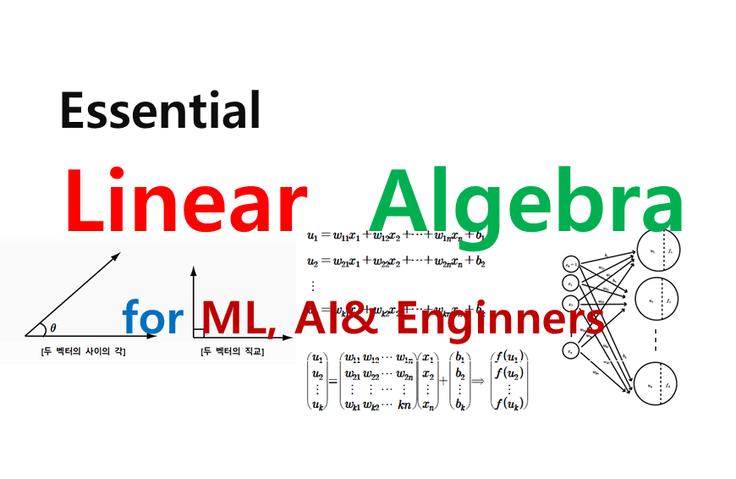
Linear Algebra: A lecture for engineering majors in machine learning, AI, robotics, computer vision, and related fields

In-depth linear algebra for engineering majors in machine learning, AI, robotics, computer vision, and related fields. Recommended for those who want to study linear algebra in depth. The material is explained as simply as possible while covering advanced topics through focused selection of subjects.

8 learners are taking this course

Level Basic

Course period Unlimited

Python
Python
Machine Learning(ML)
Deep Learning(DL)
Deep Learning(DL)
Procession
Procession
Python
Python
Machine Learning(ML)
Deep Learning(DL)
Deep Learning(DL)
Procession
Procession

What you will gain after the course

  • Linear Algebra for Engineering Majors in Machine Learning, AI, Robotics, Computer Vision, etc.

  • From the simplest possible explanation to in-depth theory, in detail.

  • Use specific examples, and explain in great detail any parts that require mathematical theory.

Multidimensional Data Representation: Various types of data, such as images, text, and speech, are represented as multidimensional vectors. Linear algebra is essential for handling and transforming this multidimensional data.

Image Processing: In the field of computer vision, images are represented as matrices. Matrix operations are used to transform and filter images, and are primarily used in convolutional neural networks (Convolutional Neural Network, CNN).

Linear transformations: Machine learning models such as neural networks primarily use linear transformations (matrix multiplication) to transform and process input data. Linear algebra provides tools for handling these transformations effectively.

Matrix decomposition: Linear algebraic techniques such as singular value decomposition (SVD) and eigendecomposition are used in dimensionality reduction techniques such as principal component analysis (PCA), helping extract important features.

Optimization Problems: Optimization problems commonly used in machine learning are based on linear algebraic concepts. For example, updating parameters to minimize a loss function is related to matrix differentiation and gradient descent.


Studying the topics above requires a great deal of time and effort. It also takes a lot of time to implement them in code if you want to demonstrate something right away. If you go to graduate school and begin studying, you may often find yourself held back by mathematics.

I majored in mathematics and spent many years researching and studying alongside engineering students, thinking deeply about how to study mathematics in a way that makes it easier while still preserving its mathematical rigor.

Therefore, in this course, we have chosen to work through specific examples and use them to study the theory.

And when there is too much material, you can often feel exhausted before even getting started. I’ve put together the curriculum so that the material is easy to understand while still allowing you to thoroughly study the essential content.

Although you’re busy, I’ve designed this so you can complete the entire course by consistently investing 15 to 30 minutes a day.

Recommended for
these people

Who is this course right for?

  • Engineering majors specializing in machine learning, AI, robotics, computer vision, etc.

  • Highly recommended for those who want to study linear algebra properly and in depth.

Need to know before starting?

  • The willingness to do it is essential.

  • Those who will study consistently without giving up until they understand.

Hello
This is jhim21

288

Learners

14

Reviews

10

Answers

4.6

Rating

7

Courses

After graduating with a PhD, I had the opportunity to study and teach Computer Vision for about five years,

To this day, I have been focusing my studies on bridging the gap between my mathematics major and engineering theories.

Areas of Expertise (Fields of Study)

Major: Mathematics (Topological Geometry), Minor: Computer Science

Current) 3D Computer Vision (3D Reconstruction), Kalman Filter, Lie-group (SO(3)),

Stochastic Differential Equation Researcher

Current) YouTube Channel Operator: Jang-hwan Lim: 3D Computer Vision

Current) Facebook Spatial AI KR Group (Mathematics Advisory Committee Member)

Education

Ph.D. in Science from Kiel University, Germany (Major in Topological Geometry & Lie-group, Minor in Computer Science)

David Hilbert-style mathematician

Reference: Mathematics Genealogy Project

Experience

Former CTO of Doobee Vision, a subsidiary of Daesung Group

Former Research Professor at Chung-Ang University Graduate School of Advanced Imaging (3D Computer Vision Research)

Books:

Optimization Theory: https://product.kyobobook.co.kr/detail/S000200518524

Link

YouTube: https://www.youtube.com/@3dcomputervision

Blog: https://blog.naver.com/jang_hwan_im


More

Curriculum

All

35 lectures ∙ (8hr 33min)

Course Materials:

Lecture resources
Published: 
Last updated: 

Reviews

Not enough reviews.
Please write a valuable review that helps everyone!

jhim21's other courses

Check out other courses by the instructor!

Similar courses

Explore other courses in the same field!

25% off for new members

$52.60

25%

$72.60