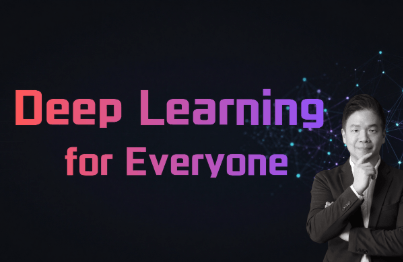
Essential Knowledge for the AI Era: <Deep Learning for Everyone>, Understandable Without Knowing Math or Coding
Have you ever been studying deep learning, only to lose sight of the bigger picture when model names and equations all appear at once? This course explains deep learning not as a collection of difficult formulas, but as the history of problem-solving that began with a single artificial neuron and progressed to ChatGPT.
I have taught hundreds of hours of deep learning lectures to learners with diverse academic backgrounds and experiences at LG Electronics DX School. Through that process, I discovered a common difficulty: “I understand it while listening to the explanation, but when a new equation or model appears, I feel lost again.” So I improved the lectures by explaining what the problem was first, why existing methods failed, and what was changed to solve it—before covering the model’s structure or calculation methods.
In this course, we follow a single visual metaphor—“drawing a line”—to connect the perceptron to CNNs, RNNs, Attention, Transformers, and large language models. Rather than calculating the equations directly, you will understand what problem each equation solves and learn to analyze new AI systems for yourself by asking the following question:
“What problem was this model trying to solve, what did it change to do so, and what decisions did it leave to humans?”
Ultimately, this course helps you develop the ability to distinguish between what should be entrusted to AI and what people must verify and take responsibility for, instead of blindly trusting or fearing AI.
The evolution of deep learning can be explained as a single continuous progression.
You can establish standards for using AI’s answers responsibly.
You can read deep learning equations in the language of concepts.
You will have a framework of questions for analyzing unfamiliar AI models.
The courage I gained in an offline classroom
The courage to start teaching on Inflearn came from the offline classroom. Through 400 sessions of deep learning lectures across multiple cohorts in the LG Electronics DX School program, I met students with diverse academic backgrounds and levels of experience. The overall student rating averaged 4.5 out of 5, and 92.3 percent of respondents gave it a 4 or 5. In particular, the moments when students from humanities, arts, and sports backgrounds who were unfamiliar with math and development told me they had come to understand the difficult flow of deep learning gave me tremendous encouragement.
Of course, it wasn’t just praise that shaped this course. I also received honest feedback such as, “When the pace is too fast, it’s easy to lose sight of the big picture midway through,” and, “I feel like I understand while listening to the explanation, but when formulas and models appear all at once, I feel lost again.” I immediately incorporated that feedback into the next class. Before showing the structure of a model, I first explained why that structure was necessary, and before calculating a formula, I tried to first show what problem the formula was meant to solve. This course is my response to both the possibilities and the areas for improvement I discovered in the offline classroom.
In the Age of Artificial Intelligence, What We Really Need Is Not the 'Right Answer' but the 'Right Question'
In the future, we will be doing more and more work together with artificial intelligence. AI can examine vast amounts of material in a short time, suggest multiple solutions, and sometimes present combinations that people had not thought of. But the more powerful AI becomes, the less human roles do not disappear. Rather, they become even clearer.
Deciding what to regard as a problem to solve, breaking a large problem down into smaller problems that AI can handle, comparing the basis and limitations of the answers produced by a model, and judging what to choose among multiple possibilities and taking responsibility for the result—all of these are still the responsibility of people.
I believe the best place to start understanding this role is in the history of deep learning.
Why specifically “history”?
The history of deep learning is not a timeline of model names and performance records. It is the story of people who discovered unsolved problems, examined why existing methods failed, changed the way they viewed those problems, and found new solutions.
When the data could not be divided by a single straight line, the researchers stacked multiple decisions into layers.
As the layers deepened, it became difficult to determine which connections to adjust and by how much, so they devised a way to propagate errors backward.
When the problem of forgetting the beginning of long sentences arose, we had it choose for itself what to remember and what to forget.
When it became difficult to fit all the content into a single memory, we came up with a way to look up the original text again when needed.
Each solution always opened up new possibilities while leaving behind the next problem to solve. This process contains attitudes worth learning even today, when we solve problems together with artificial intelligence: the attitude of breaking problems down into smaller parts, questioning assumptions we had taken for granted, and turning failures into information for the next attempt. This course goes beyond simply conveying deep learning knowledge and also explores the problem-solving processes of the researchers who changed the course of history.
Why We Added 'Liberal Arts' and 'Drawing the Line' to the Title
In this course title, we dared to use the word 'liberal arts'. Liberal arts is not a shallow reduction of specialized knowledge. It is the common language we all need to understand an unfamiliar world and make our own judgments. I believe that knowing what deep learning can and cannot do, what to entrust to artificial intelligence, and which judgments people must retain is the kind of liberal arts and common sense we all need to live alongside artificial intelligence.
Drawing lines is the common thread in this course for understanding complex deep learning models. Models learn criteria for distinguishing similar things from different ones in data and separating appropriate answers from inappropriate ones. The shape of the lines and the way they are drawn have changed over time, but how to divide data and what to consider a good answer have always been important questions. People are always at the beginning and end of determining those criteria.
What I Want to Leave with You, Learners
By the time you complete the course, you don't need to become someone who has memorized a lot of model names. Instead, I hope that when you encounter a new AI, you will be able to ask:
"What problem was this model designed to solve, and what did it change? Which answer should we choose among the alternatives, and who should be responsible for the outcome?"
This course hopes to serve as a small compass to help you collaborate with artificial intelligence through good questions and responsible choices, instead of vaguely fearing it or blindly trusting it.
Recommended for these people
Who is this course right for?
Planners, leaders, and practitioners who want to develop the knowledge and judgment needed in the AI era
People who use ChatGPT but find it difficult to explain how it works
Those who gave up on understanding deep learning because of the equations and terminology
Those who memorize model names but can’t connect them with each other
Those who start studying from scratch every time a new AI comes out
Hello, I’m Kangrok, the instructor for <Liberal Arts Deep Learning>
I’m an engineer who has been writing code for over 20 years. And for the past few years, I’ve lived as someone who teaches deep learning in the classroom. This course emerged from where those two worlds meet.
The Path I’ve Taken While Building Things
I began my career as a Cyworld developer at SK Communications. I later co-founded a game studio, where I designed and operated infrastructure capable of handling requests from 300 million users worldwide. At Kakao Games, SK Telecom, and SK Planet, I built services used daily by millions of people.
I now lead the AI consulting company Hyperpipe, helping organizations embrace AI not as a special tool but as a way of working. At dcamp, Korea’s largest startup growth partner, I support early-stage startups as a growth mentor.
Time Spent Researching Artificial Intelligence
A few years ago, I became a student again and completed a master’s degree in artificial intelligence at Yonsei University. While researching large language model–based search and recommendation systems and anomaly detection models, I encountered questions that couldn’t be explained by the intuition I had relied on for years in the field.
There were moments when 20 years of experience became powerless because I couldn’t answer the question, “Why does this work this way?”
But when research merged with my professional experience, I began to see things that had been invisible before. In the field, I was accustomed to solving problems quickly. Research taught me to place one more question before that — is this really a problem that needs to be solved, and what should we call a good solution? It was a period of reexamining the work of defining problems and choosing solutions through an academic lens.
The time I spent studying while grappling with that question became the backbone of this course.
One Sentence That Inspired This Course
At LG Electronics DX School, I conducted 400 sessions of in-person deep learning lectures across multiple cohorts. As I met students with diverse academic backgrounds and levels of experience, I was repeatedly asked the same question.
"So what does this model actually do?"
I revised the lecture script over and over because I wanted to properly answer this question. This lecture is my response to the possibilities and shortcomings I observed in offline classrooms.
Biography
Current: CEO of Hyperpipe (AI/AX consulting and AI education) · Growth Mentor at dcamp
Experience: CTO at Tumblbug · Kakao Games · SK Telecom · SK Planet · Co-founder of a game studio · SK Communications (Cyworld)
Education: Graduated from the master's program in Artificial Intelligence at Yonsei University’s Graduate School of Engineering (Master of Engineering)
Course: LG Electronics DX School Deep Learning Program, 400 sessions (student rating: 4.5 / 5.0)
Book: 『Join a Company That Helps Engineers Grow』 (Fastcampus, 2022)
Activities
Reviewing data analysis projects for 모두의연구소 AIFFELTHON
Machine Learning and Text Mining Practical Course
Multiple corporate AX training programs and workshops