
inflearn logo

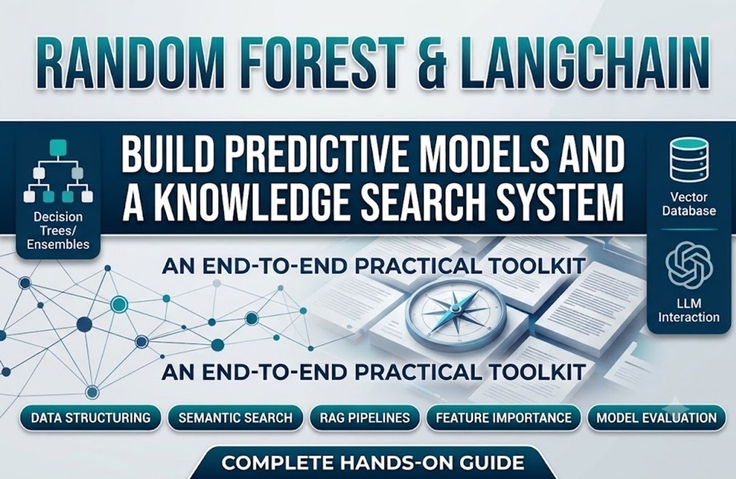
From Random Forest to LangChain Knowledge Retrieval Systems: Practical Applications of Data Analysis and LLMs

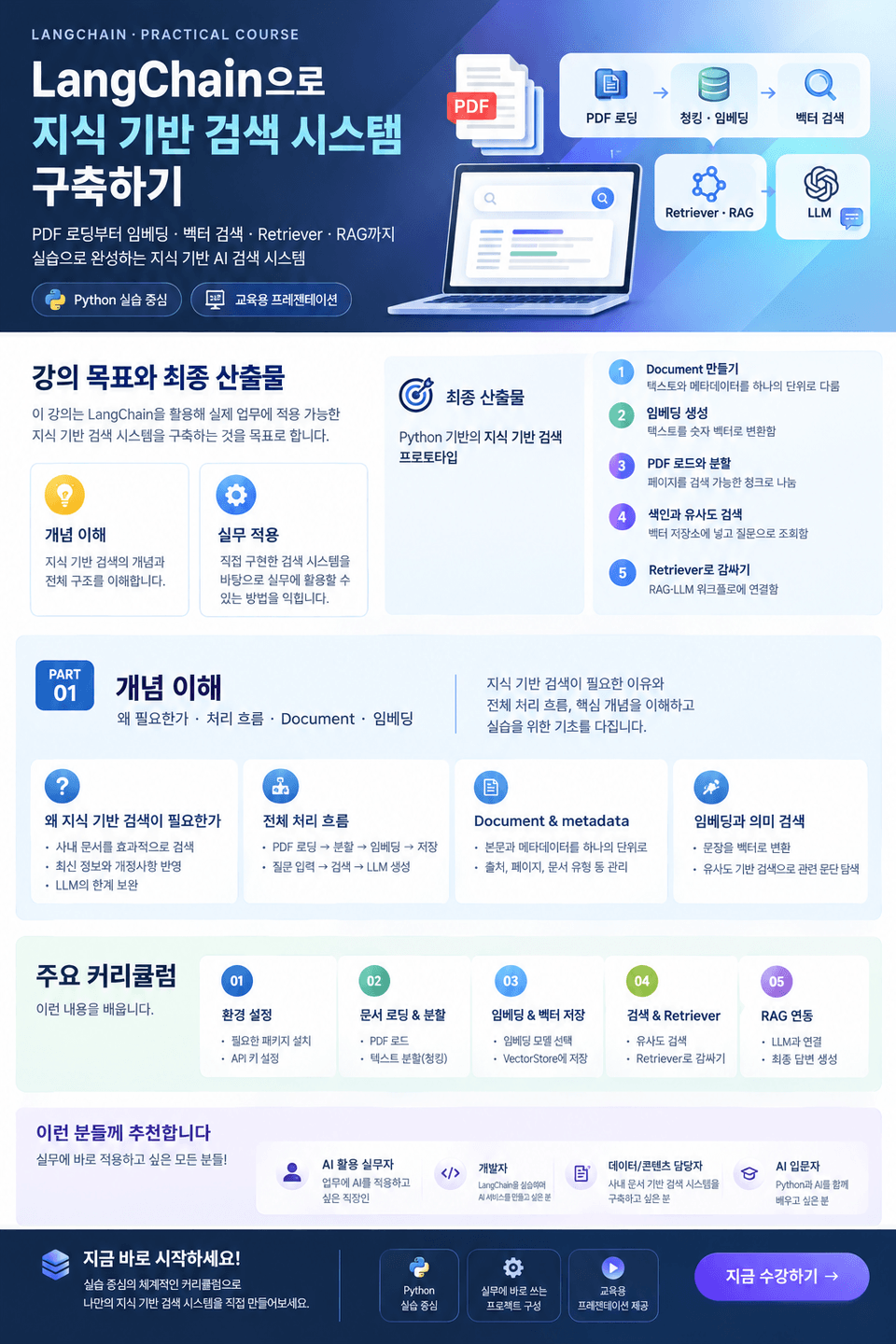
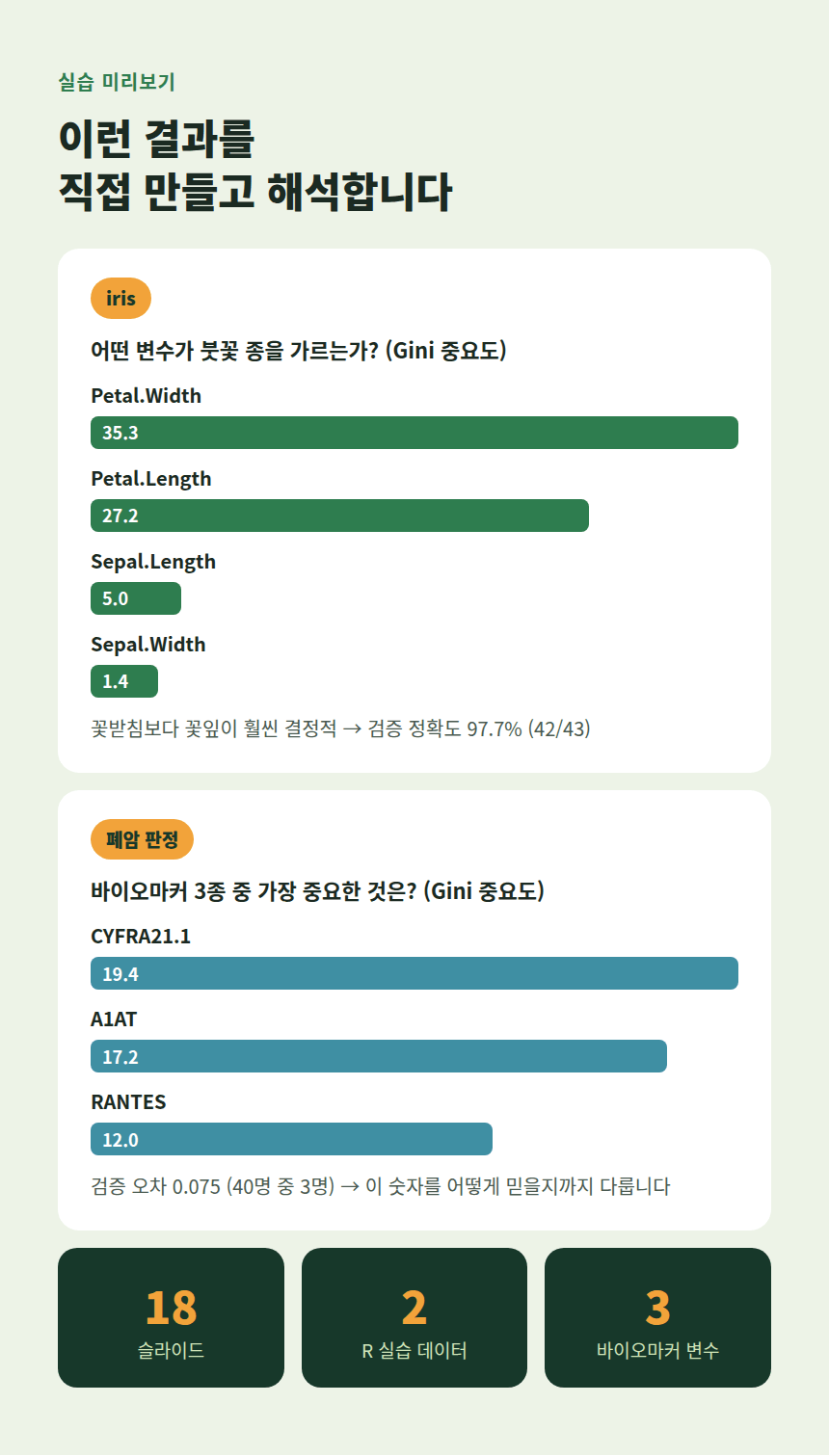
Part I Practiced in code the process of loading a PDF as page-by-page Documents, chunking it, converting the chunks into vectors through embeddings, and indexing them in a vector store. Learned the structure of converting questions into vectors, performing similarity searches (including scores, vectors, and MMR), wrapping the process as a Retriever (Runnable), and connecting it to RAG. Established practical standards for application by organizing search quality checks, security and governance (including prompt injection), and common mistakes. Part II Implemented in R the random forest algorithm, which overcomes the limitations of decision trees, and learned how to accurately interpret model results. Built the ability to read and explain key metrics such as OOB error, variable importance, and confusion matrices using iris data and real-world biomarker data. Completed an end-to-end workflow applicable directly in practice, covering hyperparameter tuning, cross-validation, and ROC curve analysis.

1 learners are taking this course

Level Basic

Course period 3 months

Python
Python
R
R
vector-database
vector-database
AI
AI
figma variable
figma variable
Python
Python
R
R
vector-database
vector-database
AI
AI
figma variable
figma variable

What you will gain after the course

  • Interpreting OOB error and variable importance metrics to assess model reliability and identify key variables

  • Model optimization through ntree and mtry hyperparameter tuning and performance comparison based on ROC curves

  • Data Unit Processing: How to Structure Text and Metadata (Sources, Pages, etc.) Using Document Objects

  • Split the long document into appropriately sized chunks, then convert the sentences into numerical vectors using embedding models such as OpenAI.

  • Vector Search and Retriever: From Vector Store Indexing to Similarity/MMR Search via Retriever

  • Full end-to-end architecture connecting to an LLM workflow (RAG)

  • A search prototype that accurately finds the paragraph closest to a question in actual PDF documents, such as company policies or manuals, instead of relying solely on an LLM’s memory.

  • Hallucination management and source preservation: Preserve not only the original content of the retrieved paragraph, but also metadata such as the source filename, page number, and character position (start_index).

Part I

  • LangChain: How to Use Search Results Rather Than Just Connect Things: PDF Loading, Embeddings, Vector Search, and RAG

  • Knowledge-Based Search Systems with LangChain: From Principles to Python Practice and Interpreting Search Results

  • AI Search Systems That Find Evidence in Documents (From PDFs to Retrievers and RAG)

  • Complete LangChain Search Systems: Documents · Chunking · Embeddings · Vector Search · Retriever · RAG

Part II

  • Random Forest: How to Read the Results Rather Than Just Run It—Classification, Feature Importance, and Tuning with R

  • Learn Random Forests with R: From Fundamentals to Lung Cancer Classification Practice and Result Interpretation

  • Random Forest: Reading the Story Behind the Numbers (From iris to Biomarkers)

  • Mastering Random Forests: Principles · R Practice · OOB · Variable Importance · Tuning

Recommended for
these people

Who is this course right for?

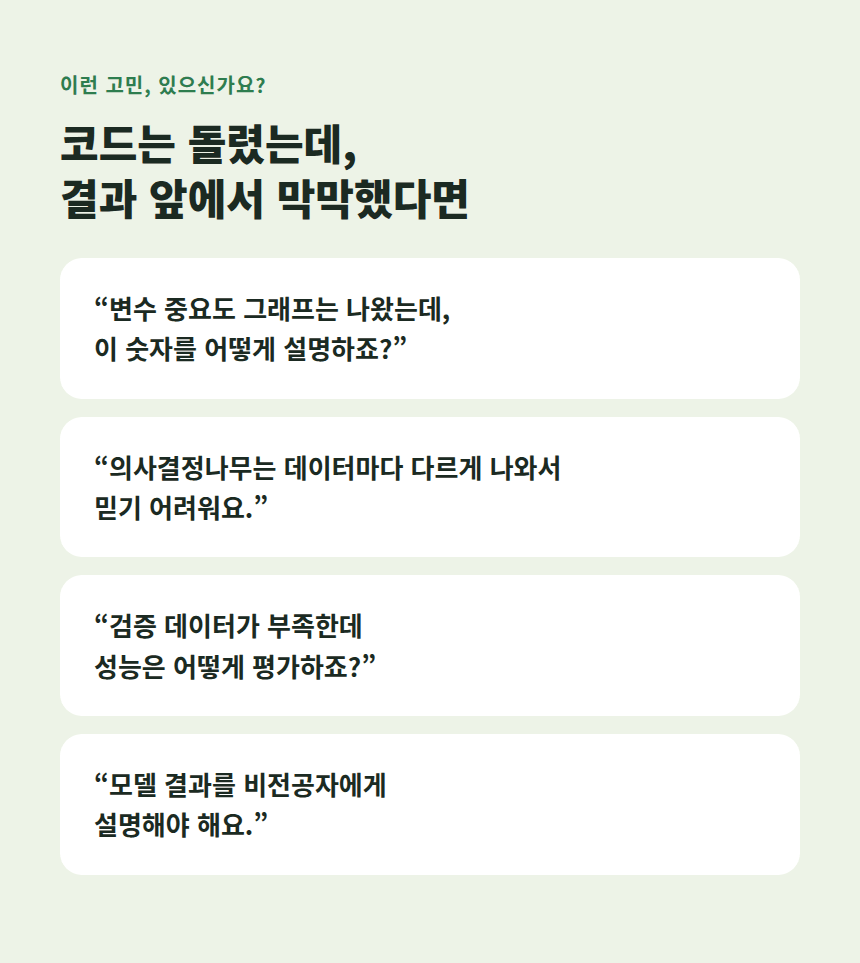
  • A beginner in data analysis who has run machine learning code but does not understand the meaning of the output results

  • A biostatistics researcher who wants to improve their ability to build and interpret classification models using R

  • Data science learners seeking to systematically study the theory and practical application of random forests

  • Integrate the countless PDF policy documents and manuals accumulated within the company with an LLM.

  • Beyond simply calling the API, I want to understand the flow of the overall architecture, from the Document object structure and text chunking (RecursiveCharacterTextSplitter) to the principles of embeddings, vector store indexing, and finally the Retriever and RAG.

Need to know before starting?

  • Experience with basic R programming syntax and data frame manipulation

  • Understanding the Basic Concepts of the Decision Tree Algorithm

  • Basic Knowledge of Classification Problems and Confusion Matrices

  • Basic methods for manipulating data such as text strings (String), lists (List), and dictionaries (Dictionary)

  • Experience navigating directories (cd) and executing basic commands in Command Prompt (CMD), PowerShell, or terminal environments

  • Experience creating virtual environments and installing necessary libraries using the package management tool pip

Hello
This is aha30005480

Career Verified

Data Analysis · AI Specialist Instructor

  • Delivered numerous data analysis and statistics training sessions for companies and public institutions

  • Full-time instructor for the Big Data and AI program at a vocational training institute

  • An expert in data analysis, statistics, and social research practice and education

  • Hands-on courses in data analysis and statistics using SPSS, R, and Python

  • Courses for the Social Research Analyst and Big Data Analyst certification exams

  • Books: Data Scientist Series Steps 1–4, Building Big Data for AI Analysis (Structured and Unstructured Korean Data), Social Research Analyst Level 2 Written & Practical (Written Response), Data Analysis Tool R Fundamental

More
Published: 
Last updated: 

Reviews

Not enough reviews.
Please write a valuable review that helps everyone!

aha30005480's other courses

Check out other courses by the instructor!

Similar courses

Explore other courses in the same field!

Limited time deal

$2.20

50%

$4.40