강의

멘토링

커뮤니티

Hardware

/

Embedded IoT

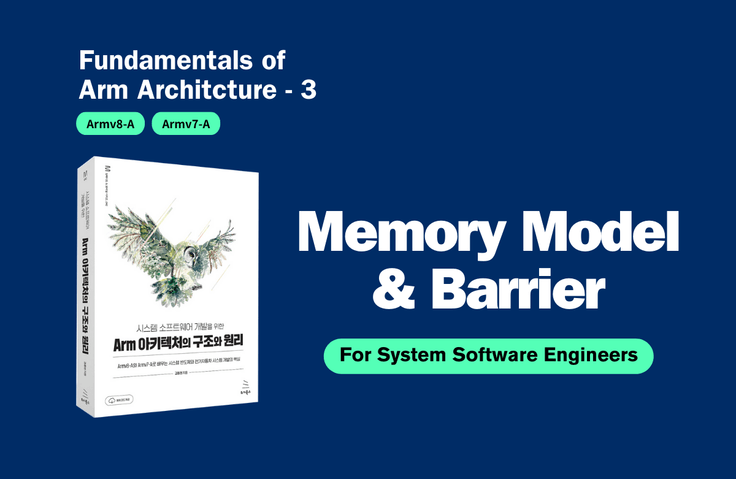
Arm Architecture: Memory Model and Barriers [Author's Direct Lecture Part 3-3]

The author of "Arm Architecture Structure and Principles for System Software Development" will properly address 'Memory Model and Barrier,' the very fundamentals of system software and core to the latest Arm architectures (Armv8-A, Armv7-A)!

(4.9) 7 reviews

115 learners

Level Basic

Course period Unlimited

  • austinkim
ARM Architecture
ARM Architecture
memory-mapped-io
memory-mapped-io
barrier
barrier
armv8
armv8
cortex-a
cortex-a
ARM Architecture
ARM Architecture
memory-mapped-io
memory-mapped-io
barrier
barrier
armv8
armv8
cortex-a
cortex-a

What you will gain after the course

  • You can understand the basic operating principles of the memory model and barriers in Arm architecture (Armv8-A).

  • Learn how Arm architecture's memory model and barrier features are applied in real projects.

  • You can get an overview of the execution flow and structure related to memory models and barriers.

  • I can answer memory model and barrier interview questions well.

1. 30% discount coupon issued for breaking 300 participants

To commemorate reaching 300 students (Parts 1 & 2), we are issuing a 30% discount coupon. Thank you. Limited to the first 200 people.

2. Roadmap Guide 🎯

This lectureRoad Map'Arm for System Software Developers - Advanced Course'is included in the course.


If you want to learn Arm architecture (Armv8-A, Armv7-A) systematically, it would be good to utilize the roadmap (30% discount on all courses). For reference, the Arm architecture roadmap (all courses taught directly by the author) isBasic Course andAdvanced CourseIt consists of 2 components.


In the latest system software
The most important Arm architecture

Not only smartphones, but also AI SoC system semiconductors, electric vehicle Automotive (autonomous driving, infotainment), and Arm processors used in cloud servers and MacBooks are all Armv8-A based 64-bit Cortex-A processors (Cortex-A53, Cortex-A57, Cortex-A72, etc...). Currently, the Armv8-A architecture can be considered the area that requires the most foundational knowledge in the system software industry.

The first step to becoming an advanced system SW developer!
Understanding memory management methods🙋‍♂

However, to become an advanced system software developer, you need to have a good understanding of how memory is managed among the key features that make up the Arm architecture. The core aspects of memory management are the 'virtual memory system', 'cache operation principles', and 'memory model and barriers'.


Why should we learn about 'memory models and barriers'?

1⃣ First, understanding memory models and barriers well enables you to develop device drivers effectively. Most device drivers control peripheral devices using memory-mapped I/O methods, and in memory models (normal memory, device memory), device memory, which is the foundation of memory-mapped I/O methods, is covered in detail.

2⃣ Second, you need to have a good understanding of device memory (one of the memory models), which is the foundation of memory-mapped I/O, in order to program effectively to efficiently control the hardware that makes up system semiconductors. This is because most system semiconductors (fabless) design independent modules (IP) that make up system semiconductors through memory-mapped I/O methods.

3⃣ Third, understanding memory models and barriers well allows you to grasp the detailed operational principles inside Arm processors. Especially in multi-core systems, you frequently encounter situations where barriers are used to solve concurrency issues, and 'memory models and barriers' can serve as foundational knowledge.

4⃣ Fourth, to do well in system software development technical interviews, you need to have a good understanding of 'memory models and barriers'. One of the frequently asked questions in experienced developer interviews is about memory reordering and memory-mapped I/O related topics.


12 years of system engineer expertise packed into this author's direct instruction!

'Structure and Principles of Arm Architecture for System Software Development' book (Chapter 17) covers 'Memory Models and Barriers' in detail. I hope you will grow further as a system software developer through the author's direct lectures.

You'll learn this kind of content

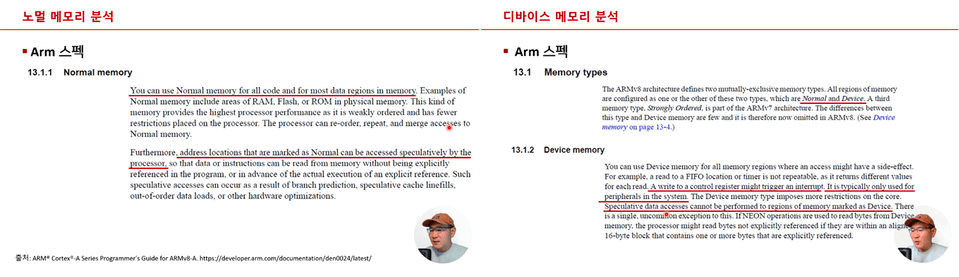
This introduces the types of memory models defined in the Arm architecture and normal memory.

Introduces the types of memory models (normal memory and device memory) while analyzing Arm specification documents in detail.

This provides a detailed explanation of device memory, which is a memory-mapped I/O interface, and reviews the memory-mapped I/O of the BCM2711 (used in Raspberry Pi).

Analyze memory-mapped I/O interfaces through debugging (Crash-Utility).

Introduces barriers and provides detailed explanations of barrier examples.

Explains the scope of barriers and data consistency in multi-core systems.

This explains in detail how barriers are utilized in actual Linux kernels and XEN hypervisors.

Based on book writing/teaching experience
Deeper and more detailed than anyone else!

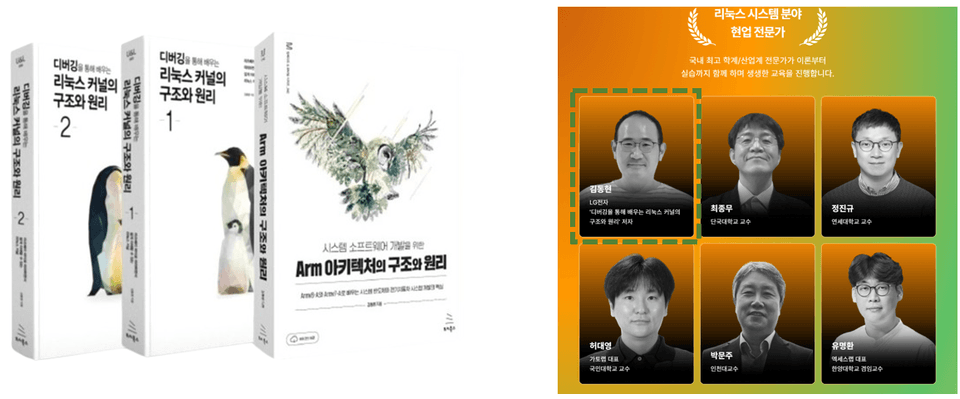
In the domestic system software field, I am the unprecedented author who wrote books on 'Arm Architecture (Armv8-A, Armv7-A)' and 'Linux Kernel'. I am also a current industry developer who best understands the latest system software trends (electric vehicles, system semiconductors - system software), and an educator who is most actively engaged in knowledge dissemination activities in the system software field.

  • Author of 'Structure and Principles of Arm Architecture for System Software Development' (2024 Korea Academy Outstanding Book Award)

  • 'Learning Linux Kernel Structure and Principles Through Debugging' (2021 Korea Academy Outstanding Book Award) Author

  • 'Programmers Dev Course: Linux System and Kernel Expert' Main Instructor

  • June 2022, Korea Computer Congress (KCC2022) - Tutorial Presentation [Conquering the Linux Kernel Using ftrace]

  • LG Electronics 'Linux Kernel' and 'Armv8 Architecture' In-house Instructor (including domestic and overseas developers) - (2020~2024)


I can confidently say that I am an educator who can explain the key features that make up the Arm architecture (Armv8-A, Armv7-A) better than anyone else in Korea.

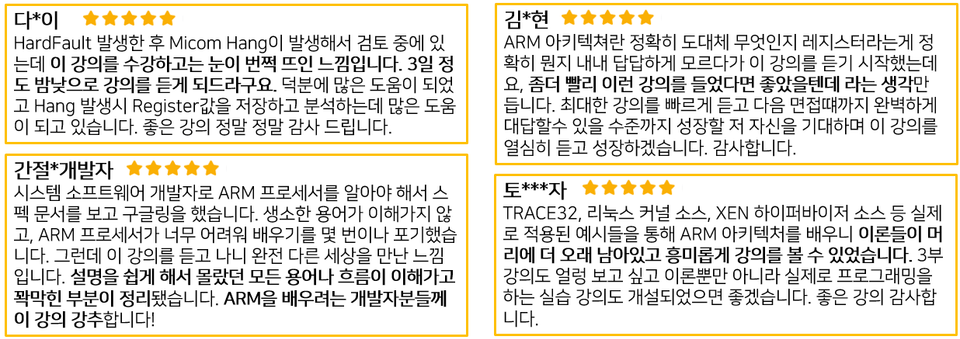
Vivid reviews left by learners


Pre-enrollment Reference Information

Prerequisites and Important Notes 📢

  • The 'Memory Model and Barriers' lecture is a course that can be easily followed even without prerequisite knowledge.

  • You should have a basic understanding of assembly instructions and registers.

  • It would be good to have an understanding of multi-core systems and system architecture.


Recommended for
these people

Who is this course right for?

  • Junior developer who wants to grow skills in the system software field, including system semiconductor (fabless) and electric vehicle sector (autonomous driving, infotainment)

  • Aspiring system software developer for system semiconductor (fabless) and electric vehicle fields

  • System software developer (system semiconductors, electric vehicles) interested in how to debug in practice using Arm architecture's capabilities.

Need to know before starting?

  • Computer Architecture

  • Operating System

Hello
This is

6,220

Learners

233

Reviews

93

Answers

4.9

Rating

22

Courses

Global Author & Linux System Software Developer (Arm, RISC-V Architecture)

A global author who has written unprecedented books on 'Arm Architecture (Armv8-A, Armv7-A)' and the 'Linux Kernel' in the domestic system software field (both books were selected as Excellent Academic Books by the National Academy of Sciences of the Republic of Korea), and is the first in Korea to author the book (in English) "Reverse Engineering Armv8-A Systems" through an international publisher (Packt). Above all, he is an active developer who is most well-versed in the latest system software trends (electric vehicles, system semiconductors-system software). He is also an educator who is most actively engaged in spreading knowledge within the system software field.

  • Author of the book (English) 'Reverse Engineering Armv8-A Systems: A practical guide to Kernel, Firmware, and TrustZone analysis', (Packt Publishing)

  • Author of 'Structure and Principles of Arm Architecture for System Software Development' (2024 National Academy of Sciences Outstanding Book Award)

  • Author of 'Structure and Principles of the Linux Kernel Learned Through Debugging' (2021, National Academy of Sciences Outstanding Scholarly Book Award)

  • Main Instructor for 'Programmers Dev Course: Linux System and Kernel Expert'

  • June 2022, Korea Computer Congress (KCC2022) - Tutorial Presentation [Conquering the Linux Kernel Using ftrace]

  • LG Electronics 'Linux Kernel' and 'Armv8 Architecture' internal instructor (including domestic and overseas developers) - (2020–Present)

I can confidently say that I am an educator who can explain the Linux kernel and Arm architecture (Armv8-A, Armv7-A) better than anyone else in Korea.

Lecture Inquiries: austindh.kim@gmail.com

Main Roadmap 🎯

'Arm for System Software Developers - basic course'

'Arm for System Software Developers - advanced course'

Linux kernel for system software developers - basic course

Curriculum

All

27 lectures ∙ (3hr 50min)

Published: 
Last updated: 

Reviews

All

7 reviews

4.9

7 reviews

  • grapesgun0624님의 프로필 이미지
    grapesgun0624

    Reviews 4

    Average Rating 5.0

    5

    100% enrolled

    It would be really great if you could explain this with an example of kernel code where barriers are used directly.

    • austinkim
      Instructor

      Thank you for your kind review.

  • heecheolsong님의 프로필 이미지
    heecheolsong

    Reviews 19

    Average Rating 5.0

    5

    33% enrolled

    • woo12346560311님의 프로필 이미지
      woo12346560311

      Reviews 5

      Average Rating 5.0

      5

      33% enrolled

      • kfcwee9463님의 프로필 이미지
        kfcwee9463

        Reviews 8

        Average Rating 5.0

        5

        100% enrolled

        • jinhoo05096242님의 프로필 이미지
          jinhoo05096242

          Reviews 3

          Average Rating 5.0

          5

          63% enrolled

          $26.40

          austinkim's other courses

          Check out other courses by the instructor!