

Learning Vue while making web games
zerocho
Free
Basic / Vue.js, Webpack, Vuex
4.9
(154)
8,000+
Learn Vue.js and Vuex and Vue Router, which are used with Vue, by creating 8 simple web games.

Basic
Vue.js, Webpack, Vuex

With the arrival of the AI era, the skills required of developers are becoming increasingly complex. You might have thought, "I just need to be good at frontend," but when you try to create your own service or integrate AI features, you eventually hit a massive wall called the backend. However, as you try to start backend development, are you overwhelmed by how much there is to learn—from database design and authentication (Auth) to storage management and complex infrastructure setup? Now, you can lay down that heavy burden. In this course, we use Supabase, which solves all these backend functions at once. We will guide you through the fastest shortcut to becoming a full-stack developer who can "instantly" complete a backend without complex server knowledge and bring ideas to life immediately.
363 learners
Level Basic
Course period Unlimited
Reviews from Early Learners
5.0
이재홍
I was planning to create a personal app and wanted to try out Supabase while considering my options for the backend and database, so I decided to take this course. It is a great course for understanding the basic features of Supabase and how it works.
5.0
루루팝팝
As I started vibe coding, I knew I needed Supabase, but as a non-developer, it felt really overwhelming at first. However, by asking the AI questions one by one, even a complete beginner like me was able to learn Supabase's features step by step! It was a field I knew nothing about, but thanks to this, I've gotten a feel for how data works. Following along with every single part of the lecture was also a huge help.
5.0
망고
I've been working on a side project with Supabase, and while I've just been asking AI questions as they come up and getting a general sense of things, I definitely feel the need to go through it all properly like this. Thank you.
A high-level overview of how the backend works.
Master DB Design and API Integration with Simple Supabase Code
Perfect implementation of the most troublesome 'Auth' system
Deploy services without complex infrastructure management.
In the era of AI, frontend alone is not enough. When trying to create your own service or implement AI features, you often run into the massive wall of the backend. Database design, user authentication, storage management, and complex infrastructure... with so much to learn, it can feel daunting, right? This course is designed specifically for you. We provide the fastest shortcut to becoming a full-stack developer who can build a backend in a flash with just Supabase without complex server knowledge and bring your ideas to life instantly.
When you need to start studying backend development to scale your service, but feel overwhelmed by how much there is to learn and don't know where to begin
When you're tired of implementing repetitive backend features (user authentication, DB, storage) every time
When it takes too long to prototype your ideas
This course isn't just about teaching you Supabase.
It is a course designed to help you grasp Backend fundamental concepts. Cloud services like AWS are far too complex for beginners to study. In contrast, Supabase allows you to start backend development right away just by knowing the basic concepts. I'll explain everything starting from backend concepts (HTTP, DB, network, CDN, login, etc.)!
Without worrying about complex DB design, authentication, or infrastructure,
I'll show you the fastest shortcut to quickly completing your own service.
You will experience building a backend in no time with Supabase.
You will learn how to build your own service in just a few hours—from database design to API integration—by leveraging Supabase's powerful features without complex server management or infrastructure setup. This is the ideal course for solo developers or entrepreneurs who want to prototype their ideas immediately.
Equip yourself with full-stack development capabilities needed in the AI era.
Even as a frontend developer, you will recognize that backend knowledge and concepts are essential for building your own services or integrating AI features, and you will learn how to handle this quickly and easily with Supabase. Put an end to the worry that "frontend alone is not enough" and take your service implementation skills to the next level.
You can perfectly implement the troublesome authentication (Auth) system.
Master how to implement complex and time-consuming authentication features—from email login and OAuth integration (like Google Login) to OTP authentication, password changes, user profile management, and token refreshing—in just a few lines of code using Supabase. Become an expert in building secure and convenient authentication systems that provide a seamless user experience.
Gain the confidence to deploy services without complex infrastructure management.
Supabase completely removes the burden of building backend infrastructure—such as server deployment, database management, and storage configuration—that often feels overwhelming. In the latter half of the course, you will gain hands-on experience implementing and deploying serverless features using Edge Functions, equipping you with the practical skills to bring your ideas to the world quickly.
Feeling overwhelmed by the growing complexity of backend development in the AI era? In this course, we will show you how to quickly and easily implement complex backend features—such as database design, user authentication, and storage management—using Supabase.
Design tables and columns using Supabase's ORM based on Node.js, and connect 1:1, 1:N, and N:M relationships. You will also learn essential knowledge for database operations through hands-on practice with RLS, trigger settings, and migrations.
Implement robust authentication systems such as email and Google OAuth login directly, and learn how to upload and manage images using storage features. Furthermore, you will implement serverless functionality through Edge Functions and learn how to deploy services without complex infrastructure.
For your reference, my teaching style has changed significantly starting with this course. Since we are in the AI era, I will no longer conduct lectures where I code live and expect you to follow along. Because the ability to ask AI "well" and command it "well" is the most important skill, I have shifted the direction to a lecture that covers fundamental concepts to help you handle AI more effectively. Additionally, by including missions throughout the lecture that you must solve on your own (which I plan to increase over time), I aim to transition toward a course where you learn by doing rather than just watching.
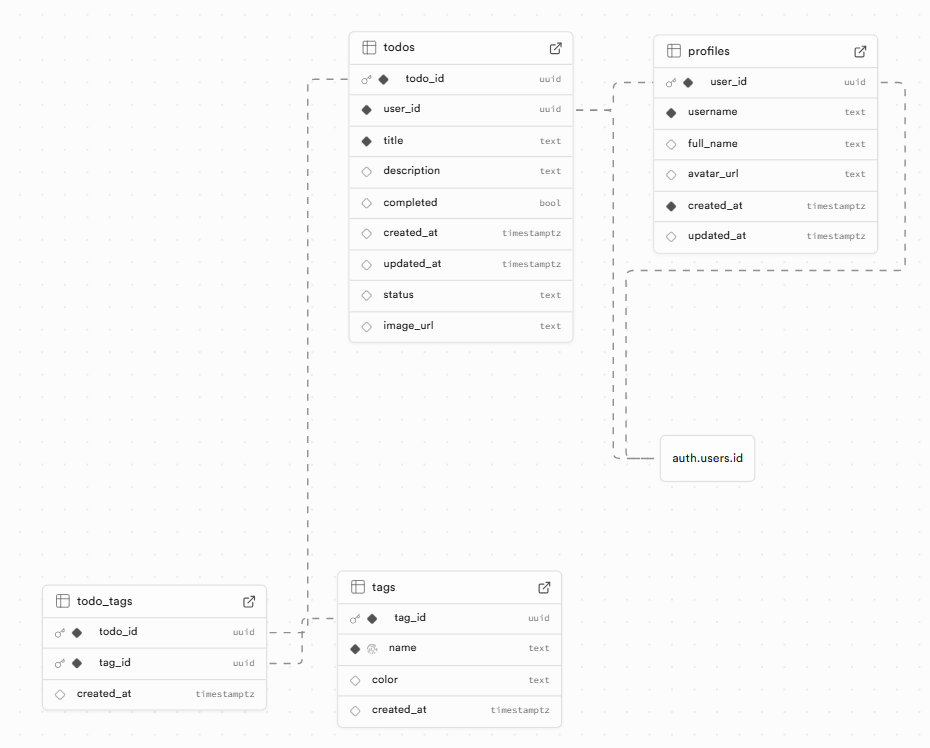
Let's start by getting a solid grasp of database concepts.
Section 1
Covers Supabase project creation and basic setup. Understand core database concepts like tables and columns, and learn various relational modeling techniques.
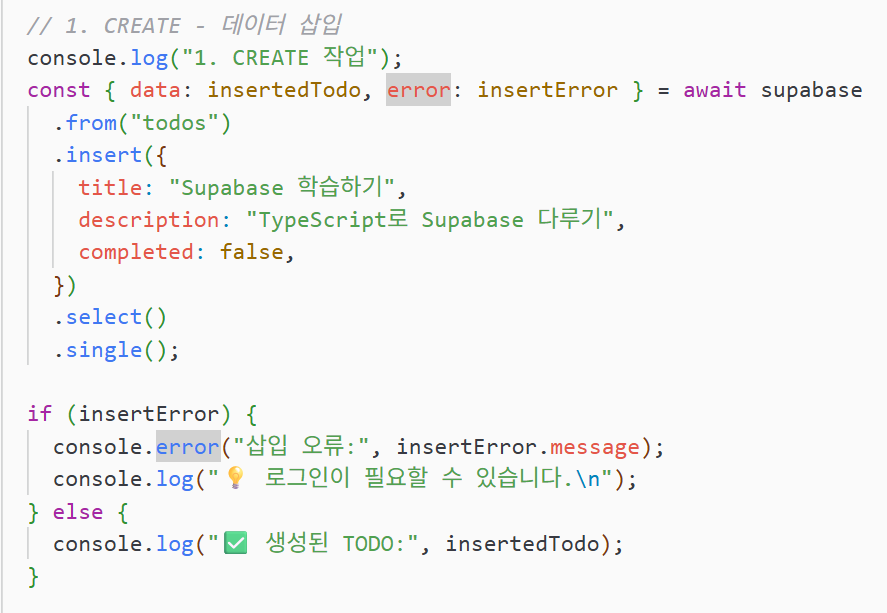
Let's manipulate the database with JS/TS.
Section 2
Learn how to interact with databases using ORM. Master database management and manipulation techniques, including CRUD operations, JOINs, migrations, and transactions.
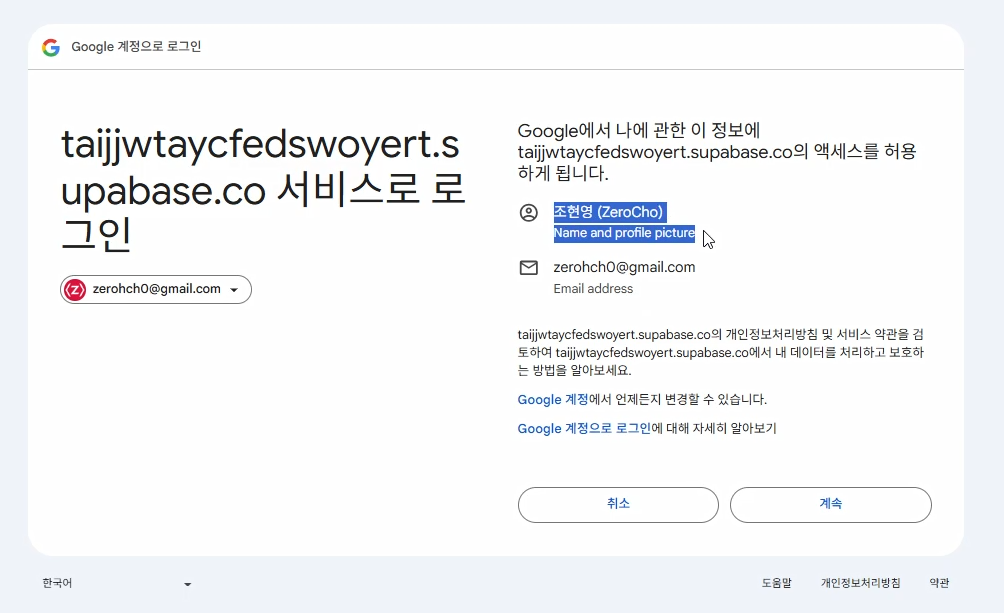
You can easily integrate things like Google Login as well.
Section 3
Learn the basic concepts of user authentication and directly implement a secure authentication system using email login, OAuth (Google), and OTP. It also covers user information management and token refresh methods.
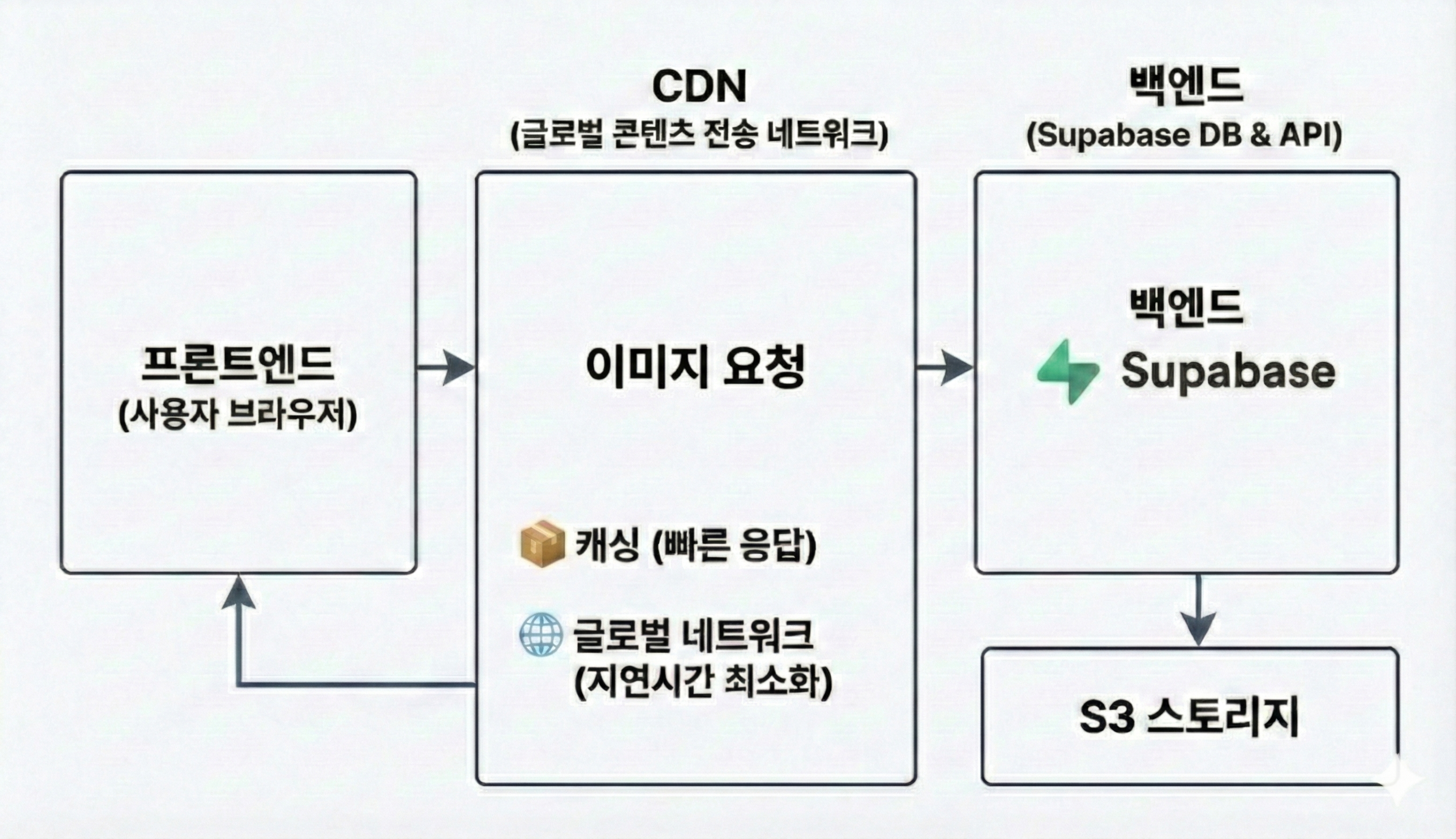
Let's upload images to storage, a file repository.
Section 4
Set up and utilize Supabase Storage for uploading and managing files like images. Learn how to configure bucket policies, generate access URLs via CDN, and implement upload and download features using signed URLs.
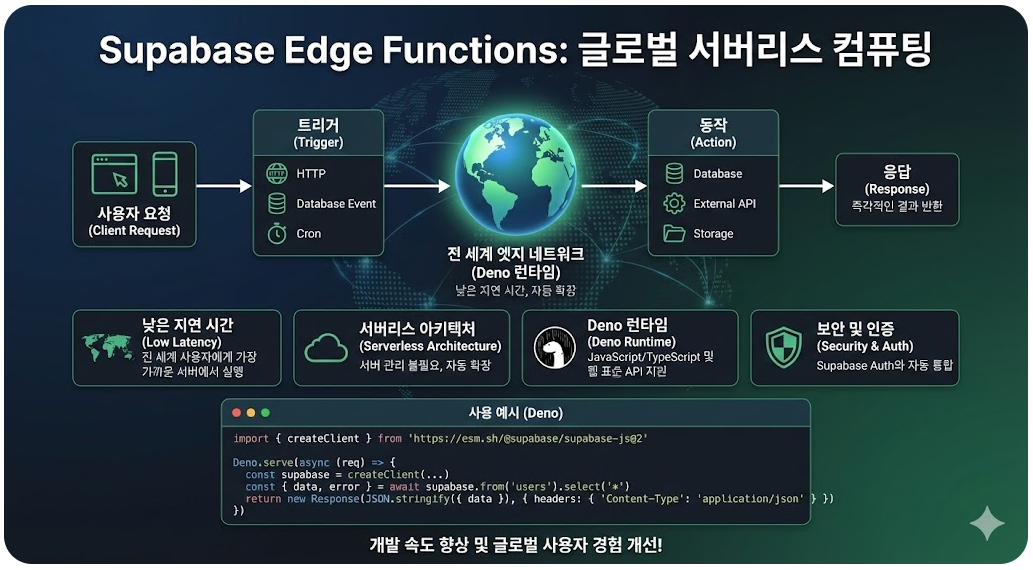
If you need to write backend logic, use Edge Functions.
Section 5
Learn how to implement serverless logic using Supabase Edge Functions. We will cover everything step-by-step, from handling HTTP requests and responses to local testing and actual server deployment.
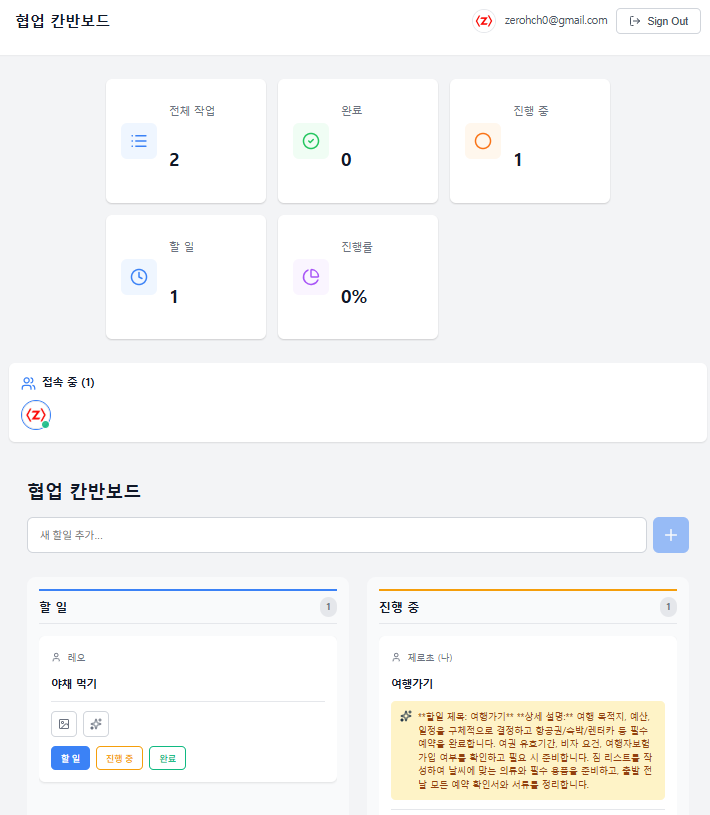
It's a Kanban board where content is updated in real-time.
Section 6
We will work on a real-time collaborative Kanban board project that integrates everything you've learned so far. There are missions included, so try implementing them with the help of AI.
Bonus: Learn the concepts of additional features such as Supabase's AI Vector, Cron, and Queue and understand how they are utilized.
Those who want to create their own service beyond simple feature implementation but have struggled to even start due to the complexity of backend development
Those who felt overwhelmed when trying to integrate AI features due to a lack of backend knowledge
Those who want to quickly prototype ideas and launch them as actual services, but find it difficult to invest time and resources into complex backend development processes such as server setup, database management, and user authentication
Those who want to rapidly develop an MVP (Minimum Viable Product) for quick market validation
Those who want to build a solid foundation in backend development but feel overwhelmed about where to begin
Those who want to learn core backend concepts like database design, API integration, and user authentication in an easy and clear way
Practice Environment
Operating System: Windows, macOS, and Linux are all supported.
Required Software: Node.js (Latest LTS version recommended)
Recommended Specifications: 4GB RAM or more
You do not need to install PostgreSQL DBMS/RDBMS directly.
Prerequisites and Precautions
Since the practice is web-based, basic knowledge of JavaScript is required.
We will use React for the final practice, but it's not the main focus, so you don't need to know it.
It's okay if you don't have backend development experience. Get started easily with Supabase.
It is ideal for solo developers/entrepreneurs who want to quickly implement their ideas.
Learning Materials
Lecture notes and practice code are provided on GitHub.
You can ask questions and receive answers through the Q&A board (I respond within 24 hours; two-time winner of the Inflearn 'Answer King' award).
Who is this course right for?
A frontend developer looking to expand into the backend.
A backend beginner taking their first steps in backend development.
Solo developers and entrepreneurs who want to quickly build and launch their own products.
Need to know before starting?
Basic knowledge of JavaScript/TypeScript syntax is required.
Node.js must be installed as there will be hands-on practice with React and Node.js.
You don't need to know React and Node.js in detail.
Backend-related topics (client/server/DB/storage/login) will be taught in the class.

Career Verified
68,817
Learners
1,822
Reviews
9,775
Answers
4.8
Rating
28
Courses
One of the key strengths of my courses is the Q&A support (Winner of the Inflearn Q&A King award twice). I respond to your questions within 24 hours, doing my best to help you out! I’ll answer your questions with the mindset that we are tackling the problems together!
One of the key strengths of my courses is the Q&A support. (Winner of the Inflearn Q&A King award twice) I respond to your questions within 24 hours, doing my best to help you out! You’ll feel like we’re solving the problems together.
👉ZeroCho Lectures
ZeroCho's full lecture roadmap. A complete roadmap of all my courses is available here.
– Author of Node.js Textbook, Self-Guided JavaScript by ZeroCho, Let's Get IT JavaScript, and TypeScript Textbook
– ZeroCho.com Operator
– Currently) Broadcasting development-related content on ZeroCho TV via YouTube
– Formerly) Smoretalk CTO
– Formerly) CTO of Today's Pickup (Youngest Development Team Lead at Kakao Mobility after exit to Kakao Mobility)
Author of Node.js Textbook, Self-Guided JavaScript by ZeroCho, Let's Get IT JavaScript, and TypeScript Textbook
Operator of ZeroCho.com
Currently running a YouTube channel ZeroCho TV, covering development topics
Former CTO at SmoreTalk
Former CTO at Today Pickup (acquired by Kakao Mobility, where I became the youngest lead developer)
All
49 lectures ∙ (5hr 46min)
Course Materials:
5.
06:41
11. ORM and CRUD
06:18
13. JOIN and ALIAS
06:18
All
22 reviews
4.7
22 reviews

Reviews 54
∙
Average Rating 4.7
5
I've been working on a side project with Supabase, and while I've just been asking AI questions as they come up and getting a general sense of things, I definitely feel the need to go through it all properly like this. Thank you.
Thank you for the great review!

Reviews 8
∙
Average Rating 5.0
Reviews 11
∙
Average Rating 5.0
5
As I started vibe coding, I knew I needed Supabase, but as a non-developer, it felt really overwhelming at first. However, by asking the AI questions one by one, even a complete beginner like me was able to learn Supabase's features step by step! It was a field I knew nothing about, but thanks to this, I've gotten a feel for how data works. Following along with every single part of the lecture was also a huge help.
Reviews 2
∙
Average Rating 5.0
Reviews 3
∙
Average Rating 5.0
Check out other courses by the instructor!
Explore other courses in the same field!
25% off for new members
$28.50
25%
$38.50
![[Renewal] ZeroCho's Introduction to JavaScript: Coding Self-StudyCourse Thumbnail](https://cdn.inflearn.com/public/courses/327126/cover/edca2ab2-47b4-45b7-92c6-5bb00fd125eb/327126.jpg?w=420)






![[Revised 3rd Edition] Node.js Textbook - From Basics to Project PracticeCourse Thumbnail](https://cdn.inflearn.com/public/courses/330181/cover/47e0125e-75ad-4946-96d3-54bbc444a188/330181-eng.jpg?w=420)
![[Renewal] TypeScript All-in-One: Part 2. Practical AnalysisCourse Thumbnail](https://cdn.inflearn.com/public/courses/329424/cover/5ae4e14d-c643-46be-9d4d-be3987a1f883/329424-eng.png?w=420)
![[Renewal] TypeScript All-in-One: Part 1. Basic SyntaxCourse Thumbnail](https://cdn.inflearn.com/public/courses/329282/cover/08ece3d3-46fe-4a46-932b-8aca91135e8e/329282-eng2.png?w=420)
![Delivery App Clone Coding [with React Native]Course Thumbnail](https://cdn.inflearn.com/public/courses/328411/cover/b51a3e0d-e2b3-49b3-8f7c-7677fb920434/328411-eng.png?w=420)
![Slack Clone Coding [Backend with NestJS + TypeORM]Course Thumbnail](https://cdn.inflearn.com/public/courses/327193/cover/010c8faf-bfc5-4c6a-9623-a68dc3b38697/327193-eng.png?w=420)
![Slack Clone Coding [Real-time Chat with React]Course Thumbnail](https://cdn.inflearn.com/public/courses/326673/cover/e430860b-4ad4-4b01-b4c7-64dccfc64b3a?w=420)
![[Renewal] Creating a NodeBird SNS with ReactCourse Thumbnail](https://cdn.inflearn.com/public/course-325637-cover/d5fd6216-71d1-490e-8759-594cbbdc1973?w=420)


![[7-day completion] Thinking database modelingCourse Thumbnail](https://cdn.inflearn.com/public/courses/332784/cover/6cc9552a-5e06-454f-a8ac-3dd5396b5204/332784.png?w=420)
![[Season 1] Spring AI in Practice: Developing a Premium Reservation AI AgentCourse Thumbnail](https://cdn.inflearn.com/public/files/courses/339732/cover/01kb2qr7zw5gf0724jvv4rndns?w=420)
![[Full-Stack Completion] Clone 3 Websites with Supabase (Next.js 14)Course Thumbnail](https://cdn.inflearn.com/public/courses/332907/cover/2975d3d7-5dcc-4e2a-977c-98b11134cfb6/332907.jpg?w=420)

![[Spring AI in Practice] Creating Your Own 24-Hour Code Reviewer & Automatic Grading AgentCourse Thumbnail](https://cdn.inflearn.com/public/files/courses/340163/cover/01kd87fc1wdcg20nnkcngd9wap?w=420)

![[MMORPG Game Development Series with C# and Unity] Part 5: DatabaseCourse Thumbnail](https://cdn.inflearn.com/public/courses/325283/course_cover/afb413e6-681e-47cd-808a-099c79fed112/rookiss-rpg-5.jpg?w=420)



![Learning Express.js Properly: Part 1 From Basics to Advanced [Basic Level]Course Thumbnail](https://cdn.inflearn.com/public/files/courses/336833/cover/01jre8d93dtfptrdx7kjrt7rh0?w=420)