
inflearn logo

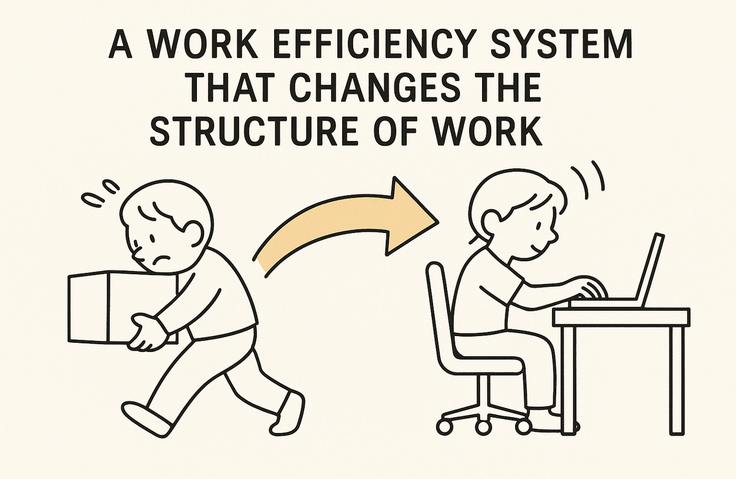
A work efficiency system that transforms the structure of work

This course is about redesigning the way you work—not just the tools you use. You’ll diagnose three sources of wasted time: delayed starts, rework, and overwork, then build a repeatable work system using templates, standards, and checklists. Through a principles-based approach applicable across roles, you’ll learn how to improve both the speed and quality of your work.

2 learners are taking this course

Level Basic

Course period Unlimited

Business Productivity
Thymeleaf
Thymeleaf
software-design
software-design
optimizing
optimizing
task-scheduling
task-scheduling
Business Productivity
Thymeleaf
Thymeleaf
software-design
software-design
optimizing
optimizing
task-scheduling
task-scheduling

What you will gain after the course

  • Analyze the causes of work delays based on speed, quality, and complexity, and set improvement priorities

  • Building a personal work system consisting of kickoff tools, definition-of-done documents, and work templates

  • Checklist-based standard process design and continuous improvement through retrospectives

[Course Introduction Body]

"I was busy, but I don't know what I did."

You may have had this feeling at the end of the day. It’s not that you didn’t work. If anything, you were at it all day long. Yet you have little to show for it.

If you break down where the time went, you’ll usually find that it leaked away in three places.

First, it’s the time it takes to get started. It takes three hours to start something that could be finished in 40 minutes.

Second, it’s the time spent doing things over. You remake what you created last month, and when the direction is off, you rewrite it from scratch.

Third, it’s time spent on things that don’t need to be done. You polish slides no one will look at and fill in unnecessary items.

These three things are not a matter of ability. They are a problem with the structure in which you take on work. If the structure remains the same, the same problems will recur no matter how many tools you change.

This course covers the steps that come before tools. You will learn 12 techniques in sequence for how to start work, how far to take it, and how to finish it. Because they do not depend on any specific app or service, you can continue using them even if you change roles or move to another company.

Each session is short, lasting around 12 to 15 minutes. Instead, a 10-minute exercise is included at the end of every session. The course is designed so you don’t just listen to the lectures and stop there—you immediately apply one thing to your own work that day.


[Recommended for]

- Professionals with 3–10 years of experience who keep working but don’t know where their time is slipping away

- Planners, developers, and operations professionals who spend long periods working alone

- People with lots of repetitive tasks and frequent handovers who have to start from scratch every time

- First-time team leaders who need to manage both their own work and their team’s work

- Those who have tried switching productivity tools several times but never noticed any meaningful improvement

Recommended for
these people

Who is this course right for?

  • An office worker who is always pressed for time despite not having much work.

  • A practitioner who has tried many tools but doesn’t feel that their work is getting any faster

  • Team managers and leaders who want to communicate a consistent way of working to their team members

Need to know before starting?

  • At least 6 months of practical work experience or experience performing repetitive tasks

  • Willingness to reflect on and improve one’s own work processes

  • Document creation and basic digital tool proficiency

Hello
This is jjangkbg7719

Career Verified

744

Learners

59

Reviews

3

Answers

4.7

Rating

36

Courses

Hello, I'm Frank.

I am an infrastructure engineer who has been wrestling with servers for over 20 years. Starting with Linux server operations, I am now in charge of the cloud infrastructure for a large-scale payment service. My daily life involves migrating from data centers to AWS, managing hundreds of instances, and tracing the causes of failures in the early hours of the morning.

The reason I created this course is simple.

I often received questions like these from those around me: "I managed to connect to the server, but I don't know what to do next." "There are so many instance types; which one should I choose?" These are the exact same points where I got stuck at first. However, when I looked for resources, I found that most of them were written for people who already knew what they were doing.

So I decided to create the course I wish I had when I first started learning.

My lectures are based on three principles.

First, I help you understand rather than memorize. Instead of just listing commands, I explain why we use them in the first place.

Second, I boldly omit unnecessary content. I do not increase the volume by including information that is useless to beginners right now.

Third, I also talk about what doesn't work. Instead of just listing the pros, I clearly point out cases where it might not be a good fit. For someone who has to make decisions in the field, that is more important.

If you feel a sense of "Ah, I should start from here" after listening to the lecture, then my goal has been achieved.

Please feel free to leave any questions you may have at any time.

More

Curriculum

All

16 lectures ∙ (11min)

Course Materials:

Lecture resources
Published: 
Last updated: 

Reviews

Not enough reviews.
Please write a valuable review that helps everyone!

jjangkbg7719's other courses

Check out other courses by the instructor!

Similar courses

Explore other courses in the same field!

Limited time deal

$3,300.00

70%

$8.80