Gemma, your voice is so nice that I can easily go through the course three times. Keke ><
It's my first time learning SQL, but I'll study hard!!!
5.0
화를참자
82% enrolled
SQL was always pushed down my priority list. I only used simple CRUD or JOINs, and I kept putting off things like subqueries or window functions, thinking I'd look into them "someday." Right now, I only handle simple data cleaning, but I had this underlying anxiety that I wouldn't even know where to start when faced with complex data. Even if I could manage somehow using AI, it felt like I was just getting by in the moment rather than actually making the knowledge mine.
Ultimately, I realized that even if AI writes the code for you, if you don't understand the data structure, you can't catch errors or even ask the right questions.
The problem-solving class was especially helpful. Solving problems consistently under a bit of pressure helped the syntax I only knew in theory finally click into muscle memory. I realized just how many fundamentals I had been missing.
If you feel stuck at the basic level, I highly recommend the combination of the lectures and the problem-solving class!!
5.0
fintesl
50% enrolled
Even though I already knew SQL, this lecture helped me solidify the concepts properly. It was great to organize the SQL syntax I had forgotten, and since it was categorized by problem types, I could focus on my weak areas and structure the different types of problems clearly in my head!
What you will gain after the course
Implementing SQL logic
Using SQL functions
A quick overview of SQL syntax
SQL coding test problem solving, Logic implementation + various functions in one lecture!
How much preparation should I do for the SQL coding test? Where and why is my solution to the problem wrong?
SQL closely related to data jobs
SQL is a programming language that helps you uncover insights and trends hidden in vast amounts of data. You can also extract and analyze only the data you need. Because SQL uses a limited syntax, implementing SQL logic and using the right functions is crucial. Therefore, SQL is the first language you encounter before joining an IT company, especially for data- related positions, from the coding test. It remains essential even after joining the company.
But aren't you sure where to start? Should you start with the basics, like database principles, or is it overwhelming? For now, let's start with solving SQL problems for coding tests !
To reduce the burden and increase efficiency.
🙋♀️ Job seekers preparing for coding tests
🙋♀️ Those who want to refer to SQL solutions and apply them to their work
🙋♀️ For those who find learning through examples more effective than theory
To help you solve general SQL problems in a short period of time, this lecture follows Leetcode 's SQL Easy difficulty problems (Korean translation provided) .
After establishing a solid foundation of knowledge, when I want to improve my skills, I start with simple problem-solving rather than delving into more difficult theories. This naturally allows me to review the concepts, and by solving the problems myself, they stick in my memory longer. Just like how you can't understand math if you only study the theory and don't practice solving problems, you won't understand it.
Don't worry if you can't solve a SQL problem on the first try. There's a gap between knowing the grammar and being able to solve the problem. At first, I couldn't solve the problem on the first try, and it took me a long time. Since it requires practice to familiarize yourself with the problem types, I've designed this course to help you approach it step-by-step with a light heart. Take the first step toward passing this year's SQL coding test!
Perfect for beginners! First Steps to SQL Coding Test
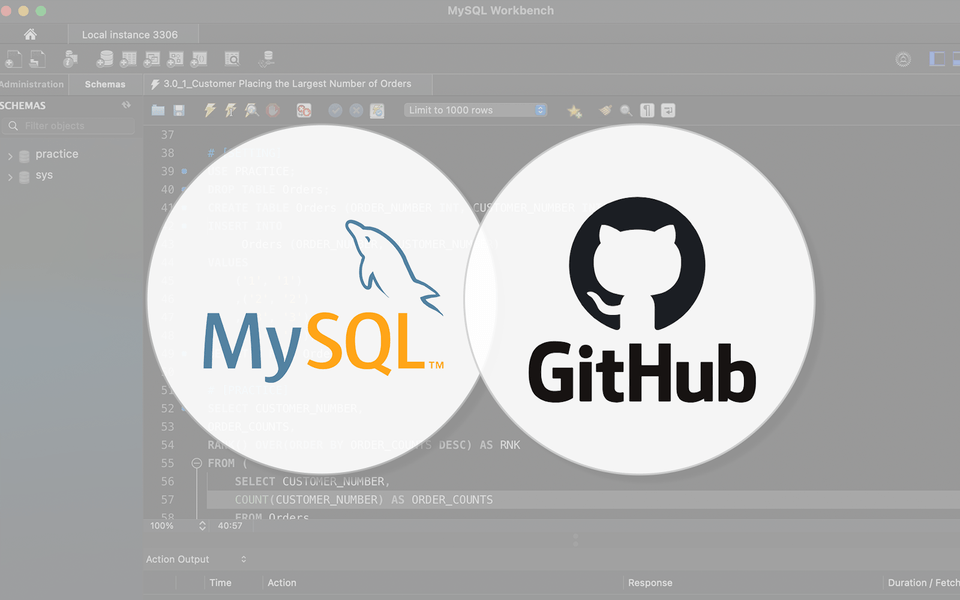
Direct SQL query in MySQL Workbench + SQL backup via Github integration
The SQL you can query from the Leetcode prompt is limited. Directly verifying the data your SQL produces is essential for improving your skills. Therefore, before solving the problem, we'll install MySQL and set up the environment to query SQL in Workbench.
We'll also set up an environment that integrates with GitHub. Uploading your code to GitHub allows you to access it anytime, anywhere, from any device (whether it's your phone or another computer), making it a valuable backup tool. GitHub integration is incredibly useful, not only for SQL, but also for other programming languages!
Provides detailed SQL problem types and homework
Even within Leetcode's Easy difficulty, there are easy and hard levels. We'll start with the easier difficulty level. Beyond difficulty, we've also divided the SQL problems by type. Some are logic-related, like CASE WHEN and GROUP BY, while others are function-related, like LAG, LEAD, and RANK. By categorizing the problems, you can see at a glance how each type of problem will be presented.
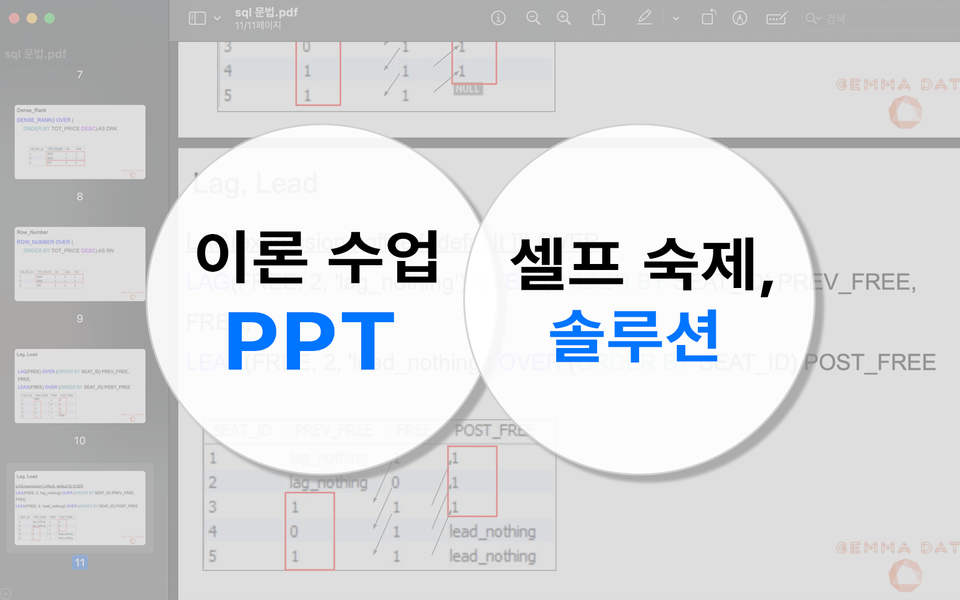
For areas requiring additional conceptual explanation, we also provide theory lecture PPTs for students. We also provide assignments and solutions for additional practice on your own. Test your SQL skills for yourself!
Detailed Curriculum
The lecture is largely divided into three parts.
Part 1. Introduction through very easy difficulty problems
Prepare for SQL coding tests by solving easier problems from Leetcode's Easy difficulty level first.
Part 2. Logic related types
Solve logic- related problems by type (e.g. join, group by, not in, case when, etc.).
After querying the SQL step by step with MySQL Workbench, we derive the final query.
Part 3. Function-related types
Solve function- related problems by type (e.g. rank, dense_rank, row_number, lag, lead, etc.).
After querying the SQL step by step with MySQL Workbench, we derive the final query.
Q&A 💭
Q. What makes this course different?
Leetcode problems are additionally divided into difficulty and type .
We provide environment settings that allow you to directly check intermediate SQL results while installing MySQL Workbench .
By installing Github together, we provide an environment setting that can back up not only the SQL used in this lecture, but also other programming languages in the future.
Q. Is this a course that non-majors can also take?
No, this course is designed for those with basic SQL knowledge. It's ideal for job seekers preparing for SQL coding tests or those just starting out in data-related fields.
Q. What level of proficiency can I expect to reach after completing this course?
The actual coding test is a mix of algorithmic and SQL questions (plus the occasional Pandas DataFrame processing question). The SQL questions aren't that difficult! (The algorithmic questions are more discriminatory.) If you follow the lectures carefully and review the code posted on Github before the coding test date, you will be able to solve the SQL section problems without difficulty.
I am Gemma, a data analyst who started in mathematics, moved into a developer career, and eventually settled into my current role after studying statistics. In data analysis, the most important thing is identifying novel insights and trends within the overflowing sea of big data. That’s easier said than done, right? However, if you can utilize the right analysis tools and methods, anyone is capable of discovering valuable gems. I would like to share these methodologies with all of you.
At first, I didn't have a feel for it, so I just watched the lecture and followed along, but as I went through the lessons, I started solving the problems before watching the lectures and asked questions about parts that weren't covered in the lectures, and I think I got the feel for it. It was much easier to understand because you answered with sincerity. Thank you!
SQL was always pushed down my priority list. I only used simple CRUD or JOINs, and I kept putting off things like subqueries or window functions, thinking I'd look into them "someday." Right now, I only handle simple data cleaning, but I had this underlying anxiety that I wouldn't even know where to start when faced with complex data. Even if I could manage somehow using AI, it felt like I was just getting by in the moment rather than actually making the knowledge mine.
Ultimately, I realized that even if AI writes the code for you, if you don't understand the data structure, you can't catch errors or even ask the right questions.
The problem-solving class was especially helpful. Solving problems consistently under a bit of pressure helped the syntax I only knew in theory finally click into muscle memory. I realized just how many fundamentals I had been missing.
If you feel stuck at the basic level, I highly recommend the combination of the lectures and the problem-solving class!!
Even though I already knew SQL, this lecture helped me solidify the concepts properly. It was great to organize the SQL syntax I had forgotten, and since it was categorized by problem types, I could focus on my weak areas and structure the different types of problems clearly in my head!









![[ITⓔCoaching] Practical Data Management with OracleCourse Thumbnail](https://cdn.inflearn.com/public/courses/327587/cover/8133dede-51cb-4410-949c-cd95aa80b7d6/327587-eng-original.jpg?w=420)

![Mastering Java from "Standard of Java" to Oracle SQL Bootcamp [Full vers.]Course Thumbnail](https://cdn.inflearn.com/public/files/courses/336223/cover/01k2j32xzj93q4a4mhs8ra9q4b?w=420)
![[MMORPG Game Development Series with C# and Unity] Part 5: DatabaseCourse Thumbnail](https://cdn.inflearn.com/public/courses/325283/course_cover/afb413e6-681e-47cd-808a-099c79fed112/rookiss-rpg-5.jpg?w=420)