This is a lecture that has everything I need! This is a must-see lecture for anyone who wants to introduce practical test code!
It doesn't end with mocking to integration testing, but it's so informative, even to static code testing,
and it's so great that it doesn't just explain the theory, but shows you how to write code so that you can apply it yourself.
Sometimes, after taking the lecture, I only have a vague feeling and can't actually apply it, but this lecture was so useful and good because I could apply it to my project by looking at each sector. I highly recommend it and thank you to the instructor!
5.0
고래밥
93% enrolled
It introduced the overall usage of test code. It seems that the lecture did not cover the details in the limited lecture time, but it was a lecture that gave a general idea of what is used the most.
5.0
qoeotl
100% enrolled
Even beginners can easily follow along, and I recommend it. Now, I will try to break it by applying it. Thank you.
What you will gain after the course
How to write basic tests using JUnit5
Mocking and Slice Testing using mockito
Building integrated tests and environments using containers
Testing architecture and style through static code analysis
Test Automation with Git and GitHub
Testing begins with setting up the environment! Learn Spring testing used in the field 🔥
✅ We've created this course so you can easily follow along, covering everything from the basics to practical testing . ✅ Maximize efficiency in a short time! Each practice step is designed to be repeated and reviewed , allowing you to complete the training quickly. ✅ Additional Notion course materials provided! We've compiled them so you can use Notion as a reference after completing the course to develop your desired application.
Most testing courses focus solely on "writing" test code. However, anyone who has actually written test code knows that without first "building" a test environment, you'll find yourself in a situation where you can't write test code. Don't you want to write real tests that will work in the workplace ? This course will give you the experience quickly and easily!
Hello 👋 I'm Juju, working as a backend developer at a unicorn company!
I fully understand the challenges of self-study. I, too, have taken a long and winding path, starting with the C language and eventually working as a Spring backend developer at a unicorn company. I created this course with the hope that students will learn by taking shortcuts, without feeling lost like I did. 😄
I recommend this to these people 🙆♀️
I want to write test code in a Spring environment, but I don't know what to learn!
👉 Are you new to writing tests? Typically, writing tests starts with learning JUnit and Mockito! My course also covers these topics, so by the end of the course, you'll have hands-on experience writing tests!
I want to try writing test code at work, but I don't know how to approach it!
👉 It seems that the main reason why test code writing in the field is difficult is because of the difficulty in building an integrated test environment! Since the field utilizes a variety of data sources and infrastructure, after taking this course, if you gradually isolate these sources, build a test environment, and utilize mocking, you'll be able to write test code in the field!
Here's a shortcut to practical testing.
If you want to learn how to configure and write a test environment 😅
Learn how to write tests !
If you want to experience building a high-level test environment in a short period of time, 🫢
Even if you have a database , you won't be afraid to write test code !
If you're a job seeker who wants to include testing experience on your backend resume 😎
You will be able to write practical level test code !
If you want to set up a testing environment in the field 😅
You will have an indicator to judge whether the codeyou are developing is good !
Spring Testing from A to Z Learn the essentials quickly 📌
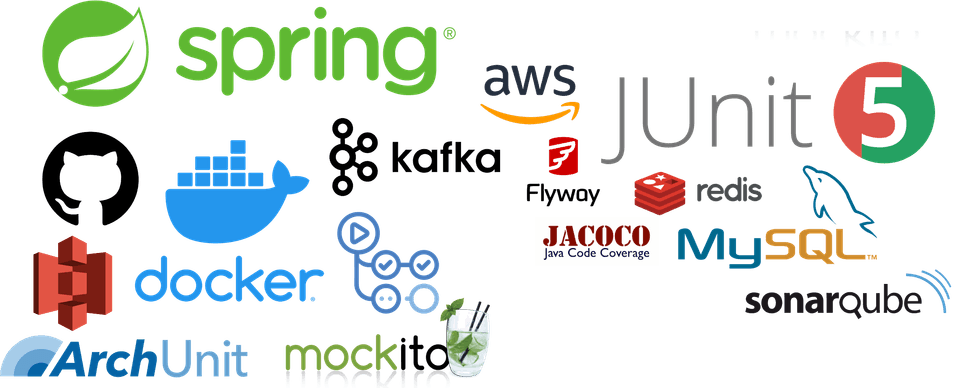
✅ How to write basic tests using JUnit5
✅ Mocking and Slice Testing with Mockito
✅ RDBMS integration testing using docker-compose, testcontainers, and flyway
✅ AWS Testing Using LocalStack
✅ Kafka testing using kraft mode Kafka containers
✅ Code style testing using spotless and git hooks
✅ Architecture testing using Arhcunit
✅ Static code analysis using Sonarqube
✅ Test automation using Github Actions
Expected Questions Q&A 💬
Q. Is there anything I need to prepare before attending the lecture?
All you need to do is install the necessary software! I've provided a list of software you need to install in Notion, along with a command to check if it's installed correctly.
Q. Can I listen to it even though I've never written test code before?
If you've developed simple CRUD applications (to-do lists, bulletin boards, etc.) using Spring, you'll find this course easy to follow! Even if you haven't used Redis, Kafka, or AWS before, you're in luck! Through countless iterative processes, we've meticulously crafted this course so that you can follow along and get the same results!
Q. Is it okay to practice in a Windows environment instead of macOS?
Java is a cross-platform language that runs smoothly on both Windows and Mac! However, I understand that Docker requires Windows settings like WSL. However, I installed it myself and found that it was easy to install using the Windows Docker desktop app. If Windows students have any issues installing Docker, please leave a question and I'll be happy to help!
Q. What level of content is covered in the class?
This course covers a wide range of topics, from writing very basic test code to building a production-ready environment. DevOps engineers will need to study even more than this course covers, but if your goal is to become a backend developer, this course will provide you with a comprehensive overview of backend testing from A to Z!
Q. What should I do after I become strong?
This course aims to provide hands-on experience writing test code and setting up an environment. In practice, the focus in the field is on developing application source code effectively to ensure efficient test code. This is because well-isolated source code and environments lead to better test code. Once you've mastered how to write test code, I recommend studying architecture and design patterns!
Q. I'm currently working on backend development. I'd like to apply the RDBMS integration testing covered in the lecture to my work. How should I approach this?
If you already have a production database, it can be overwhelming to know where to begin. First, try extracting the DDL from a Schema Dump of the production database in a test environment with the JPA auto-ddl: validate option enabled, and then initialize the test database as described in the lecture! This will be your first step toward integration testing.
If you've developed a simple CRUD application (to-do list, bulletin board, etc.) using Spring, this course will be easy for you!
Rather than listening to it over several days, I recommend taking a weekend or holiday and tackling the lecture all at once that day!
The characters in this work are based on sample data from Live2D, Inc., in accordance with the terms and conditions established by Live2D, Inc. This work was created at the creator's complete discretion.
Recommended for these people
Who is this course right for?
Anyone who wants to experience building a high-level test environment in a short period of time
Anyone who wants to include testing experience on their resume when preparing for a backend job
Anyone who wants to learn how to configure and write a test environment
Anyone who wants to have a high-level testing environment in the field
Hello! I am Juju, a knowledge sharer. I am currently working as a backend engineer at a global big tech company, where I am developing AI platforms to stay ahead of the times! I have experience with various services, including a Korean unicorn service and a global service with 30 million WAU, and I have extensive experience as a tech lead and technical interviewer. IT is constantly changing, and I have continued to study accordingly. By studying everything from 1990s IT books to current trends, I focus on the "unchanging principles" that permeate software engineering.
Experience/Portfolio/Personal Videos
(Current) Developer at a major global IT corporation, residing overseas
(Former) Backend Developer at a Korean Unicorn Company
This is a lecture that has everything I need! This is a must-see lecture for anyone who wants to introduce practical test code!
It doesn't end with mocking to integration testing, but it's so informative, even to static code testing,
and it's so great that it doesn't just explain the theory, but shows you how to write code so that you can apply it yourself.
Sometimes, after taking the lecture, I only have a vague feeling and can't actually apply it, but this lecture was so useful and good because I could apply it to my project by looking at each sector. I highly recommend it and thank you to the instructor!
It introduced the overall usage of test code. It seems that the lecture did not cover the details in the limited lecture time, but it was a lecture that gave a general idea of what is used the most.
This lecture perfectly covers integrated testing that is not covered in books on the market.
In fact, test code may not be noticeable, but it is an area that cannot be ignored when considering maintainability in the field,
so it is a lecture with a high value for taking because it is well covered in a field style.
Hello! This is knowledge sharer Juju. Recently, I've been busy with my work, so I haven't been able to properly reply to the course reviews. 🥲 Thanks to the pleasant course review after a long time, I'm energized. I designed the practice while thinking about "so that it can be applied in the field vs. so that it is easy to take the course"! Thank you for your kind words and thank you for the good course review!