P2P Communication Using WebRTC That No One Tells You About
July
$36.30
Beginner / Go, webrtc, p2p, JavaScript, Socket.io
4.0
(10)
100+
You can learn about implementing webcam and peer-to-peer communication using WebRTC.

Beginner
Go, webrtc, p2p

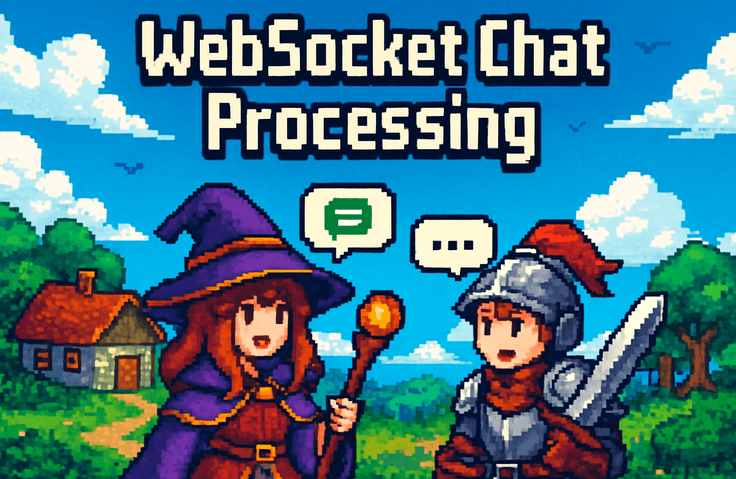
This is a lecture about learning WebSocket communication for chat servers used in streaming platforms and actually implementing it.
651 learners
Level Basic
Course period Unlimited
Reviews from Early Learners
5.0
YongJun(Passion)
I have come to understand sockets.
5.0
rnxogud123
I really enjoyed the lecture. I used another monitor to watch the lecture, so I didn't have any major inconveniences. It was my first time configuring a server other than the http API server, but I think there's a lot to learn.
5.0
Hong
The font size is definitely on the small side.. ㅠㅠ However, I only had a slight inconvenience in viewing it, but the lecture itself was very informative and the topic quickly taught the core, so it was very helpful. Thank you.
Reasons for using WebSocket communication
The difference between HTTP communication and WebSocket communication
Advantages and Disadvantages of WebSocket
The protocol for handling such real-time data is WebSocket communication.
It's not typical HTTP communication, but rather communication designed to reduce the overhead of persistent connections and handle concurrency.
This course provides a simple web template, and the goal is to implement chat functionality by building the desired server on that template.
If you're a backend developer who knows how to write general HTTP APIs, this is a course that will help you grow into a backend developer who can handle even more diverse protocols.
I hope that through my lectures, you can rediscover the excitement and joy of studying coding once again.
Students preparing for employment may have this kind of thinking.
However, after going through various interviews at large corporations and mid-sized companies, getting hired, and actually working at a company in Pangyo,
There are no cases where you only develop for general HTTP communication.
You could create a fundamental data collection module, or you could build a server that acts as a gateway through RPC.
For this reason, studying and implementing various protocols beyond HTTP communication is a very important factor in job hunting and practical work.
If you're curious about RPC communication for handling large-scale TPS, my course below will be very helpful.
📌 It's possible. It's not an impossible development approach.
📌 However, server developers generally need to minimize server resource usage as much as possible.
📌 Therefore, for communications that require maintaining a persistent connection, such as chat servers, using WebSocket is very suitable.
📌 As you can see in these videos, when building actual platforms, you don't just use HTTP but utilize various protocols.

I want to level up in backend development.Those who understand HTTP through bootcamps, self-study, or their major, but don't know what to do next
Backend developers / Students

I'm curious about various network communications
For those who are curious about various protocols and want to learn
aspiring developers

I'm curious about infrastructure setup based on protocols
As a DevOps engineer, you need to consider protocols when applying load balancing
DevOps Engineer / Student
📌 Learning about the WebSocket protocol
📌 Methods to reduce overhead for continuous communication
📌 A complete portfolio by implementing a chat server yourself
📌 Knowledge to propose ideas for new services beyond HTTP protocol in practical work
The goal is to build a chat server like this.
This course aims to implement a chat server like the one shown in the video.

Provides front-end templates
This course is focused on the backend.
Therefore, we provide a separate front-end template for testing and debugging.

Things to be careful about when using websockets,
I'll share the debugging experience I went through directly in actual work.
Pangyo developers will show you everything about how to boilerplate Node, and how to handle logging through winston.
The course is explained based on MacOS (M1).
The course uses Go and Node.js. Even if you don't know Go, it's fine because Node.js code is provided.
The IDE used is Goland and vscode.
Beyond covering existing service logic, it focuses on how to implement zero-downtime deployment and how to process event streams.
It also covers methods for making the service more robust through additional MySQL design.
If you're interested, please check out the link!!
Who is this course right for?
Backend developers who have only worked with HTTP
A job seeker new to development
Developers interested in various protocols
Someone curious about protocols as a DevOps engineer
Need to know before starting?
Go [If you don't know it, it's fine as long as you know Node.js.]
NodeJs [If you don't know it, that's fine as long as you know Go.]

3,889
Learners
202
Reviews
88
Answers
4.4
Rating
15
Courses
Introduction
As a non-major, I am currently working as a platform server developer in Pangyo.
I enjoy server optimization and various query tuning, and I strive to explain simple features to you in a quick and easy-to-understand manner.
Experience
[Former] Sandbox Blockchain Developer
[Former] Backend Developer at a Nexon subsidiary
[Former] Platform Server Developer at a major tech company in Pangyo
[Current] Server Developer at a Pangyo-based parent company
All
25 lectures ∙ (1hr 49min)
Course Materials:
All
40 reviews
4.2
40 reviews

Reviews 5
∙
Average Rating 4.6
3
The screen is too small. Even with the zoom function, the resolution is low and my eyes hurt so I can't see it. Is the video not updating? I was going to refer to it, but my eyes hurt so much that I can't.. ---------------------------------------- It was a good composition that allowed me to understand web sockets simply.
Sorry. Since the lecture standard basically uses dual monitors, the lecture font tends to be a little small. This is a problem that occurred because I overlooked this part and wrote it. ㅠㅠ This part has been reflected in the second lecture, so if you are curious about the web socket service, please refer to it. I will also update the lecture source code in the future. Thank you again for taking the lecture and I apologize for the inconvenience...!!

Reviews 4
∙
Average Rating 2.3
1
The keyboard is too loud and it's hard to see the source
I'm sorry I couldn't satisfy you ㅠㅠ I heard that the lecture sound was too low, so I turned it up a bit, but I guess it was very uncomfortable...ㅠ I received a lot of feedback about the font size, so I'll try to come back with a video that takes that into consideration in the future. Thank you for listening!
Reviews 1
∙
Average Rating 1.0
1
I am not satisfied with the quality of the lectures.
Hello, thank you for leaving a review. If there is any part that you were not satisfied with, please let me know so that I can consider it and improve it and prepare to come back with a better lecture in the future. Thank you!!
Reviews 10
∙
Average Rating 3.0
1
The title of the lecture is 'High-volume chat TPS processing...' but the content of the lecture is 'Websocket chat sample!!!'
Hello, thank you for leaving a review. First of all, I'm sorry that I didn't give you a satisfactory impression. The reason I used the name of the class is because I wanted to cover web sockets, which are absolutely necessary for handling large-volume chats. I personally thought it was a good topic, but I'm sorry if it caused confusion. Next time, I will refer to this and come back with a better class. Thank you!
Reviews 3
∙
Average Rating 3.7
1
Ah... Honestly, I'm not sure if this price is right for the content. I honestly can't recommend it.
First of all, thank you for taking the class. I focused on making a simple implementation myself, and I'm sorry that I couldn't satisfy you. I'm embarrassed. ㅠㅠ I'll come back with a better class next time. Thank you for leaving a review!!
Check out other courses by the instructor!
Explore other courses in the same field!
25% off for new members
$10.90
25%
$20.90





![Project Structure and Database Handling for Backend Employment [MySQL, Mongo]Course Thumbnail](https://cdn.inflearn.com/public/courses/332866/cover/002e90d9-1412-4a10-a9c6-39aa22d99671/332866.png?w=420)


![Learning Express.js Properly: Part 1 From Basics to Advanced [Basic Level]Course Thumbnail](https://cdn.inflearn.com/public/files/courses/336833/cover/01jre8d93dtfptrdx7kjrt7rh0?w=420)