

inflearn logo
Challenge
In progress

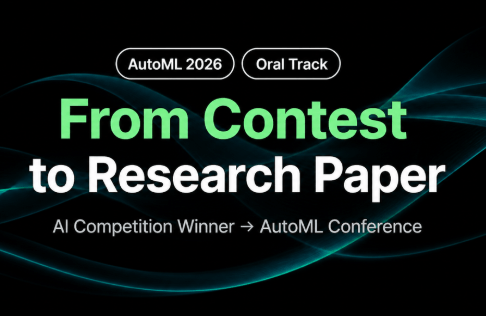
[Free Live] The process of developing an AI competition-winning algorithm into an oral presentation paper for an international conference

This program is intended for developers, data scientists, AI/ML researchers, and graduate students who are participating in AI competitions or wish to develop ideas gained from competitions into actual research and papers. Starting with the time-series forecasting algorithm used to win 3rd place in the K League-University of Seoul Open AI Competition (which featured 947 participating teams), we will share the actual research process—from problem analysis and algorithm design to performance improvement, research idea derivation, and paper writing. In particular, we will go beyond simply achieving good results in a competition. We will introduce a case-centered approach on how we identified the limitations of the winning algorithm, evolved it into a new algorithm called FS-DCM, and eventually developed it into an Oral paper for the Methods Track at the International Conference on Automated Machine Learning (AutoML Conference 2024). Through the entire workflow of "Competition → Winning Algorithm → Research Idea → Algorithm Advancement → Paper → International Conference Oral," we will explore how to connect AI competition experiences to actual research achievements.

Free Live
Machine Learning(ML)
Deep Learning(DL)
AI
Data Engineering

라이브 1 회

DEVJH님과 함께해요!

Co-instructor

How did an AI competition-winning algorithm become an international conference paper?

Achieving good results in an AI competition and producing a research paper seem like two completely different stories.

However, by deeply analyzing a single problem, repeating experiments, and generalizing the ideas discovered in the process, the experience from a competition can be developed into actual research.

In this live session, based on the actual experience of ranking 3rd out of 947 teams in the K League-University of Seoul Open AI Competition, we will share the process of how an idea that started in a competition evolved into an International Conference on Automated Machine Learning (AutoML Conference 2026, https://2026.automl.cc/accepted-papers/) Methods Track Oral paper.


🎯 This live session is for people like this

  • Those who are participating in AI competitions but want to create an experience that goes beyond just improving their scores

  • Those who want to develop ideas gained from competitions into research papers

  • Those who are wondering how to start machine learning and deep learning research

  • A student conducting AI research in graduate school

  • Developers and data scientists who want to bridge the gap between AI research and practice

  • Those who are curious about the process of writing papers for international conferences

  • Those who are curious about the process of how actual researchers define problems and develop algorithms


🏆 Research that started from an actual competition

The research to be introduced in this live session was not a project started for the purpose of writing a paper from the beginning.

It started from the process of solving a time-series forecasting problem in an actual AI competition.

In competitions, it is important to achieve good performance within a limited time, but research is not completed simply by raising leaderboard scores.

In this study, while re-analyzing the algorithm used in the competition,

"Why does this method work well?"

"In what situations do limitations arise?"

"Can this idea be applied to other data and problems?"

I asked these questions.

And based on these questions, I enhanced existing methods and developed new research ideas.


🔬 Competition → Research Idea → Algorithm → Paper

In the live session, we will look at the step-by-step process of how a single idea develops into research.

1. Problem Analysis

It explains how the data was viewed and how the problem was defined when first encountering the time-series forecasting problem.

We will look at how hypotheses were formed by analyzing the characteristics of the data and the structure of the problem, rather than simply selecting a model.

2. Algorithm Design

We introduce the approaches and experimental strategies actually used in the competition.

We will look at which ideas were tried, which methods were effective, and conversely, which approaches failed.

3. Performance Improvement

It explains how patterns discovered during the process of increasing leaderboard scores were analyzed and connected to the next experiment.

Focus on the process of improving the algorithm itself based on an understanding of the problem, rather than simple hyperparameter tuning.

4. Deriving Research Ideas

We will examine the process of generalizing ideas into a form that is not dependent on a specific dataset, rather than simply using the experience gained from the competition as is.

In this process, we explain through actual cases how the limitations of existing methods were discovered and how new research hypotheses were formulated.

5. Development into a New Algorithm

Through this process, we introduce the ideas and design background of FS-DCM (Frequency-Separated Dual-Context Modeling with Dynamic Local Volatility Weighting for Time-Series AutoML), which was developed.

Rather than simply listing complex formulas,

Why this structure was necessary

Which problems it was designed to solve

What makes it different from existing methods

focuses on explaining.

6. Writing the Paper

It also covers how results obtained from competitions were transformed into research questions and developed into the structure of a paper.

Based on actual paper writing experience, I will discuss the differences between listing experimental results and writing a research paper, as well as how to connect research hypotheses with experiments.

7. International Conference Oral Acceptance

Finally, I will share the process and research experience of developing the study into an AutoML Conference 2026 Methods Track Oral paper.


📌 What will be covered in the live session

  • How to approach AI competition problems

  • Time series forecasting problem analysis and experimental strategies

  • The process of designing the award-winning algorithm

  • Experimental methods for performance improvement

  • How to find research ideas from failed experiments

  • How to generalize competition ideas

  • The process of creating a new algorithm from the limitations of existing methods

  • Core ideas of the FS-DCM algorithm

  • How to connect experimental results to research hypotheses

  • The process of developing competition results into a research paper

  • The process of writing papers for international conferences and conducting research

  • Experience of being accepted for an Oral presentation at AutoML Conference 2026


💡 What you will gain from this live session

We are not just talking about how to get high scores in competitions.

The core of this live session is how to delve deeply into a single problem and develop it into a research idea.

Instead of letting the experience gained from the competition end as a mere award on your resume,

Problem Solving → Experimentation → Award → Discovering Limitations → Research Hypothesis → Algorithm Development → Paper Writing → International Conference

I will show you the actual process of connecting it to.

If you are participating in AI competitions but wondering, "How can I develop this experience into research?", you can gain specific direction through real-world examples.


👨‍💻 Instructor Introduction

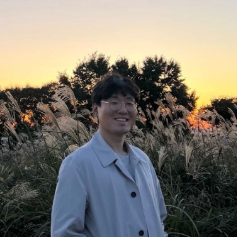
I am researching machine learning and deep learning while balancing my professional career with a Master's program in Artificial Intelligence at Yonsei University.

I have participated in AI competitions to solve real-world problems and gain award-winning experience, and by developing ideas obtained from these competitions into research, I presented an AutoML Conference 2026 Oral paper.

I am currently operating the AI learning platform Modoo AI (https://mdooai.com), engaging with AI learners, and also conducting generative AI education and mentoring as an Upstage Certified Trainer.

Based on my experience in research, practice, and education, I deliver complex AI technologies in a way that is easy and accurate to understand for everyone, from those learning AI for the first time to those looking to start their research.


🚀 From a single competition experience to research

Not just an AI competition that ends with an award,

"What kind of research questions can we create from these results?"

We will explore this together from that perspective.

Check out the link between AI competitions and research through real-world examples.

8월

16일

챌린지 시작일

2026년 8월 16일 오전 09:00

챌린지 종료일

2026년 8월 16일 오후 02:30

챌린지 커리큘럼

All

1 lectures

Course Materials:

Live

Reviews

Not enough reviews.
Please write a valuable review that helps everyone!

취소 및 환불 규정
챌린지는 지식공유자가 설정한 수업 최소 정원이 충족되지 않을 경우, 폐강 안내가 고지되며 결제 내역이 자동취소됩니다.

DEVJH's other courses

Check out other courses by the instructor!

Free