How did 4 non-majors become data analysts? [Monthly Datarian Seminar Replay | January 2022]
Are you a non-major hoping to pursue a career as a data analyst?
If you are curious about how we, with backgrounds in Logistics, Business Administration, Creative Writing, and Mechanical Engineering, became data analysts, you can find hints in this seminar.
I was at a loss as to what to do with my career in data analysisㅠㅠ This was a helpful resource that helped me resolve my worries that I had been struggling with alone! I will definitely be attending the monthly webinar :)
5.0
Jayden1116
100% enrolled
While I was aiming to become a data analyst, I came across Datalian. It was really helpful because it covered realistic stories. Thank you!
5.0
남혜정
100% enrolled
It explains the essential content in an easy-to-understand and friendly manner. It is especially great because it provides comfort and encouragement to non-majors to pursue the path of becoming data analysts. I gained confidence and I want to take more lectures at Inflearn. ㅠ
What you will gain after the course
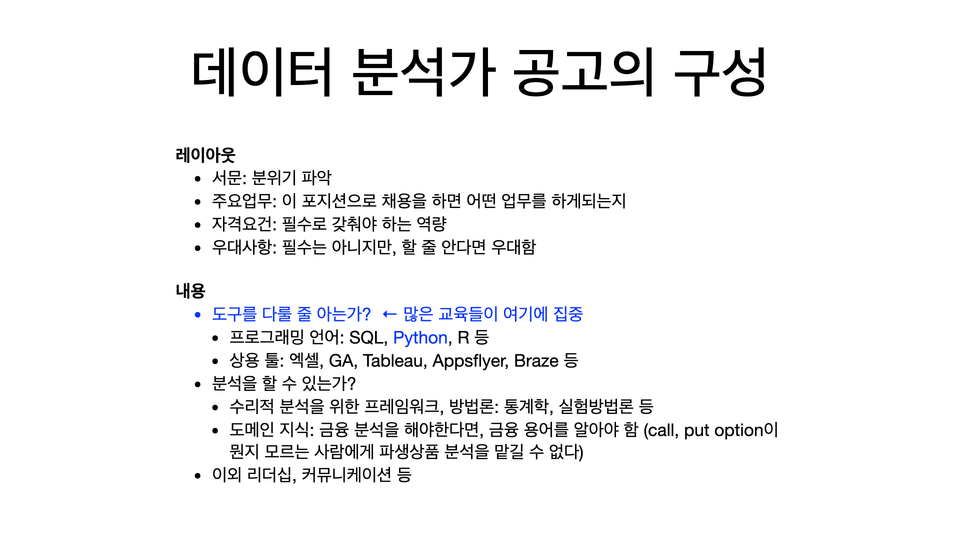
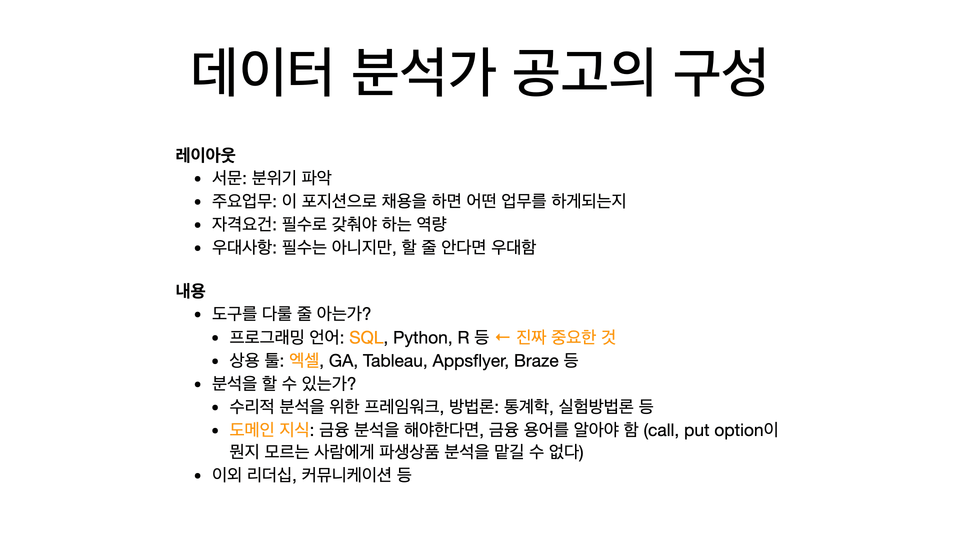
How to Read Data Analyst Job Postings
Mindset for preparing to get a job as a data analyst
📍 Notice
This lecture will be converted to a free course starting Monday, June 2, 2025. Please keep this in mind before paying for the lecture.
If you have any inquiries, please click the 'Inquiry' button at the bottom right to leave a message.
Approximately 2,600 cumulative applicants! Check out the much-talked-about seminar through this video.
📢 Please check before taking the course!
This course is a recorded video (VOD) of the "4 Non-Majors: How Did They Become Data Analysts?" live seminar held in January 2022.
It includes answers to real-time chat questions that came up during the live presentation.
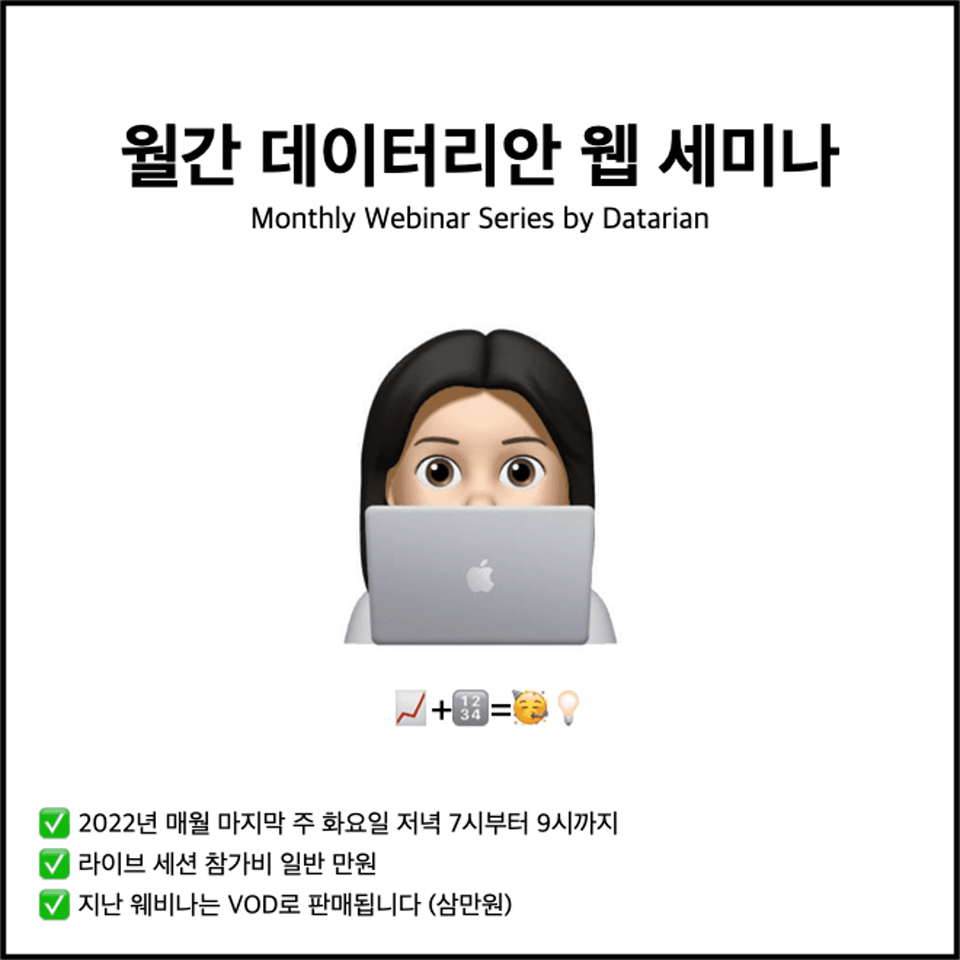
Now happening every month! Seminar! Monthly Datarian Seminar 🎤
Everything you've been curious about regarding data analysts!
Is there anywhere we can have an open and honest conversation about hiring data analysts?
Is there a place where we can share what data analysts do, what challenges they face, and look for solutions together?
I'm curious about what kind of concerns everyone studying data analysis has and how they are solving them; how can I hear about their stories?
After much deliberation, Datarian has finally made a move. In 2022, we will be holding relay seminars every last Tuesday evening of the month.
Over 200 applicants! You can rewatch the popular Monthly Datarian January Seminar on video.
January's Datarian Seminar is 🔍
In January, under the theme "How did 4 non-majors become data analysts?", four analysts from Datarian who come from non-relevant academic backgrounds sit down to have a candid conversation about how they became data analysts, what preparations they made, and whether they faced any difficulties as non-majors.
Recommended for these people ✅
Those who are commonly referred to as 'non-majors' but are interested in getting a job or switching careers to become a data analyst.
Those who are not data analysts but want to develop their analytical skills and are wondering where to find good information.
Those who are curious about how four individuals from Logistics, Business Administration, Creative Writing, and Mechanical Engineering backgrounds became data analysts.
Job seekers who find it difficult to read data analyst job postings and feel they are vague
📺 Seminars will continue in February!
[February Topic] Data Analyst Resumes That Lead Directly to Interviews
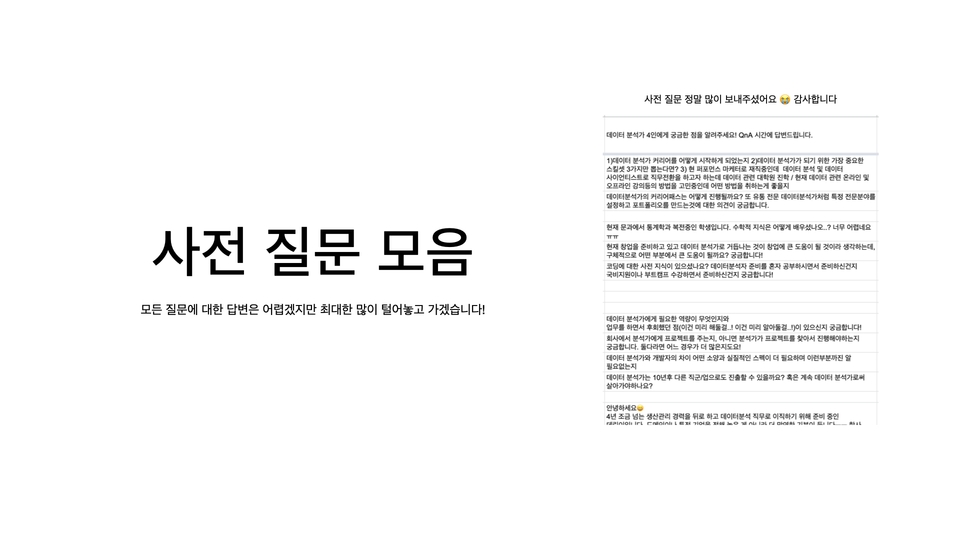
Four data analysts, who majored in logistics, business administration, creative writing, and mechanical engineering respectively, provide honest answers to pre-submitted questions.
We talk candidly about what is truly important for becoming a data analyst and performing the job. "You need a master's degree to become a data analyst? Who's the one spreading that rumor?"
Part 1 - Data Analyst Job Search Story + How to Read Job Postings
In Part 1, we covered various stories essential for starting a career path as a data analyst, including how they became a data analyst, what their mindset was, and how to read job postings.
#Part 2 - Q&A with 4 Data Analysts from Non-CS Backgrounds
In Part 2, four data analysts from various academic backgrounds answer pre-submitted questions. Since the respondents majored in Logistics, Business Administration, Mechanical Engineering, and Creative Writing respectively, you'll be able to see a wide range of perspectives on a single question :D
Pre-questions answered in Part 2
I'm curious to know why you decided to pursue a career in data analysis.
Is a data analyst a player who performs all types of analytical roles? Looking at job postings for Data Analysts, Business Analysts, and Product Analysts, some describe Data Analyst tasks as modeling, while others describe them as product analysis like Funnel/AARRR. I'm curious about the fundamental range of skills I should build up.
What was the most difficult or challenging part of working as a data analyst? I'm curious about the concerns people face in the field.
I believe that for a non-major to enter the data analysis field, they need relevant experience or a portfolio that surpasses those of related majors. How did you go about preparing such experiences or your portfolio?
If you had to pick the top 3 most important skill sets for becoming a data analyst, what would they be?
I've heard that a Master's degree is almost mandatory for data analysis roles; do those currently working in the field share the same opinion?
Points that are good to emphasize in an interview as a rookie data analyst
As a non-major who has only been studying data analysis for about a year, I still lack a lot of confidence. I feel like my understanding of basic machine learning concepts isn't solid and my coding skills are lacking, so I'm hesitant to even apply for internships because I'm not sure if I can perform well at a company. How can I find the courage to take that first step?
January Seminar Participant Introduction 📖
Speaker <Sunmi> 🎤
[Double major in Logistics and Business Administration] After working as a data analyst at Coupang, Hyperconnect, and Kakao, I am now the CEO of Datarian. I am also an instructor for the "SQL Practice is Better Than a Hundred Lectures" camp. In Part 1, I plan to talk about how I became a data analyst and how to read job postings.
Panel <Minju> 🏄♂️
[Mechanical Engineering Major] After founding a co-living startup and working as an analyst at a B2B logistics startup, I am now the CEO of Datarian. I am a young entrepreneur with experience ranging from founding to exit.
Panelist <Bomin> 🚀
[Creative Writing Major] Analyst at a recruitment platform. A poet. On the surface, he seems to practice non-possession, but with incredible execution and energy, he is always busy with endless projects. You could call him the Haemin Sunim of Datarian.
Panelist <Hyejeong> 👻
[Business Administration Major] Even before graduating from university, I worked as a full-time data analyst at a content company after completing an internship. Currently, I have reached a state of nirvana after resigning. Although my current highest level of education is a high school graduate, I am experiencing life at a faster pace than others through my journey of employment and resignation.
Check out the Q&A! 💬
Q. When is the Monthly Datarian Seminar held? Where can I apply?
The Datarian website is where you can find information about next month's seminar. You can also sign up right there!
Q. Is there anything I need to prepare before listening?
None :D Anyone can listen!
Q. Is it possible to view the slides used in the seminar separately?
You can view the slides on the Datarian blog. Please check the link below! https://bit.ly/3MR3CjF
If you're curious about the live participation reviews 👏
What was the most impressive part of the seminar?
It was impressive to learn that SQL and Google Sheets are primarily used in practice. While most data analysis courses cover Python, R, and even Hadoop, I had a lot of trouble deciding which tools to prioritize for my studies. Now, the criteria have become clear.
I was impressed by the advice to always ask a question when the interviewer asks, "Do you have any questions?"
The specific practical examples were impressive. For instance, the story about delivering data via spreadsheets to help facilitate further analysis.
I decided I wanted to pursue a career in data analysis and was just endlessly making study plans, but the mention of excessive perfectionism really hit home...
It was great that there were no standardized answers thanks to the diverse experiences of the four individuals.
It was great because many misconceptions about data analysts (especially the idea that a master's degree is a must) were cleared up, and you shared the truly essential skills and attitudes.
The content shared during the Q&A session was very impressive! (Which basically means everything was great.) I could really feel the sincerity and care you put into reading through the numerous questions in your answers. Thank you for providing answers from various perspectives; I’m leaving with many helpful hints.
A final word for Datarian!
Thank you for providing such an opportunity for us to gather.
In these times when the demand for data analysis is increasing, you are like a ray of light. Thank you.
It was an even more meaningful session because it consisted of stories based on the four panelists' firsthand experiences.
The role of data analysis felt like it was shrouded in fog, but I’m glad I could gain confidence and establish a direction for my future studies.
I always feel a great deal of fear when facing something for the first time, but once I actually confront it, I realize I was just afraid of a shadow cast by something very small. This lecture was exactly like that for me, and I think it will help me maintain a positive mindset as I prepare for my future career.
Recommended for these people
Who is this course right for?
Those who are interested in getting a job or changing careers as a data analyst
Those who want to develop their analytical skills and are wondering where to get information.
For those who are curious about how four non-majors became data analysts.
Those who find reading job postings difficult and vague
I was at a loss as to what to do with my career in data analysisㅠㅠ This was a helpful resource that helped me resolve my worries that I had been struggling with alone! I will definitely be attending the monthly webinar :)
It explains the essential content in an easy-to-understand and friendly manner. It is especially great because it provides comfort and encouragement to non-majors to pursue the path of becoming data analysts. I gained confidence and I want to take more lectures at Inflearn. ㅠ





![[A hundred words are not as good as seeing once] Basic SQL for data analysisCourse Thumbnail](https://cdn.inflearn.com/public/courses/324566/cover/aa1fac55-6e80-4506-9c92-f32c2b65f93a/sql_basic.png?w=420)

![[Practice Makes Perfect] Intermediate SQL for Data AnalysisCourse Thumbnail](https://cdn.inflearn.com/public/courses/324568/cover/9f81ac3f-d663-49e7-9eda-61253189790c/sql_intermediate.png?w=420)

![Data Analysis Portfolio That Takes You Straight to an Interview [Datarian Seminar Replay | January 2025]Course Thumbnail](https://cdn.inflearn.com/public/courses/336048/cover/c90f7e08-0953-41b6-9892-236f20b110ec/336048.png?w=420)
![Data Analyst Resumes That Lead Straight to Interviews [Monthly Datarian Seminar Replay | February 2022]Course Thumbnail](https://cdn.inflearn.com/public/courses/328519/cover/9dcb604b-7dd6-464b-909c-686ed349a891/328519-eng.png?w=420)
![Everything About Marketing Performance Analysis (feat. GA4) [Monthly Datarian Seminar Replay | November 2023]Course Thumbnail](https://cdn.inflearn.com/public/courses/332465/cover/fc2a010b-e04d-48ee-b842-f3698bc66634/332465-eng.png?w=420)
![Complete Guide to Data Analyst Job Preparation by Industry Professionals [Monthly Datarian Seminar Replay | September 2023]Course Thumbnail](https://cdn.inflearn.com/public/courses/331936/cover/9c693d54-1183-4dcf-bda8-a46e161c61d2/331936-eng.png?w=420)
![How to Create a Data Analysis Portfolio That Stands Out to Interviewers [Datarian Seminar Replay | May 2026]Course Thumbnail](https://cdn.inflearn.com/public/files/courses/342570/cover/01kttv90pd2czjrsqfgx59egvv?w=420)
![Data-Driven Content Marketing That Drives Business Growth [Monthly Datarian Seminar Replay | May 2023]Course Thumbnail](https://cdn.inflearn.com/public/courses/331081/cover/b10ce0eb-8a35-4653-a3f5-488a06981d60/331081-eng.png?w=420)
![Data-Driven Design Without a Data Analyst [Datarian Seminar Replay | November 2025]Course Thumbnail](https://cdn.inflearn.com/public/files/courses/339608/cover/01kbpcbn9gv7ysm630hkz313gd?w=420)
![What kind of work do you do as a data analyst? [Monthly Datarian Seminar Replay | January 2023]Course Thumbnail](https://cdn.inflearn.com/public/courses/329969/cover/33071a28-148a-4600-9226-ba177e628b06/329969-eng.png?w=420)
![The Core of Data Experimentation Culture: A/B Testing [Monthly Datarian Seminar Replay | November 2022]Course Thumbnail](https://cdn.inflearn.com/public/courses/329680/cover/13a4e12e-374a-445b-bf3e-a4282e2ead29/329680-eng.png?w=420)
![Data Analysis Skills for Immediate Use in Practice [Monthly Datarian Seminar Replay | April 2022]Course Thumbnail](https://cdn.inflearn.com/public/courses/328708/cover/75cd40e3-b22d-42fb-a613-572707875ab4/328708-eng.png?w=420)
![Effectively Persuading Marketing Plans Based on Data [Datalian Seminar Replay | October 2024]Course Thumbnail](https://cdn.inflearn.com/public/courses/335163/cover/af19c098-8652-462d-8533-939a23e1d5bd/335163.png?w=420)
![Data Analyst Career with Generative AI [Datalian Seminar Replay | May 2024]Course Thumbnail](https://cdn.inflearn.com/public/courses/333839/cover/8abc6cdd-25bd-4a69-9527-16b9fc9cb460/333839.png?w=420)
![Senior Data Analyst's SQL Coding Test Know-how Revealed [Monthly Datalian Seminar Replay | December 2023]Course Thumbnail](https://cdn.inflearn.com/public/courses/332774/cover/a9900f25-50a4-46f1-930d-e6ef03ea88f1/332774.png?w=420)
![These days, hot side projects and ways to view data [Monthly Datarian Seminar Replay | August 2023]Course Thumbnail](https://cdn.inflearn.com/public/courses/331782/cover/4683da6b-272f-4901-a0d9-a744f00289e9/331782-eng.png?w=420)
![GA4 Utilization Methods You Can Use Right Away Tomorrow [Monthly Datarian Seminar Replay | June 2023]Course Thumbnail](https://cdn.inflearn.com/public/courses/331370/cover/e1ecc7a1-6c05-4951-857a-aa6a72eee87a/331370-eng.png?w=420)
![How Should You Prepare to Become a Data Analyst? [Monthly Datarian Seminar Replay | February 2023]Course Thumbnail](https://cdn.inflearn.com/public/courses/330276/cover/19ca276d-b62f-4d60-a5c6-9650ed6dfe92/330276-eng.png?w=420)

![Building a Self-Growing Analyst Career [Monthly Datarian Seminar Replay | June 2022]Course Thumbnail](https://cdn.inflearn.com/public/courses/328885/cover/ce2d2845-8935-4379-9a2c-14ad1193d89b/328885-eng.png?w=420)
![What does a data analyst do? [Monthly Datarian Seminar Replay | March 2022]Course Thumbnail](https://cdn.inflearn.com/public/courses/328570/cover/158d2129-e4a3-4471-b575-dfea5f6d5b68/328570-eng.png?w=420)