
inflearn logo
inflearn logo

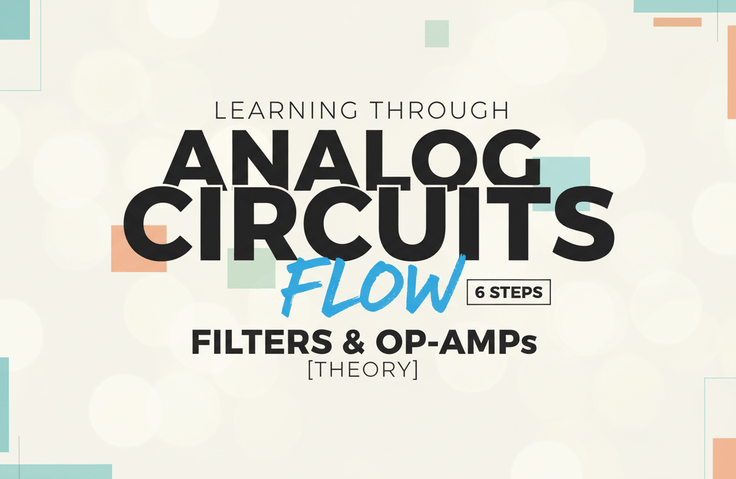
Learning Analog Circuits Through Flow, Not Formulas: 6 Steps to Understanding Filters and OP-AMPs [Theory Edition]

The 0s and 1s we talk about, HIGH and LOW, logic gates and flip-flops— they all emerge from the physical event of analog signals crossing a threshold. If so, wouldn't understanding the world before logic— the movements created by current and voltage— be the true beginning of circuit design? This course takes that first step together.

(4.0) 5 reviews

27 learners

Level Beginner

Course period Unlimited

Computer Architecture

Reviews from Early Learners

Reviews from Early Learners

4.0

5.0

성이름

100% enrolled

I'm a junior majoring in Physics. I've always been interested in analog circuits and wanted to pursue a career in that field, so I searched for and took this course. The instructor explained everything from basic analog circuit concepts to OP-AMP operating principles and applications in an easy-to-understand and kind manner, and also showed how to apply them in actual circuits, which was very helpful. I hope this course becomes widely known to people like me who are interested in analog circuits or whose career path is related to this field~

5.0

NEKO

100% enrolled

It was a confusing part, but your explanation was so good that I understood it well.

5.0

aerolbn

100% enrolled

I am currently working in the electrical field, not electronics. (In the past, I also worked in firmware. Since I didn't major in electrical or electronic engineering, I struggled a lot in the beginning. TT) I often see juniors who focus solely on the formulas themselves, but when asked about physical characteristics, they don't really understand the essence or can't answer immediately. For example, when looking at the capacitive reactance formula $1/(2\pi fC)$, I tell them that rather than just memorizing the formula, they should first get a feel for it: "Since a capacitor's reactance decreases when the change in electricity is large, noise with a high frequency will be effectively removed through a capacitor connected to the ground." I explain that understanding this intuition before memorizing the formula allows them to solve problems faster in practice later on. I believe this lecture is excellent because it focuses more on the fundamental properties of circuits rather than just the formulas. (When I studied, I used formulas to infer basic properties, but the difference here is that this lecture starts with the basic properties first.) However, because it helps you see the essence first and lacks formulas, those who want to study more deeply might find it too simple. It seems difficult to apply the content to practical work based on this alone (I think it's impossible to make practical application possible through a one-and-a-half-hour lecture). Explanations of formulas, inferring basic circuit properties through those formulas, and practical application methods definitely need to be supplemented. I kindly request that you cover these topics in the intermediate class.

What you will gain after the course

  • The Physical Meaning of Current and Voltage

  • Basic Understanding of RLC Circuits

  • Understanding the concept of 'signal' through the flow of electric current

  • Understanding transistors as 'regulators' rather than 'gates'

  • How to Read Circuits as 'Language'

Course Introduction

Analog circuits won't make sense if you start by memorizing formulas.
This course starts with 'flow' instead of equations.

Why voltage is generated, why current flows, and how resistors/capacitors handle that flow.
Then, building differential amplification and OP-AMPs on top of that intuition, we'll finally get you to a level where you can "draw" buffer, inverting, and non-inverting amplifiers as well as HPF/LPF filters.

The goal is not 'problem solving', but rather a state where cause-path-result automatically connects in your mind when looking at a circuit.


I recommend this for:

  • I learned circuit theory but can't see the circuits

  • Those for whom voltage/current/R/C/OP-AMP feel disconnected and don't come together

  • Beginners in electronics/electrical engineering/physics/semiconductors, those interested in analog design

  • Those who want to understand the basics (AFE) of amplifying and filtering small signals like sensors/ECG

  • If you get discouraged when "Bode plots/differential equations" appear first (this course doesn't go that route)


What You'll Gain After Taking This Course

  • You can explain voltage/current not through "formulas" but with a physical intuition.

  • You will intuitively understand the meaning of time, buffering, limiting, and storage using R/C.

  • You can view LPF/HPF before and after the waveform and choose "which components to discard."

  • You will develop an intuition for current steering, which is the core of differential amplification.

  • You understand the essence of OP-AMP feedback (V+≈V-), and

    • You can select and design buffer / inverting / non-inverting configurations according to your purpose.

  • Ultimately, you'll be able to draw an AFE chain like Sensor → Buffer → Gain → HPF → LPF on your own.


Course Features

  • Minimal equations: Necessary formulas are used only at a "subtitle" level.


  • Analogy → Landing in Circuit Language: Starts with analogies but ends with circuit design terminology.

  • From Basics to Practical Application: Goes beyond simple concept explanations to cover "when to use what."


Curriculum (Stages 1-6)

  1. Physical Intuition of Current and Voltage: Why do electrons move? Reference point (GND)

  2. Resistors and Capacitors: The fundamental language of circuits that control flow and temporarily store

  3. The Seed of Amplification (Transistor Intuition): How "Control" Leads to Amplification

  4. Differential Amplification & the Essence of OP-AMP: Difference (ΔV) → Distribution (ΔI) → Output (ΔVout)

  5. The Essence of Filters (HPF/LPF): Keeping Only the Desired Signal (Understanding Through Before/After Waveforms)

  6. 3 Practical OP-AMP Configurations: Buffer / Inverting / Non-inverting (Creating Functions with Feedback)


A word before taking the course

When you grasp the intuition before the formulas, your learning speed changes afterward.
This course is the "first map" that builds that intuition.

Recommended for
these people

Who is this course right for?

  • Beginners in Electronics, Physics, and Computer Science

  • A college student who wants to rebuild their foundational knowledge in their major

  • Someone who dreams of becoming an engineer who thinks physically

  • People who prefer hands-on learning

Need to know before starting?

  • Basic Programming Knowledge

  • Intuitive Understanding of Differential Equations

Hello
This is tjrgud007264321

27

Learners

5

Reviews

4.0

Rating

1

Course

I am Seokhyeong Lee, and I am currently researching semiconductors and analog circuits.

I personally designed a 12-bit SAR ADC and performed LVS/DRC verification and chip fabrication within a Synopsys environment, gaining a deep understanding of the connection between theory and practical circuitry. In this lecture, based on that exp

I personally designed a 12-bit SAR ADC,

I performed LVS/DRC verification and chip fabrication within the Synopsys environment,

I have gained a deep understanding of the connection between theory and actual circuitry.

In this course, based on that experience, we will build a "foundational base for moving from analog through digital to ASIC design" together.

In this lecture, based on that experience,

“Building the fundamental foundation that progresses from analog through digital to ASIC design” together..

More

Curriculum

All

8 lectures ∙ (1hr 35min)

Course Materials:

Lecture resources
Published: 
Last updated: 

Reviews

All

5 reviews

4.0

5 reviews

  • aerolbn님의 프로필 이미지
    aerolbn

    Reviews 33

    Average Rating 5.0

    Edited

    5

    100% enrolled

    I am currently working in the electrical field, not electronics. (In the past, I also worked in firmware. Since I didn't major in electrical or electronic engineering, I struggled a lot in the beginning. TT) I often see juniors who focus solely on the formulas themselves, but when asked about physical characteristics, they don't really understand the essence or can't answer immediately. For example, when looking at the capacitive reactance formula $1/(2\pi fC)$, I tell them that rather than just memorizing the formula, they should first get a feel for it: "Since a capacitor's reactance decreases when the change in electricity is large, noise with a high frequency will be effectively removed through a capacitor connected to the ground." I explain that understanding this intuition before memorizing the formula allows them to solve problems faster in practice later on. I believe this lecture is excellent because it focuses more on the fundamental properties of circuits rather than just the formulas. (When I studied, I used formulas to infer basic properties, but the difference here is that this lecture starts with the basic properties first.) However, because it helps you see the essence first and lacks formulas, those who want to study more deeply might find it too simple. It seems difficult to apply the content to practical work based on this alone (I think it's impossible to make practical application possible through a one-and-a-half-hour lecture). Explanations of formulas, inferring basic circuit properties through those formulas, and practical application methods definitely need to be supplemented. I kindly request that you cover these topics in the intermediate class.

    • zktchang33님의 프로필 이미지
      zktchang33

      Reviews 17

      Average Rating 4.3

      4

      100% enrolled

      • gimsiwon916643님의 프로필 이미지
        gimsiwon916643

        Reviews 1

        Average Rating 5.0

        5

        100% enrolled

        I'm a junior majoring in Physics. I've always been interested in analog circuits and wanted to pursue a career in that field, so I searched for and took this course. The instructor explained everything from basic analog circuit concepts to OP-AMP operating principles and applications in an easy-to-understand and kind manner, and also showed how to apply them in actual circuits, which was very helpful. I hope this course becomes widely known to people like me who are interested in analog circuits or whose career path is related to this field~

        • tjrgud007264321
          Instructor

          Hello! Thank you so much for taking the time to leave such a thoughtful review. With your physics background, you must have a solid theoretical foundation, and I'm truly proud as an instructor to hear that my 'intuitive approach' helped you understand OP-AMP operating principles and practical applications. While analog circuit design can feel like it has a high barrier to entry, I'm confident that with your perspective of seeing through to the 'physical essence' as you do now, you'll become an excellent engineer. If you encounter any difficulties while studying, please feel free to post questions on the Q&A board anytime. I sincerely support your career path! Fighting!

      • ijongwon1471069님의 프로필 이미지
        ijongwon1471069

        Reviews 1

        Average Rating 5.0

        Edited

        5

        100% enrolled

        It was a confusing part, but your explanation was so good that I understood it well.

        • tjrgud007264321
          Instructor

          NEKO, thank you for your valuable review! You're right. When studying circuits, the formulas often obscure the real principles, which can be very confusing. 😅 I'm truly happy as an instructor to hear that my explanation helped clear up those frustrating parts for you. I'm rooting for you to design circuits with confidence and no more confusion!

      • gch105093523님의 프로필 이미지
        gch105093523

        Reviews 1

        Average Rating 1.0

        1

        100% enrolled

        I am not satisfied with the quality of the lecture.

        Similar courses

        Explore other courses in the same field!

        $34.10