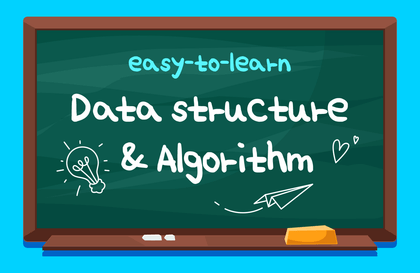
Data Structures and Algorithms Made Easy with Diagrams (Basics)
gamja5

$42.90
Beginner / Algorithm
4.9
(187)
2,500+
In this lecture, you can learn linear data structures and algorithms.

Beginner
Algorithm

Are you a non-major who doesn't know how to start learning C language? Did you learn C language as a major in school, but still can't write code? What's the point of studying C language for a long time? When you can't even create a single line of code properly... I'll pass on the know-how so you can program yourself. In this course, together with an experienced senior developer, you'll gradually learn C language grammar and application methods, and I'll guide you to a level where you can work on simple projects.
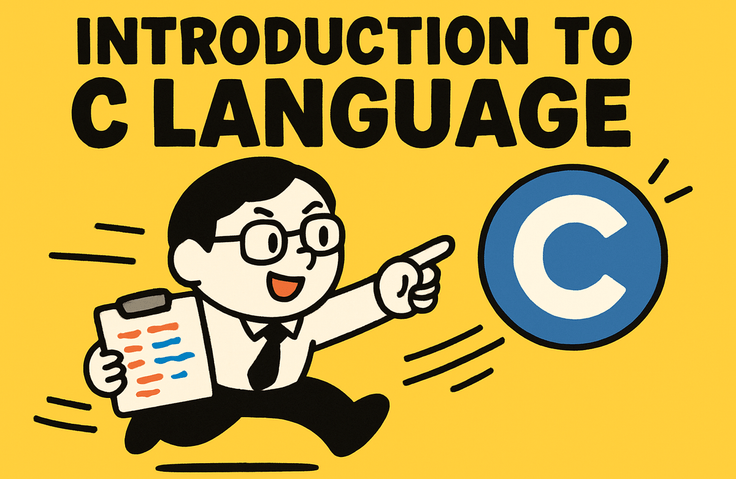
# Understanding the Core Syntax of C Language
The ability to write C code directly through small-scale practice projects
A senior developer who is a developer to the core sharing practical work experience
# Prerequisites for Learning Data Structures and Algorithms in C To effectively learn data structures and algorithms in C, you need the following foundational knowledge: ## 1. Basic C Programming Concepts - Variables and data types (int, char, float, double) - Operators (arithmetic, logical, relational) - Control structures (if-else, switch-case) - Loops (for, while, do-while) - Functions (declaration, definition, calling) ## 2. Pointers - Understanding memory addresses - Pointer declaration and initialization - Pointer arithmetic - Pointers and arrays - Pointers and functions (pass by reference) -
Dejavu C Programming
Do both CS majors and non-majors feel overwhelmed when facing the C language?
I, who have accumulated 20 years of IT research/development experience at Kakao, EA, and more, will teach you directly!
The frustration of C language learned in school not translating into coding ability,
The confusion of not knowing where to start with programming, I will solve all of this for you.
Together, we'll complete the C project,
and I'll vividly pass on the know-how of a developer who's a coder to the bone.
You can learn the core principles and practical applications of the C language based on real-world experience. Even though 50 years have passed since its introduction, the goal is to achieve a deep understanding of the C language, which is still being utilized in various fields.
Beyond simple grammar education, develop problem-solving skills by creating actual projects. Elevate your development capabilities through the experience of writing and completing code on your own.
Through the C language, you will build a solid foundation in essential algorithm learning. Along with the basics of coding tests for employment, you can systematically acquire practical knowledge required in real development environments and gain confidence.
I worked as a Korean natural language processing and backend developer at Kakao and Kakao Community, and developed game servers for FIFA Online 3 and FIFA Online 4 at EA, a world-renowned game development and distribution company.
I have gained practical experience working on numerous projects using various languages including C, C++, Java, Python, and Node.js (Javascript, Typescript).
However, I can't forget the overwhelming moments when I first learned C language.
I understand well the situation where it's difficult to write actual code with just the grammar learned in school, and I want to share my experience of overcoming this.
To avoid getting lost in the vast world of C language, we've designed the most efficient learning roadmap.
Based on real developer experience, we'll solidly build your foundation in the core essentials of C language.
C language, which only felt complicated, will no longer be intimidating when you're with hardcore developer Dejavu.

Dejavu Developer
Build a solid foundation in C language with your own hands.
Now, it's your turn.
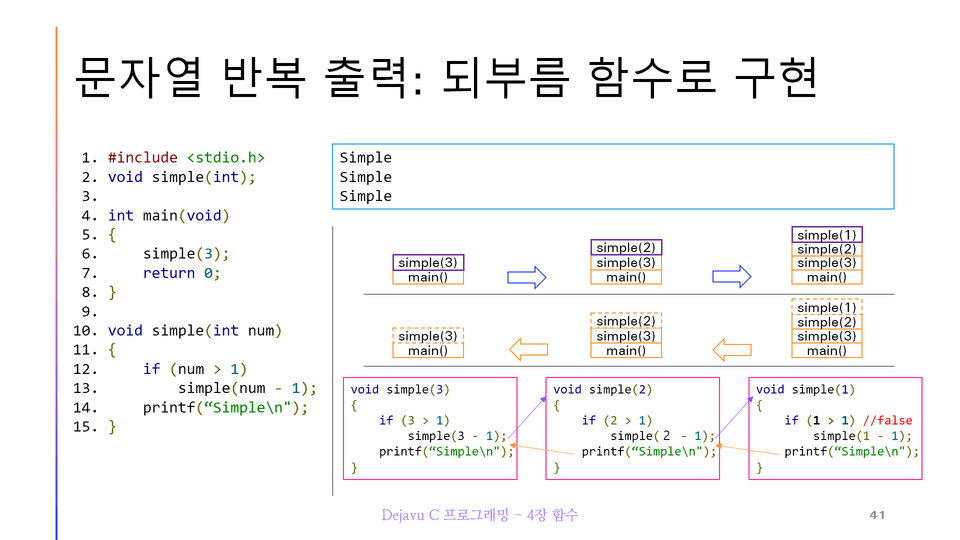
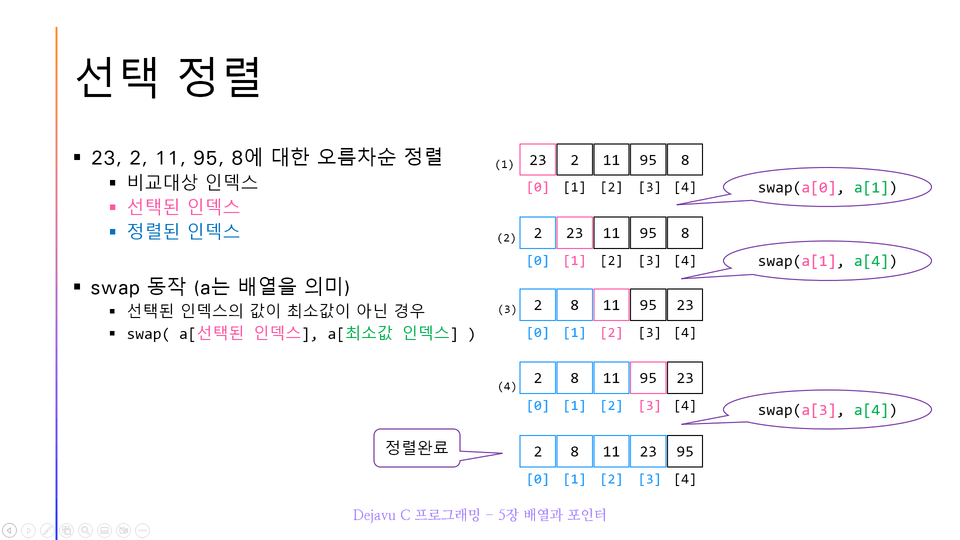
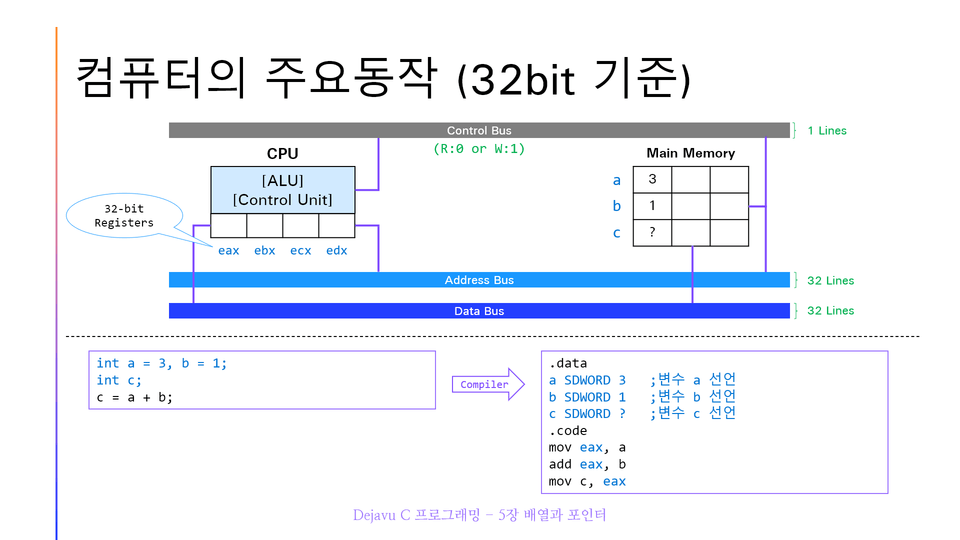
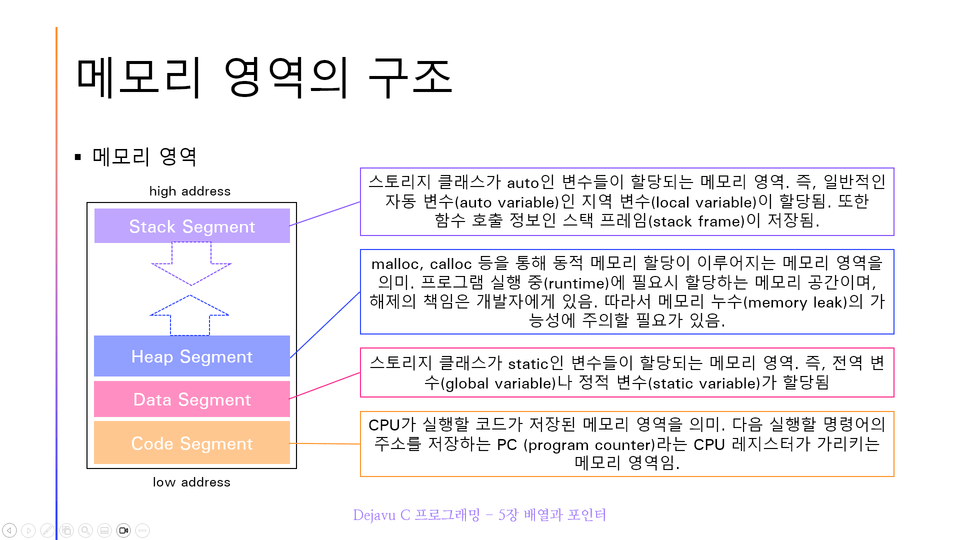
This introduces the background of the C language's creation, its relationship with the Unix operating system, and its development process. We'll examine the standardization process from K&R C to ANSI C and understand the compilation method, which is a core feature of the C language. By establishing a clear learning strategy, we maximize learning efficiency.
Learn the basic writing rules and execution process of the C language through simple example code. Conduct hands-on practice based on the know-how of senior developers to increase your interest in programming.
Learn the basic data types of C language (integer, floating-point, character types, etc.) and the concept of variables. Master how to process data using various operators (arithmetic, relational, logical, bitwise operators), and understand type conversion, typedef, and the sizeof operator.
Learn how to control program execution flow using conditional statements (if, else), loops (while, for), and branch statements (break, continue). Enhance your practical programming skills through various application examples utilizing different control statements.
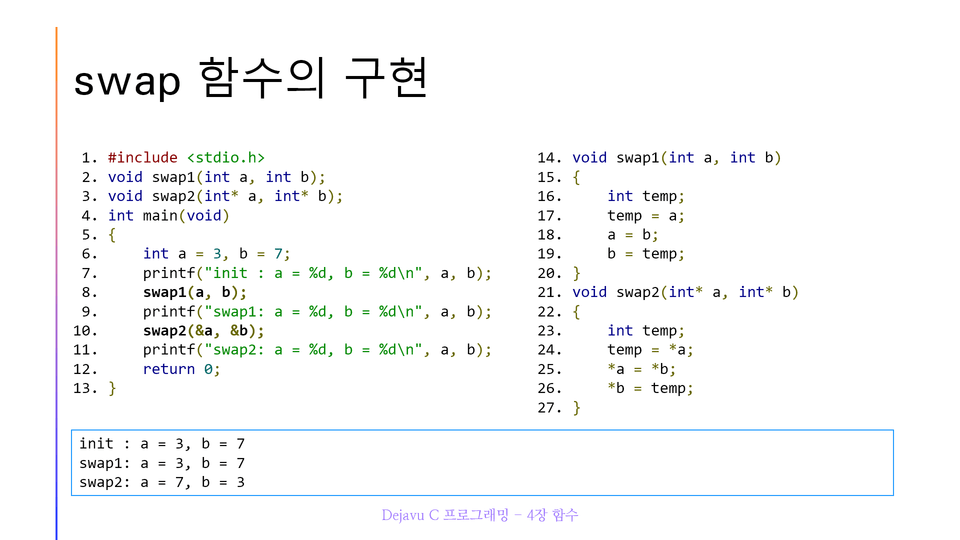
You will learn about functions that enhance code reusability. You will understand and practice function definitions, parameter passing methods, storage classes, and the principles and applications of recursive functions.
Learn the concepts of arrays (one-dimensional and multidimensional) and pointers for efficient data management. Master dynamic memory allocation techniques using pointers and explore use cases of function pointers.
You'll learn about the role of the preprocessor (#include, #define) that processes source code before compilation. You'll study the structure of header files and how to utilize advanced preprocessor directives.
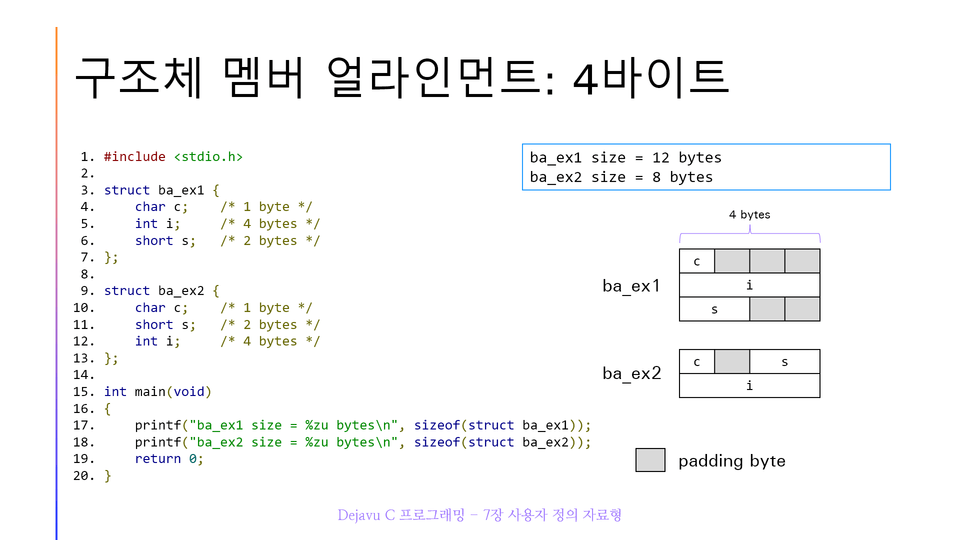
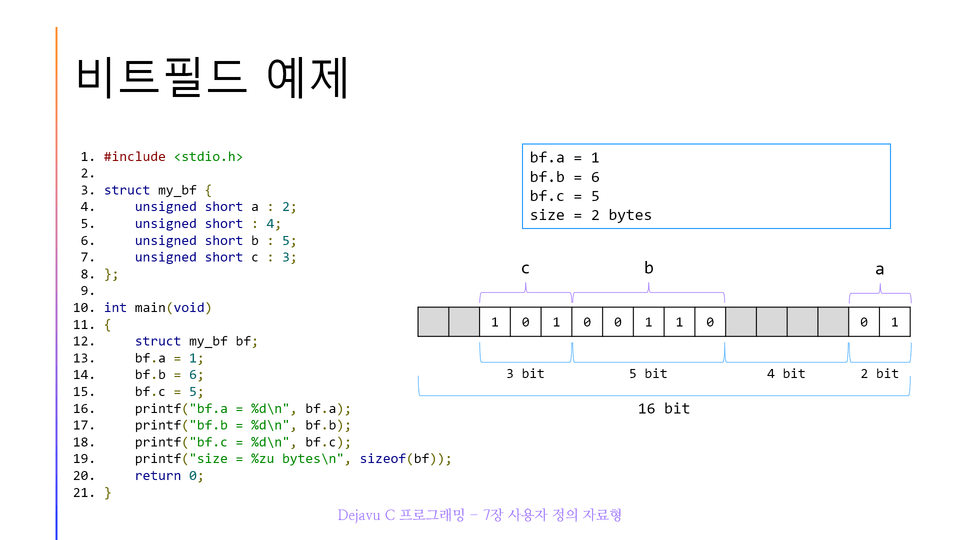
Learn how to design and utilize user-defined data types such as structures, enumerations, and unions based on abstraction concepts. Master complex data representation using structures and the use of bit fields.
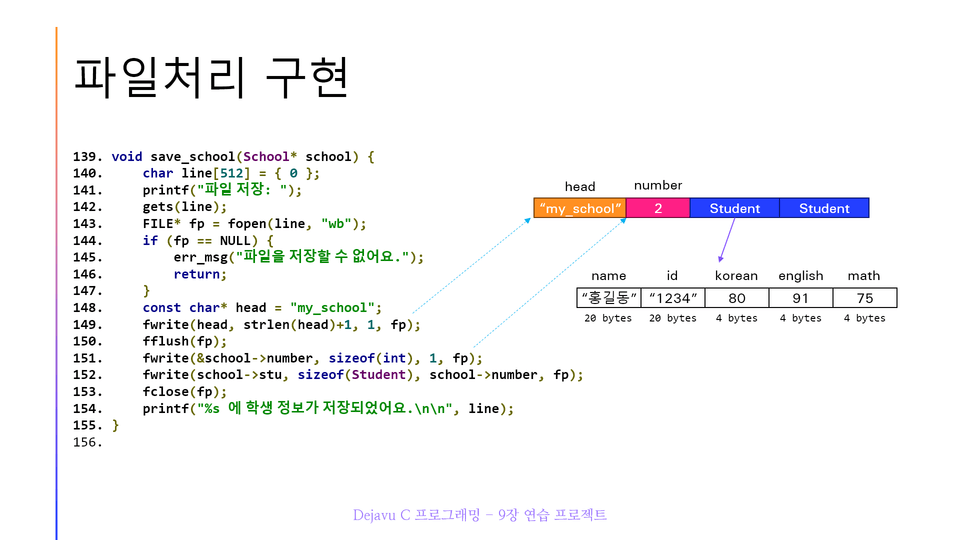
Learn how to create files and read and write data. Understand the differences between text file and binary file processing, and master how to permanently store and manage data through file input/output.
We will conduct a small-scale project by mobilizing all the C grammar and practical content we have learned so far. This is a core course for completing practical programming skills. We present guidelines for becoming a developer.


C Language, Complete Beginner Just Starting Out
Learners who want to build programming fundamentals
Practice Environment
You need an Integrated Development Environment (IDE) for C language practice. Please install Microsoft Visual Studio 2022 or later.
The operating system is based on Windows by default. If you install a C compiler and source code editor, you can use both macOS and Linux operating systems, but you will need to install and manage the development environment yourself.
Prerequisites and Important Notes
This course is designed for those who are learning the basic syntax of the C language for the first time.
This course is suitable for those who have learned C language in school but find it difficult to write code.
I recommend this for those who want to solidify their C language grammar before learning data structures and algorithms.
Learning Materials
I understand that you're providing lecture slide PDF materials. I'm ready to help translate them from Korean to English. Please share the PDF content or text that you'd like me to translate, and I'll apply the translation guidelines to ensure: - Accurate preservation of meaning - Natural English flow - Proper handling of any HTML markers or formatting - Consistent use of the translation glossary terms - Maintenance of the original structure and layout Go ahead and provide the content
I provide practice example code and project files.
We support questions and answers through the C language developer community.
Who is this course right for?
As someone with a computer science background who has learned C language but doesn't know how to write code
As a non-major, for those who want to start programming through C language
Those who want to review C language syntax before studying data structures and algorithms
Need to know before starting?
In Windows operating systems, basic usage of folders (directories) and files
The ability to install files found through search engines on Windows
Basic units (bit, byte, kilobyte, megabyte, gigabyte, ...)

Career Verified
ABD (All But Dissertation), Department of Electronic and Computer Engineering, Hanyang University (Seoul)
Internet Measurement Research
Development of Anomaly Detection AI for DDoS attacks, worm viruses, etc.
Development of large-scale traffic analysis tools (C, Java, MySQL)
Kakao and Kakao Communities
Korean Natural Language Processing (C, Python, MySQL)
Backend Development
(Java, Node.js, MySQL)
Electronic Arts Korea Studio (EA Korea Studio)
FIFA Online 3 Game Server Development (Node.js, MongoDB)
FIFA Online 4 (currently FC Online) game server development
Books
Novel-like C Lecture Notes, Jabook
Easy-to-Understand JAVA for SCJP, Leehan Publishing
Patent
Registered Patent 10-1195413, Application Development Apparatus and Method
All
45 lectures ∙ (27hr 34min)
Course Materials:
3. First example
18:09
4. second example
09:47
5. Third example
12:55
7. Data Types
09:03
8. integer type
46:33
9. floating-point
31:05
10. String
33:00
11. Boolean
24:39
12. Type Conversion
22:31
All
2 reviews
Explore other courses in the same field!
25% off for new members
$48.20
25%
$68.20



![[Jushin Game Academy Burger Teacher] Game C++ for complete beginnersCourse Thumbnail](https://cdn.inflearn.com/public/courses/332671/cover/5273da0d-7825-4a93-887f-9612dd9b2f33/332671.png?w=420)
![iOS App Monetization Start, Swift Grammar Master [Beginner, Intermediate, Advanced]Course Thumbnail](https://cdn.inflearn.com/public/files/courses/338375/cover/01k4z0gcg20pmkbh40vz2xtv5c?w=420)

![iOS App Monetization Start, Swift Grammar Master [Beginner]Course Thumbnail](https://cdn.inflearn.com/public/files/courses/338128/cover/01k6et8h5h41twq0b2q2y5ymcg?w=420)
![[Technologies Supporting Game Development in the AI Era] Hong Sabu's Diablo 1 PCG Dungeon Generation AlgorithmCourse Thumbnail](https://cdn.inflearn.com/public/files/courses/339418/cover/ai/3/35ec9a71-902f-46ed-85cb-75edb6d7fa4a.png?w=420)