inflearn logo

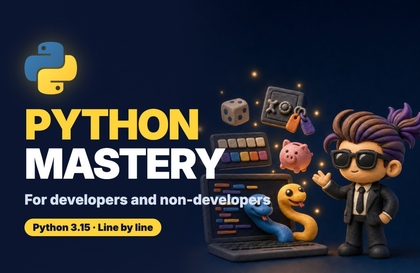
Python Advanced: See How It Works Under the Hood — 20-Lesson Course

A 20-lesson course for people who have used Python syntax, exploring the underlying rules behind features like `len()`, `for`, `with`, and decorators, starting with the principles. It covers the data model, functions and generators, class design and types, exceptions, concurrency, performance measurement, testing, and packaging in turn, then wraps up with the structure of an asynchronous batch collection and validation example in the final lesson.

19 learners are taking this course

Level Basic

Course period Unlimited

Python
Python
pytest
pytest
asyncio
asyncio
oop
oop
Python
Python
pytest
pytest
asyncio
asyncio
oop
oop

What you will gain after the course

  • You can explain how built-in functions and operators work by adding dunder methods such as __repr__, __len__, __getitem__, and __add__ to a class you create yourself. (Lessons 1–2)

  • You’ll understand the differences between reference counting, cyclic garbage collection, shallow and deep copies, and __slots__, and be able to choose the right data structure for the situation from among list, deque, dict, set, Counter, and bisect. (Lessons 3–4)

  • You can read from the code the order in which late binding in closures, decorators and functools.wraps, iterators, generators and itertools, and with and ExitStack execute. (Lessons 5–9)

  • You can establish criteria for deciding when to use properties, MRO, composition, dataclasses, StrEnum, match, descriptors, __init_subclass__, Protocol, and generic syntax. (Lessons 10–13)

  • You know how to log errors using raise from, logging, and ExceptionGroup, and can choose between a thread pool, process pool, or asyncio depending on whether the task is CPU-bound or I/O-bound. (Lessons 14–16)

  • You can understand how to use timeit, cProfile, and tracemalloc; pytest fixtures, parametrize, and spec mocks; and the src layout and pyproject.toml configuration, then organize them into a single pipeline structure. (Lessons 17–20)

Recommended for
these people

Who is this course right for?

  • For those who have built small programs using conditionals, loops, functions, and classes, and now want to understand why the code behaves the way it does.

  • Anyone who gets stuck reading open-source code when they encounter dunder methods, decorators, or descriptors.

  • For anyone who needs guidelines on choosing between lists, generators, deques, threads, processes, and asyncio.

  • Anyone who wants to review exception handling, testing, and package structure against a clear set of standards.

Need to know before starting?

  • It would be great if you have experience writing short scripts using basic Python syntax (variables, conditionals, loops, functions, and classes).

  • It’s easier to follow along if you know how to use lists and dictionaries and import modules from the standard library.

Hello
This is catgpt

Career Verified

A through-and-through AI researcher, 'CatGPT', who busted their ass reading papers and fine-tuning models. Then one day, a bolt-from-the-blue mission landed in their lap: "You’ve finished building the model, right? Now write the front end and back end too so we can deliver it to the client."

To survive, I was forced to make a tearful career change into a full-stack developer. After successfully delivering the solution and making it back, AI had advanced so much that this time, instead of coding, I found myself taking on the role of a PM coordinating a team with AI...!

Not stopping there, this max-level engineer went all in and poured their full-stack soul into building a “lecture production automation pipeline” and even bringing an “AI instructor” to life. What fate awaits CatGPT, the full-stack AI engineer who has automated even their own livelihood(?)!

More

Reviews

Not enough reviews.
Please write a valuable review that helps everyone!

catgpt's other courses

Check out other courses by the instructor!

Similar courses

Explore other courses in the same field!

Free