
inflearn logo

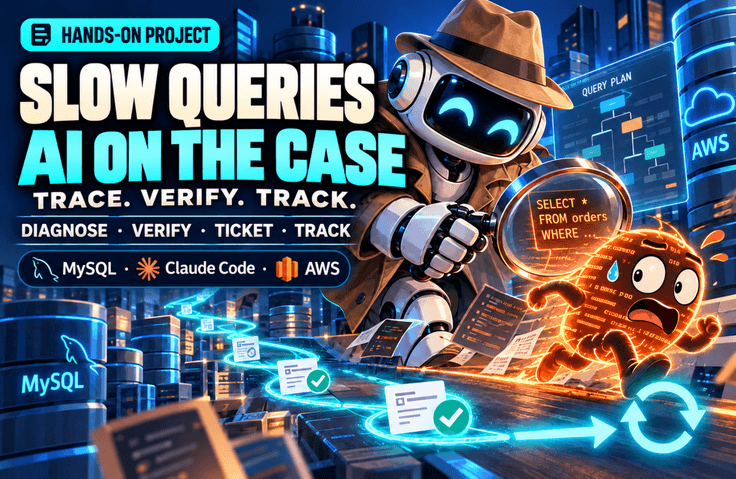
MySQL Query Tuning Automation: From AI Diagnosis to Recurrence Tracking

After learning SQL tuning, automate recurring tuning tasks. This hands-on project connects everything from collecting MySQL queries to AI diagnosis, empirical validation, handoff to the person in charge, and tracking recurrence.

1 learners are taking this course

Level Intermediate

Course period Unlimited

Python
Python
SQL
SQL
AWS
AWS
MySQL
MySQL
grafana
grafana
Python
Python
SQL
SQL
AWS
AWS
MySQL
MySQL
grafana
grafana

What you will gain after the course

  • Create a query priority table based on total load and execution count, and record the reasons for accepting, rejecting, or deferring AI suggestions.

  • Connects on-site verification, handoff to the person in charge, improvement, and recurrence tracking, and completes a post-action performance report.

MySQL Query Automation: From AI Diagnosis to Recurrence Tracking

After learning SQL tuning, automate repetitive response tasks. This hands-on project connects everything from MySQL query collection to AI diagnosis, validation, handoff to the person in charge, and recurrence tracking.

From collection to recurrence tracking, all in one flow

Query collection → AI diagnosis → Benchmark validation → Assignee ticket → Resolution and recurrence tracking

  • Collection: Store snapshot differences in performance_schema cumulative values and prioritize responses based on execution count and total load.

  • Diagnosis: Review execution plans and improvement suggestions using read-only evidence tools and Claude Code.

  • Validation: Measure result consistency and performance before and after a single ADD INDEX operation in a separate DB, then roll back the index.

  • Handoff: Link the CMDB owner information with existing tickets to prevent duplicate issuance.

  • Tracking: Record post-resolution observations and recurrence status in Grafana reports and work logs.

Indexes in the production DB are not applied automatically. The validation results and change plan are documented, and actual production changes undergo human approval and review.

Four deliverables completed after taking the course

  • Query prioritization table: Compare average execution time, frequency, and total load, and explain the priority targets and reasons for exclusion.

  • AI Recommendation Validation Record: Verify result equivalence, execution plans, before-and-after measurements, and rollback conditions, then document the rationale for adoption, rejection, or deferral.

  • Owner request form: Link the target cluster, query fingerprint, responsible team, and existing ticket.

  • Post-implementation performance report: Record whether it was actually applied, the observation conditions and sample, improvements, deteriorations, recurrences, and next steps.

Getting Started + 7 Learning Sections, 8 Sections Total

  1. Getting Started · Learning Materials and Practice Path: Check the learning sequence and scope of verification.

  2. Prepare observability criteria and the hands-on environment: distinguish average time, execution count, and total load.

  3. Execution plans, indexes, and query tuning decisions: Practice reading execution plans and improving indexes and queries.

  4. Collection, detection, and CMDB integration: Configure snapshots and detection rules, and distinguish collection gaps from actual non-execution.

  5. Claude Code diagnostics and real-world validation: Review AI suggestions and measure their effectiveness in a separate database.

  6. Owners, tickets, resolution, and recurrence tracking: Link duplicate prevention with resolution and recurrence statuses.

  7. Grafana · outcome logging · operational changes: Visualize observability results and record implementation details and outcomes.

  8. Comprehensive assessment project and AWS expansion: Complete the comprehensive project and explore cloud expansion paths.

59 lessons · 2 hours 41 minutes of video. In addition to watching the videos, time is required to prepare the environment and complete the hands-on exercises and assignments.

Practice validation and post hoc judgment through 9 scenarios.

It covers cases involving changed results, collection gaps, no execution, unused indexes, environmental changes, rollbacks, improvements, deteriorations, and non-application. It explains what additional evidence is needed using synthetic cases, answer templates, explanations, and evaluation rubrics.

Automatic grading checks whether the required items match the judgment codes. The quality of the explanations is reviewed separately using a rubric, and passing the assignment does not mean obtaining an official qualification or approval for operational changes.

Preview the actual lessons before purchasing

In the curriculum below, you can preview “01-01 Course Introduction” (3 minutes 36 seconds) and “01-06 What Should We Fix First? Prioritizing by Total Load” (2 minutes 30 seconds).

A separate promotional video of approximately 1 minute and 41 seconds includes about 90 seconds of actual class excerpts. The promotional video and the free class preview are different videos.

The course uses locally synthesized male AI narration. The main course includes optional Korean subtitles, as well as separate SRT files and a script, so please check the explanation speed and pronunciation in the preview.

Recommended for these people

  • Backend developers who want to read SELECT·JOIN and automate responses to recurring slow queries

  • DBAs, SREs, and platform engineers looking to connect diagnosis, handoff to the person in charge, and post-incident monitoring

  • Technical leads who want to determine whether to apply AI recommendations based on evidence and real-world measurements

Basic SQL and indexing concepts, terminal commands, and the fundamentals of Python virtual environments are required. For an introduction to SQL syntax and preparation for the SQLP exam, a separate foundational course is recommended.

Practice Environment and Additional Costs

  • Account-free decision-making assignment: Get started with Python 3.10 or later and an editor. Use only the Python standard library; no external APIs or cloud accounts are required.

  • Local MySQL practice: Docker or a separate MySQL environment and Python are required. Since 2 million synthetic order rows are used, please ensure you have sufficient memory, disk space, and available ports. Execution time and query plans vary by environment.

  • Run a new AI diagnostic: Claude Code authentication and read-only practice tools are required, and service usage fees are charged separately. You can also learn from the recorded results.

  • AWS extended practice: Terraform and CLI, an approved AWS account, permission to delete resources, and model access are required, and additional charges apply upon deployment.

Provided materials and AWS supplementary sources

It includes 59 lessons totaling 2 hours and 41 minutes of video, SRTs and scripts, a workbook, key concept check questions, synthetic assignments with explanations, a decision rubric, four types of work record templates, and installation, verification, and deletion instructions.

We also provide supplementary AWS resources that verify collection and detection in a separate synthetic RDS environment, internal tickets, Bedrock diagnostics, and the addition and removal of verification indexes, along with resolution and recurrence tracking. Check the execution records, tests, and verification scope by specification in the public AWS supplementary sources and documentation.

Full redeployment and benchmarking under the latest minimum specifications, actual Jira·Slack transmissions, long-term recovery, and migration to existing production databases are subject to separate verification. Execution results and AI responses may vary by environment. Model weights, company operational data, and authentication values are not included in the provided materials.

Questions Before Purchase

Does the AI automatically apply indexes to the production database?
No. We verify them in a separate validation database and roll them back. AWS apply-plan creates a change plan, while actual production changes undergo human approval and review.

Can I get started without an AI account?
Yes. You can start with recorded results and account-free synthetic decision-making tasks. Separate authentication and costs are required to run new AI diagnostics or AWS deployments.

Do I need to achieve the same performance as in the example?
It varies depending on the data distribution, statistics, optimizer, and execution environment. You will learn how to compare result consistency, execution plans, and before-and-after measurement evidence under identical conditions.

How are questions answered and updates provided?
The access period is unlimited. For six months after purchase, we support questions and answers about the course content and provided examples, and respond within seven days of receiving a question. We will correct any identified errors in the lectures and exercises for six months after release. Individual tuning of your company's operational database, deployment services, and integration with individual systems are not included in the support scope.

Introducing the instructor, Data Mastermind

I’m a data expert with over 20 years of experience in databases and IT. I have worked as a DBA and DB Platform team manager in the gaming, finance, and IT services industries, handling SQL tuning and database platforms. I created this course to connect the collection, diagnosis, validation, handoff to the responsible person, and follow-up tracking of recurring query issues. I’ll also share practical automation workflows and criteria for validating AI suggestions.

Recommended for
these people

Who is this course right for?

  • A backend developer who can read SQL and wants to automate recurring query tuning requests

  • DBAs, SREs, and platform engineers looking to validate AI recommendations and connect owners, tickets, and improvement tracking

Need to know before starting?

  • Basic SQL SELECT, JOIN, and WHERE and Index Concepts

  • Ability to read Python code and terminal commands. Local practice requires Docker, while AWS expansion requires a separate account and incurs costs.

Hello
This is dorian05202988

Career Verified

I am a data professional with over 20 years of experience in databases and IT. As a DBA and manager of DB Platform teams, I have worked with database platforms and specialize in MySQL, PostgreSQL, Oracle, MongoDB, SQL tuning, AWS, Terraform, and Python. Drawing on experience in gaming, finance, and IT services, I explain database and cloud architectures. I have published *Practical Oracle Tuning: Learning SQL Patterns* and *A Practical Guide to Oracle Pro*C Projects*, and presented on serverless architectures, database selection, and multi-database strategies at AWS Summit 2018 and 2019 and Data Is Fun 2020. Recently, I have been working on slow-query analysis and tuning recommendations using Bedrock LLM, database specification estimation automation, and query workflows through a DB metadata MCP server and Slack bot. In this course, I explain the end-to-end process—from collecting MySQL queries through AI diagnosis, empirical validation, handoff to the person in charge, resolution, and tracking recurrence—using publicly available supplementary source code and synthetic data. Rather than applying AI suggestions as-is, I share criteria for verifying result equivalence, execution plans, and observability conditions, as well as when to put a recommendation on hold if the supporting evidence is insufficient. Company operational data and authentication credentials are not included in the course materials.

More

Curriculum

All

59 lectures ∙ (2hr 41min)

Course Materials:

Lecture resources
Published: 
Last updated: 

Reviews

Not enough reviews.
Please write a valuable review that helps everyone!

Similar courses

Explore other courses in the same field!

Limited time deal

$18.70

68%

$59.40