

Master calculus 2 using Python: integration, intuition, code
Mike X Cohen
Theory, numerical approximations, intuition, and visualization in integral calculus. Enhance your math-coding skills.
Beginner
Python, Numpy, Integral Differential
Develop a deep understanding and intuition for calculus. Solve problems and implement algorithms by hand and in Python.
35 learners
Level Beginner
Course period Unlimited
Understand differential calculus
Explore mathematical functions – rational, polynomial, transcendantal, trig
Limits and tricks for solving limits problems
Differentiation rules and proofs
Tips and tricks for differentiation
Python (NumPy and SymPy)
Practice applied calculus
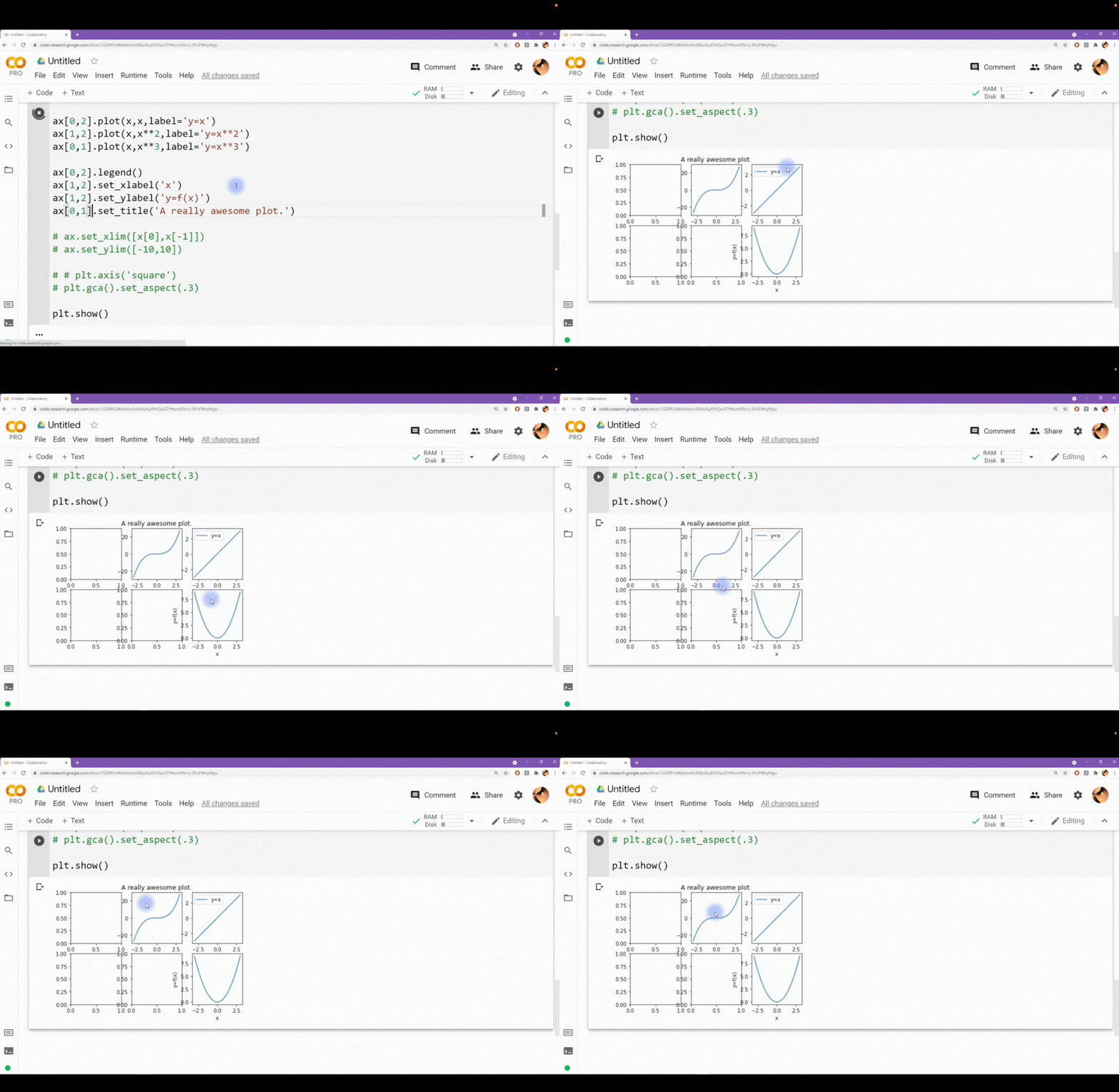
Visualizing math functions (matplotlib)
Calculus is a beautiful topic in mathematics. No, really!
At its heart, calculus is about change. Life is full of change, and calculus is the language that humans developed (invented or discovered – that's an ongoing debate!) to understand how physical, biological, and abstract systems change. Calculus is more than just some equations you have to memorize; it's a way of looking at the world and trying to understand how the tiniest infinitesimal changes can lead to gigantic complexity bigger than the imagination.
OK, but aside from all that fluff, calculus is also really important for basically every piece of engineering and digital technology that has touched humanity. Indeed, the history of calculus is the history of civilization.
You want to learn data science? → You need calculus.
You want to learn machine-learning? → You need calculus.
You want to learn deep learning? → You need calculus.
You want to learn computational science? → You need calculus.
💡You want to learn... I think you see the pattern here ;)
There are three reasons to learn calculus:
📌 It has applications for understanding data science and machine-learning algorithms, but it's also a beautiful topic in its own right.
📌 Learning math will train your critical thinking and reasoning skills. Any branch of mathematics will train your brain, but calculus especially so, because doing calculus is a lot of like running scientific experiments – generate hypotheses, test them in experiments by holding variables constant, and measuring the output.
📌 It's a better hobby than sitting around watching netflix. Seriously. Learning math will help protect you from age-related cognitive decline. Challenge your mind to keep it sharp!
🗣️ So, how do you learn calculus?
You can learn it the way most people do – by watching someone else scratch on a chalkboard while you furiously take notes and try to decipher their sloppy handwriting, all the while having a little voice in your head telling you that you don't get it because you're not smart enough.
OR you can try a different approach.
I follow the maxim "you can learn a lot of math with a bit of coding."
In this course, you will use Python (mostly the numpy and sympy libraries) as a novel tool to help you learn concepts, proofs, visualizations, and algorithms in calculus.
1️⃣ Practical applications: Calculus is essential for understanding data science, machine learning, deep learning, computational science, and many other fields.
2️⃣ Mental exercise: Learning calculus, particularly in combination with Python, will train your critical thinking and reasoning skills.
3️⃣ Lifelong benefits: Engaging your mind with calculus can help protect against age-related cognitive decline and offer a fulfilling alternative to passive leisure activities.
No, this course is not about coding math. And it's not about using Python to cheat on your math homework.

You will translate formulas into code and implement core calculus algorithms
You can gain a deep knowledge of concepts in calculus by solving challenging coding exercises
You will develop intuition for why functions behave the way they do through graphic engine in Python
You will learn the limits of computers for learning calculus, and why you still need to use your brain and freshly developed calculus skills

Python is a versatile and user-friendly programming language that complements calculus, especially when using libraries like NumPy and SymPy. By incorporating Python into your calculus studies, you can gain a deeper understanding of mathematical concepts, proofs, visualizations, and algorithms.
If you are new to Python, then don't worry!
This course comes with a 7+ hour Python coding tutorial (potentially up to 12 hours if you complete all the exercises) that is designed for beginners and will teach you the coding skills you'll need for this course.
1️⃣
Calculus students looking for better educational material
2️⃣
Mathematicians who want to implement math in code
3️⃣
Coders who want to use Python to learn math
Everyone knows that you need to solve math problems to learn math. This course has exercises for you to solve in nearly every video - and I explain the answers to every single exercise (not only the odd-numbered ones, lol).
But wait, there's more! I don't just give you problems to work on; I will teach you how to create your own exercises (and solutions) so you can custom-tailor your own homework assignments to practice exactly the skills you most need to work on. Because you know, "give someone a fish" versus "teach someone to fish."
One thing I've learned from 20+ years of teaching is that no two learners are the same, which means that no course will be right for everyone. I hope you find this course a valuable learning resource – and fun to work through! – but the reality is that this course won't be ideal for everyone. Please watch the preview videos and check out the reviews before enrolling.
Basic high-school math
NO programming experience needed
NO prior experience with calculus needed!
This course provides a certification of completion in a format suitable for resumes and portfolios.
By completing the course, you can receive this, which can serve as official proof of your learning accomplishments.
You can switch both audio and subtitles according to your learning style. Select your preferred language.
Who is this course right for?
Mathematicians who want to implement math in code
Anyone who wants to understand calculus intuitively and through real applications
Coders who want to use Python to learn math
Those looking for a modern, practical approach rather than traditional chalkboard-style lectures
Students who want to review or rebuild their understanding of college-level calculus
Anyone seeking a brain-stimulating hobby
73
Learners
6
Reviews
5.0
Rating
2
Courses
Independent educator, ex-neuroscience professor. I make courses and write self-paced textbooks on applied math, coding (Python and MATLAB), data science, machine-learning, deep learning, and LLM mechanisms.
My motto is "you can learn a lot of math with a bit of coding."
저는 독립 교육자로 일하고 있으며, 이전에는 신경과학 교수로 활동했습니다.
응용수학, 코딩 (Python 및 MATLAB), 데이터 사이언스, 머신러닝, 딥러닝, 그리고 LLM 메커니즘에 관한 강의와 자기주도 학습용 교재를 제작하고 있습니다.
저의 모토는 간단합니다. "코딩을 조금만 할 줄 알면, 수학을 훨씬 쉽고 많이 배울 수 있다."
All
175 lectures ∙ (41hr 15min)
All
3 reviews
5.0
3 reviews
Reviews 4
∙
Average Rating 5.0
Reviews 330
∙
Average Rating 5.0
Reviews 4
∙
Average Rating 5.0
Check out other courses by the instructor!
Explore other courses in the same field!