- "I use JPA because it’s convenient as an ORM."
- I know that calling save() saves it.
- I’m not really sure about the persistence context…
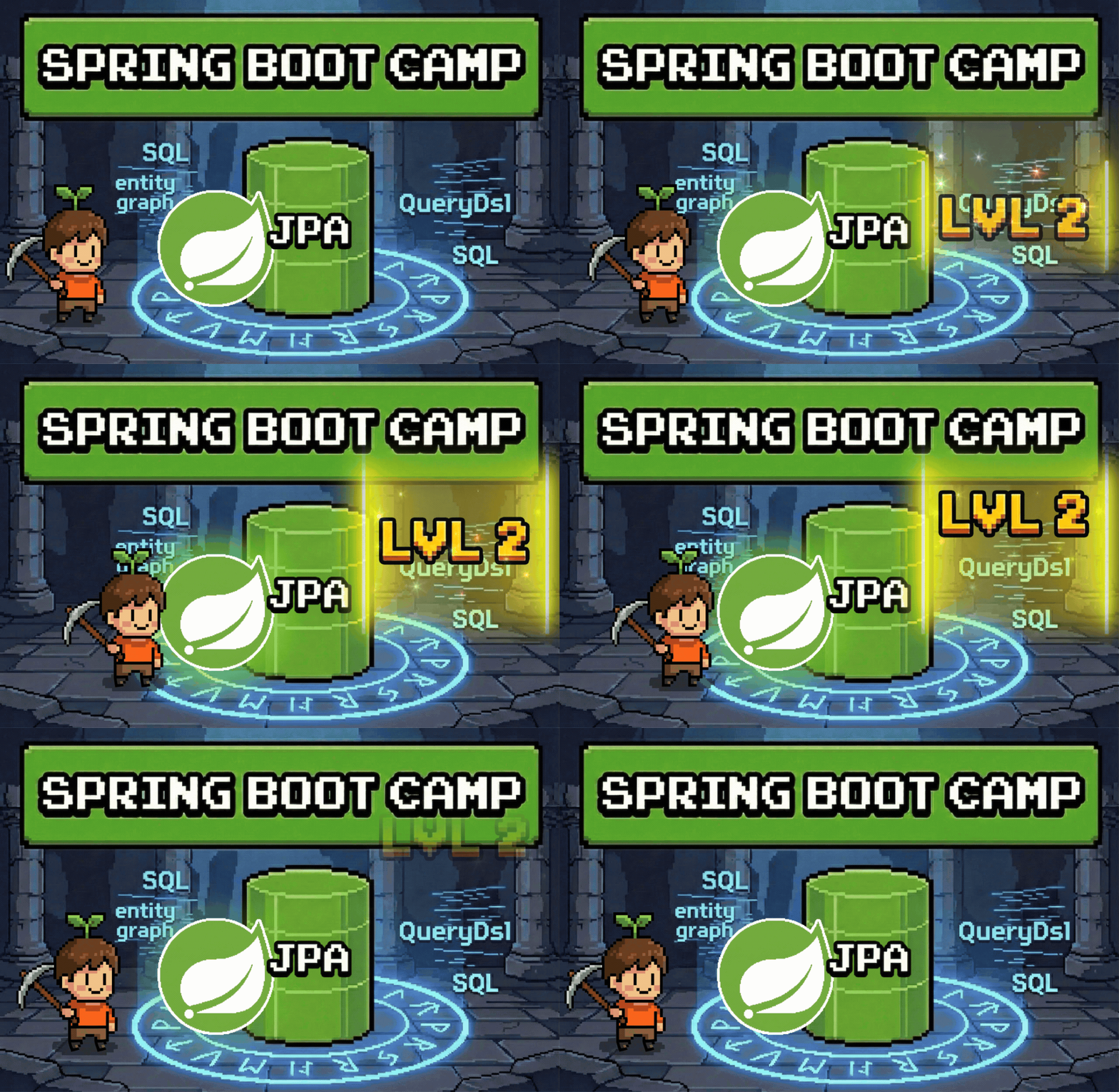
Complete Mastery of JPA for Professional Developers
Persistence Context ~ QueryDSL · Lv.2
🧠 Lv.2 · From the persistence context to real-world patterns
From Pain to Salvation: A Learning Method · Practical JPA
save() works, but
if you can't explain “why”, you'll fail.
For those who have done CRUD with JdbcTemplate but get stuck at “What is the persistence context?” Experience the pain of 35 lines of pure JDBC first, then realize the greatness of JPA and become a developer who can explain its inner workings through the “pain → salvation” learning method.
Simple query
35 lines of JDBC
3 lines of JPA
Target audience
Those who have used JdbcTemplate but don't understand the persistence context
Method
Pain → Salvation — 41 lessons over 5 weeks that you experience and understand firsthand
Results
Explain the “why” behind the persistence context, N+1, and QueryDSL
Why do I keep getting stuck again?
Most JPA courses teach only “how.”
"Add @Entity and use save()." It works if you follow along. But interviewers ask, "How does the persistence context work?" and "How did you solve the N+1 problem?".
save()만 알아요
You stop at “Just add @Entity and use save().”
내부를 몰라요
They cannot explain the principles behind the persistence context, N+1, and dirty checking.
JDBC를 안 겪었어요
Without experiencing the pain of writing 35 lines of JDBC, you won’t appreciate JPA.
This course deliberately puts you through the pain first. Only those who have personally written 35 lines of JDBC can explain why the persistence context is necessary.
🧠 Understanding JPA Through Metaphors
Core concepts, explained in a way you’ll never forget after hearing them just once.
Persistence context · write-behind · lazy loading · dynamic queries · N+1 · relationships — explained through analogies rather than code, revealing “what” and “why” in full.
영속성컨텍스트
"What is the persistence context?"
It is explained as a secretary that works through the first-level cache and dirty checking.
쓰기지연
"When does the INSERT go out?"
It responds that, like bundling packages together, they are collected and sent all at once., chúng được gom lại và gửi một lần.
지연로딩
"How does lazy loading work?"
Explains that the fake employee (proxy) loads when real work arises. sẽ tải khi có công việc thực sự phát sinh.
동적쿼리
"How did you write the dynamic query?"
Safely at compile time with QueryDSL Lego assembly..
N+1
"How did you solve the N+1 problem?"
We answer using three methods, including Fetch Join..
연관관계
"Why did you design @ManyToOne that way?"
We explain that mapping resolves the object–table mismatch. được giải quyết bằng ánh xạ.
Pain → Redemption · 5 Weeks
You have to experience it firsthand for it to be etched into your bones.
You must not learn save() first. Every week, you experience “pain → salvation” firsthand. After going through the 35-line hell and the N+1 explosion, the principles behind them will flow effortlessly in interviews.
1주차
With JDBC, I wrote 35 lines for a single SELECT.
After that pain, you’ll feel the revolution of three lines with the persistence context.
2주차
EnumType omission and data corruption caused by merge().
Safely protect against this with EnumType.STRING and change detection.
3주차
Fetching 10 members triggered 11 queries.
Experience reducing it to one query with a single line of Fetch Join..
4주차
I copy-pasted createdAt into every entity.
Inherit common fields with a single BaseEntity..
5주차
A typo in a JPQL string caused a runtime failure.
Catch it at compile time with QueryDSL. tại thời điểm biên dịch.
Before / After
The same questions and answers determine whether you pass.
- "When I tried doing it directly with JDBC, dealing with the mismatch between objects and tables was difficult."
- "The persistence context's first-level cache and dirty checking solved this."
- I answer N+1 with three approaches, including Fetch Join.
Lv.1 Next up
CRUD works, but I get stuck again in interviews.
I built CRUD with JdbcTemplate. But then the common path to rejection begins again.
1
I built CRUD with JdbcTemplate
2
“Why do we have to write SQL as a string?”.
3
Interviewer: "What is a persistence context?" "…Pardon?"
4
Rejected because you couldn't explain it, having never used it 😵
Backend Developer Roadmap
This course is the core of the roadmap, Lv.2.
If you’ve built a solid foundation in Spring Boot in Lv.1, it’s now time to master JPA, one of the most widely used technologies in real-world development.
Lv.0
데이터베이스 핵심 개념
Build a strong foundation before starting Spring.
Lv.1
Spring Boot 입문
Build APIs with Spring and prepare for interviews.
Lv.2
현업 개발자의 JPA 완전 정복 (이 강의)
From the persistence context to QueryDSL.
Lv.3
6주 완성 백엔드 이력서 돋보이는 법 ↗
Once you’ve equipped yourself with practical skills, it’s time to stand out with your résumé and get past the screening stage.
Maybe you’ve experienced this?
Have you ever experienced something like this?
Have you ever been at a loss for words when asked, "Can you explain the persistence context?"
Have you ever been unable to give more than one answer to “Have you solved the N+1 problem?”
Curriculum
5 weeks, 41 lessons · From the persistence context to QueryDSL.
Persistence Context → Entity Mapping → Relationships & Proxies → Inheritance & Value Types → QueryDSL. Experience each concept as “pain → salvation.” Click a section to view the detailed table of contents.
섹션 1. 🦸 1주차 · 영속성 컨텍스트, JDBC 고통 → 구원
- 1😱 The pain of pure JDBC: 35 lines for a single SELECT
- 2🦸 Persistence Context: The Savior That Solved the Pain
- 3📦 First-level cache: The secret to minimizing database access
- 4🔍 Dirty checking: I know what you changed
- 5📮 Write-behind: Batch it all at once
섹션 2. 🏷️ 2주차 · 엔티티 매핑과 Spring Data JPA
- 6🏷️ A Complete Understanding of @Entity·@Table·@Column
- 7🔑 Primary Key Mapping Strategies
- 8🚽 Flush: The Moment the Water Goes Down
- 9👻 Detached state: when the assistant leaves work
- 10🎁 The pitfalls of Spring Data JPA + save()·merge()
섹션 3. 🌍 3주차 · 연관관계와 프록시·지연 로딩
- 11🌍 Object World vs. Table World
- 12↔️ Unidirectional and bidirectional relationships and the rule of the owner
- 13⚡ Eager Loading vs Lazy Loading: Why Is LAZY the Default?
- 14🎭 Proxy: The Fake Object That Enables Lazy Loading
- 15👨👦 CASCADE·Orphan Removal
섹션 4. 🧬 4주차 · 상속 매핑과 값 타입
- 16🧬 Inheritance Mapping: JOIN vs Single-Table Strategy
- 17📋 @MappedSuperclass: Common Fields with BaseEntity
- 18💳 Real-world: Payment domain inheritance + AttributeConverter
- 19🎁 Value Types: Embedded and Immutable Objects
- 20📚 Limitations of Value Type Collections and Alternatives
섹션 5. 🏗️ 5주차 · QueryDSL 실무
- 21🏗️ Project Environment Setup and the Secrets of Q Classes
- 22🔎 Basic Syntax: Search · Sorting · Pagination · Aggregation
- 23🔗 Joins and fetch joins: The solution to N+1
- 24🚦 Dynamic Queries: BooleanBuilder and Multiple Parameters
- 25⚡ Performance Optimization: DTO Projections and Bulk Operations
Recommended for those who
If you can do CRUD but can’t explain what happens internally.
A good fit for you if
🙋
Those who have performed CRUD with JdbcTemplate but don’t know about the "persistence context"
🤔
Those who know save() but don’t know “what happens internally”
🧑💻
Those who can’t identify an N+1 problem when it occurs in their code
🎯
Those who want to answer “Explain the persistence context” based on experience
Those who need to align their expectations
- Those who are completely new to Spring and JPA (we recommend taking Lv.1 first)
- Those unfamiliar with Java syntax itself
- Those who insist on using only raw SQL without an ORM
Before Enrolling Reference
Lv.2 — You can get started with experience at the Lv.1 level.
01
Experience working with Spring, even briefly (completing the Lv.1 Spring Boot Introduction course is recommended). dù chỉ một chút (khuyến nghị hoàn thành khóa nhập môn Spring Boot Lv.1).
02
Experience with MySQL CRUD..
03
IntelliJ Community (free) is sufficient — available for both Windows and Mac, with installation instructions for each OS.
What You’ll Be Able to Do After the Course
By the end of the course, you’ll be able to do these four things.
We explain the internal workings of the persistence context's first-level cache and dirty checking..
Solve the N+1 problem in three ways, including Fetch Join. bằng 3 phương pháp, bao gồm Fetch Join.
Resolve the object-relational paradigm mismatch with relationship mapping., giải quyết sự không tương thích giữa mô hình đối tượng và mô hình bảng.
Create type-safe dynamic queries at compile time with QueryDSL..
Why this course?
Directly taught by a working developer who reached the final interviews at Coupang and Yanolja.
A sixth-year developer who made it to the final interviews at Coupang and Yanolja, and an instructor with a job-hunting story spanning 24 companies, teaches you directly.
Former server developer at Viva Republica (Toss) — explains the “why” from a perspective proven in real-world practice.
This isn’t a course that simply tells you “how” and leaves it at that—it connects concepts → hands-on experience → interview answers.
I run a developer employment community (KakaoTalk · Discord) and support students all the way through.

Student Benefits
Leave a course review and receive the JPA interview questions workbook.
🎁 Special Benefits for Students
We have compiled the course content into the [Lv.2] JPA Interview Questions Workbook (Notion link).
A Notion workbook of frequently asked interview questions and model answers on topics such as the persistence context, N+1, and QueryDSL—so you can practice directly.
JPA Interview Question Book
Notion Link Provided
Course Review Verification
How to receive it — Please verify your course review in the community. The verification method is provided in the final lecture of the curriculum, 🎁 EVENT🎁 How to verify your course review.
🎟 EVENT 2 — Submit the Google Form via the provided link and receive a 15% discount coupon.
💻 EVENT 3 — JetBrains collaboration benefit: a 3-month free IntelliJ license (promotion code: HYUNJOONPARKxJB, for new JetBrains users). The usage period is valid until December 31, 2026.
💬 KakaoTalk Channel Benefits
Add the Dingcodingco KakaoTalk channel and receive a 15% discount coupon.
💻 On PC, scan the QR code
📱 채널 추가하고 쿠폰 받기 →
On mobile, access it with just one tap.
※ Discounts cannot be combined.
FAQ
Expand only the sections you're curious about to check them.
JPA를 처음 보는데 들어도 되나요?
This course is Level 2. It assumes you have either tried CRUD with JdbcTemplate or have beginner-level experience with Lv.1 Spring Boot. If you’re completely new to JPA, we recommend starting with Lv.1.
따라하기 강의랑 뭐가 다른가요?
We deliberately make you suffer first. You’ll write 35 lines of pure JDBC for a single SELECT and experience the hell of 11 queries exploding due to N+1. Only then will you truly appreciate the power of three lines for the persistence context and a single line for a fetch join. This experience will help you craft interview answers that begin with, "I’ve experienced it firsthand."
실습 환경은 어떻게 되나요?
We use IntelliJ. The Community (free) version is sufficient, and it works on both Windows and Mac. We share the learning materials (Notion and PDF) and project code.
이 강의를 들으면 어디까지 할 수 있나요?
Master the JPA concepts most commonly used in practice—from the persistence context, relationships, proxies, inheritance mapping, and value types to QueryDSL. This is Backend Roadmap Lv.2, the next step after Lv.1 (Introduction to Spring Boot).
Don’t memorize it—be able to explain the persistence context, including ‘why.’
Only after suffering through 35 lines of JDBC can you appreciate the revolution of 3 lines of JPA. Only after experiencing N+1 hell will Fetch Join be etched into your bones. Five weeks from now, you’ll be giving answers that start with, "I’ve experienced it firsthand."





![Coding Test Bible [java]Course Thumbnail](https://cdn.inflearn.com/public/files/courses/338131/cover/01k03hbjrmebh2jdendasjtqnm?w=420)

![2026 Coding Test All-in-One [JAVA]Course Thumbnail](https://cdn.inflearn.com/public/files/courses/339641/cover/01kaycw3h9vr2qs2ed5j6p2f9m?w=420)
![1. Web Development Basics [HTML, CSS]Course Thumbnail](https://cdn.inflearn.com/public/courses/324886/course_cover/998919c5-399f-416c-9f57-c611ae178c51/html-css-basic-eng.png?w=420)