inflearn logo

Introduction to Saju Myungri: Reading My Destiny Through Twenty-Two Characters

Learn the basic structure of Saju Palja and the meanings of the Heavenly Stems and Earthly Branches, and study how to establish and interpret your own Saju using the Manseryeok (Ten Thousand Year Calendar). By understanding the Sipsin system and the flow of Daewun (Great Fortune) and Sewun (Annual Fortune), you will be able to read your own Saju and write an interpretation report in just 12 sessions.

3 learners are taking this course

Level Beginner

Course period Unlimited

Marketing Theory
Marketing Theory
Game Planning
Game Planning
reflection
reflection
parent-child
parent-child
self-attention
self-attention
Marketing Theory
Marketing Theory
Game Planning
Game Planning
reflection
reflection
parent-child
parent-child
self-attention
self-attention

What you will gain after the course

  • Understanding the structure of the four pillars of Saju and the properties of the twenty-two characters of the Heavenly Stems and Earthly Branches

  • Establishing Saju through the Manseryeok and interpreting the role of each character using Sipsin.

  • Analysis of periodic trends and preparation of interpretation reports applying Daewun (Great Fortune) and Sewun (Annual Fortune)


Reading Myself:
First Steps into Saju


Did you feel lost because you couldn't understand the meaning of the characters even after opening a Saju app?


I also learned through over 20 years of handling servers and large-scale payment service infrastructure that complex structures can only be read when there is an order and a standard.
In this lecture, we will set up the four pillars using the Manseryeok, connect the Heavenly Stems, Earthly Branches, and the Ten Gods to

directly read your own Saju and organize it into an interpretation.

By following the flow of the Great Fortune (Daeun) and Annual Fortune (Seun), experience Saju not as a prediction, but as a map for understanding yourself.


What you can gain from this course

Read the flow of your life through twenty-two characters.

The roles of the four pillars and the heavenly stems/earthly branches can be learned so that you can explain the structure of your own Saju (Four Pillars of Destiny). Rather than vague interpretations, you will establish criteria for reading the relationships between the characters.

You will construct your own Saju chart using the Manseoryeok (Ten Thousand Year Calendar) and interpret the role of each character using the Ten Gods (Sipsin). By applying the Daewun (Great Fortune) and Sewun (Annual Fortune), you will organize the flow of each period and complete a full written interpretation.

Saju is not a book of prophecies, but a map for examining the flow of life. From the perspective of an engineer who has structurally analyzed complex servers and the causes of failures for over twenty years, I will break down difficult concepts according to order and standards.

After completing the course, you will be able to establish your own Saju and explain it through interpretation.
I will alleviate the points that felt overwhelming when first learning and provide a standard for you to continue your studies on your own.


An engineer who used to track down late-night system failures encountered Saju (Korean astrology).

I have operated Linux servers for over 20 years and migrated data centers to the cloud.

I monitored hundreds of instances in large-scale payment services and tracked down the causes of failures every dawn.

Even complex systems reveal answers when you break down their structures and roles. Similarly, in Saju, one must first examine the relationships between the four pillars and the twenty-two characters.

Even those who felt overwhelmed by the characters displayed on the app can complete their own interpretation by following the flow of the Manseryeok, Sipsin, and the major and yearly cycles.

Learn the meanings of the twenty-two characters and establish the structure of the four pillars. Instead of vague fortune-telling, you will gain a standard for reading the flow. Start by looking at the first character today.


Curriculum Structure

Reading Saju with Twenty-Two Characters

Section 1

Lecture Introduction and Introduction to Saju Myungli

It introduces the basic concepts of Saju Myeongri and guides you through the learning scope and direction covered in the lecture. It provides a foundational perspective so that learners new to Saju can understand the overall content.

Section 2

Target Audience and Overall Roadmap

This explains the purpose of the learners who want to study Saju Myeongri and how to utilize the lectures. It presents a comprehensive roadmap for the order in which the core contents of Saju Myeongri will be studied over 12 sessions.

Section 3

The structure of Saju Palja and the four pillars

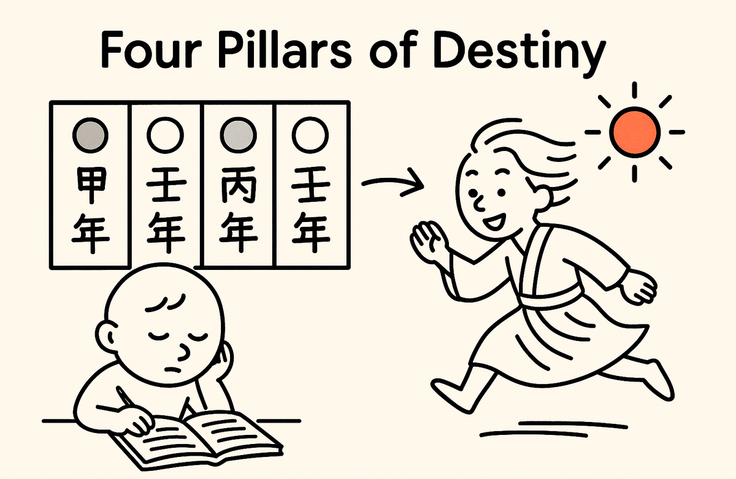
Understand what Saju is as a field of study and adopt a perspective that views Saju not as a prophecy, but as a map for reading the flow of life. Learn about the four pillars—the Year, Month, Day, and Hour pillars—and the meaning represented by each pillar.

Section 4

Basics of Heavenly Stems, Earthly Branches, and Manseryeok

You will learn the system of the twenty-two characters—the Heavenly Stems and Earthly Branches that make up Saju Palja—and the principles of their classification based on Yin-Yang and the Five Elements. You will also master how to establish a Saju profile using the Manseoryeok (Ten-Thousand Year Calendar) and the concept of the Saju New Year based on Ipchun (the onset of spring).

Section 5

Efficient Learning Methods and Common Mistakes for Beginners

We provide a learning sequence and a 100-day roadmap for systematically studying Saju Myeongri. We will examine common mistakes beginners often make and summarize the core content that must be remembered from the first lecture.

Section 6

Understanding the World Through Yin and Yang

You will learn how to view worldly phenomena and energies as different properties through Yin and Yang, the basic classification principle of Saju Myeongli. Following this, you will establish the foundational concepts for understanding the relationship between the Heavenly Stems, Earthly Branches, and the Five Elements.


Who this course is for

Recommended for the following people

Beginners who find the meanings of the characters confusing even when looking at a Saju (Four Pillars of Destiny) app

Those who want to establish their own Saju (Four Pillars of Destiny) using a Manseryeok and write their own interpretations.


Notes before taking the course


Practice Environment

  • You can take the course on Windows, Mac, and Linux.

  • You will need a device to use the Manseryeok (perpetual calendar) service.

  • A basic computer with an internet connection is sufficient.

Prerequisite Knowledge and Important Notes

  • Prior knowledge of Saju Myeongrihak is not required.

  • Please check your date of birth and birth time.

  • Saju should be approached as a tool for reading flows rather than as a means of prophecy.

Learning Materials

  • Use the learning materials that summarize the lecture content.

  • Check the Manseryeok screen and the Saju birth chart together.

  • It is helpful to prepare summary tables for the Heavenly Stems, Earthly Branches, and Ten Gods.


Recommended for
these people

Who is this course right for?

  • Beginners who are encountering Saju Myeongri for the first time and want to learn systematically from the basics.

  • Learners who have used Saju apps but struggle with interpretation because they do not know the meaning of the characters.

  • Those who want to understand their own and others' temperaments and develop Saju (Korean astrology) into a hobby or side job.

Need to know before starting?

  • None (No knowledge of Chinese characters required)

  • Manseuryeok (perpetual calendar) app or website available

  • Information about one's date and time of birth

Hello
This is jjangkbg7719

Career Verified

506

Learners

33

Reviews

2

Answers

4.8

Rating

22

Courses

Hello, I'm Frank.

I am an infrastructure engineer who has been wrestling with servers for over 20 years. Starting with Linux server operations, I am now in charge of the cloud infrastructure for a large-scale payment service. My daily life involves migrating from data centers to AWS, managing hundreds of instances, and tracing the causes of failures in the early hours of the morning.

The reason I created this course is simple.

I often received questions like these from those around me: "I managed to connect to the server, but I don't know what to do next." "There are so many instance types; which one should I choose?" These are the exact same points where I got stuck at first. However, when I looked for resources, I found that most of them were written for people who already knew what they were doing.

So I decided to create the course I wish I had when I first started learning.

My lectures are based on three principles.

First, I help you understand rather than memorize. Instead of just listing commands, I explain why we use them in the first place.

Second, I boldly omit unnecessary content. I do not increase the volume by including information that is useless to beginners right now.

Third, I also talk about what doesn't work. Instead of just listing the pros, I clearly point out cases where it might not be a good fit. For someone who has to make decisions in the field, that is more important.

If you feel a sense of "Ah, I should start from here" after listening to the lecture, then my goal has been achieved.

Please feel free to leave any questions you may have at any time.

More

Curriculum

All

20 lectures ∙ (28min)

Course Materials:

Lecture resources
Published: 
Last updated: 

Reviews

Not enough reviews.
Please write a valuable review that helps everyone!

jjangkbg7719's other courses

Check out other courses by the instructor!

Similar courses

Explore other courses in the same field!

Limited time deal

$3.30

62%

$8.80