inflearn logo

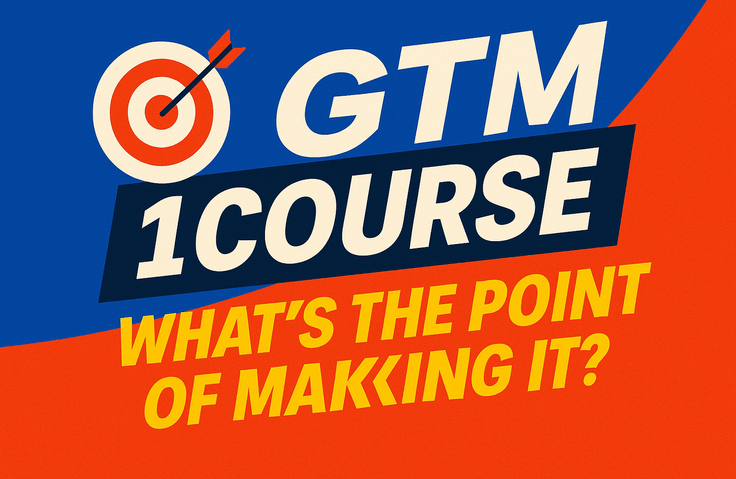
GTM (Go-To-Market) 101 Course | What’s the point of making it if you don’t make money?

Selling once is luck; selling repeatedly is strategy. Most teams already have behavioral data piling up, yet fail to ask it the right questions—and miss the people who are ready to buy. This course connects the entire process in one continuous flow: choosing a market (ICP·segments), designing value (positioning·pricing), and directly engineering a repeatable revenue engine with data (PQL·triggers·RevOps). The goal is not to memorize a “formula that always works.” Instead, you will develop transferable skills and strengthen your understanding of theory (applied management science, statistics, business administration, and marketing) through hands-on practice—skills that remain applicable even as the company, product, or customer changes. Drawing on experience designing the GTM strategy of a profitable unicorn as Gamma’s Senior GTM Strategy Manager, as well as real-world PLG cases such as Railway, we break them down not as “answers to copy,” but as “mirrors that reflect the theory.” By the time you complete the course, you will have not just a convincing document, but a system that actually works.

9 learners are taking this course

Level Beginner

Course period 1 months

    Service Planning
    Service Planning
    Project Management (PM)
    Project Management (PM)
    sales
    sales
    Business Plan
    Business Plan
    Information Strategy Planning
    Information Strategy Planning
    Service Planning
    Service Planning
    Project Management (PM)
    Project Management (PM)
    sales
    sales
    Business Plan
    Business Plan
    Information Strategy Planning
    Information Strategy Planning

    What you will gain after the course

    • GTM Playbook Tailored to My Product/Company (ICP · Segments → Value · Pricing → Motion · Funnel → Metrics Framework)

    • Working PQL scoring notebook (Python) — selecting signals through uplift analysis and implementing an 'interpretable linear score' from scratch

    • Event-Based Trigger & Routing Workflow (CRM Integration + ICP × Behavioral Dual Criteria)

    • Revenue Measurement Dashboard — MRR Movements, Cohorts, NRR, and Simple Forecasting

    • Practical skills for modeling behavioral data into account-level signals with SQL and dbt

    • The ability to identify and correct errors, biases, and label leakage in plausible AI-generated outputs

    • Principles and Theories Behind the Pricing Plan Strategies of Various Companies

    • A deliverable that can be applied directly to a company or used as a portfolio when applying for GTM engineer/RevOps positions

    Selling once is luck; selling repeatedly is strategy.

    Did your company’s product sell last year? If so—was it luck or strategy?

    It sells through personal connections, through the luck of getting media coverage, and through the CEO’s own legwork. The problem is what comes next. Do the second, third, and hundredth sales happen through the same structure? If not, that’s not revenue—it’s an episode.

    This course teaches the role that bridges that gap—GTM (Go-To-Market). You’ll learn to choose a market, design value, and directly engineer a repeatable revenue structure using data—four on design plus four on engineering, for eight core lessons.


    Why Doesn’t Your Product Sell Repeatedly?

    Most companies suffer from two illnesses.

    Vision sickness — selling only dreams without revenue. Meeting-room sickness — repeatedly debating internally without going to market. Both grow where "rigorous market validation" is missing.

    And an even more decisive truth. It’s not that your product doesn’t sell because you lack data. It doesn’t sell because you haven’t asked questions of the data. About 75% of PLG companies already have user behavior data but don’t use it for lead scoring. They have the oil, but they’re not drilling. This course will have you personally bridge that gap—the one between data and questions.


    This course does not sell a 'formula.'

    A course that says, "Just do this and your sales will increase," is a scam.

    Your company and the company next door have different products, different customers, and completely different markets, timing, and data. If all of these are different, can there really be a rule that always works? It simply doesn’t make logical sense.

    That’s why this course teaches not a formula for copying someone else’s conclusions, but transferable skills and theory that you can redesign whenever the context changes. Academically, GTM rests on four pillars — management science (decision-making, optimization, and measurement), statistics (signal selection, uplift, experimentation, and causality), business administration (strategy, organization, pricing, and finance), and marketing (positioning, segmentation, and channels).

    Every company case in this course (Gamma, Railway, Coupang, Slack, Zoom, Figma, Remember, LBox, Peloton, Samsung, and Watcha) is 'not an answer to copy' but 'a mirror reflecting the theory'. Rather than saying, "Let's do it like Gamma," take away the thinking process Gamma used to apply it to its own context.


    Recommended for these people

    • I sold it once, but I’m a founder or PM who relies on luck because I haven’t been able to build a ‘structure that sells repeatedly’.

    • Marketers, salespeople, and growth professionals who only accumulate white paper downloads (MQLs) while failing to convert, yet have never asked a single question in their behavioral data

    • Teams that miss their launch timing by repeatedly debating internally and focusing only on vision instead of going to market

    • In an era when AI is blurring job boundaries, PMs looking to transition into GTM/RevOps through market analysis, strategy, and data skills

    • Data and analytics professionals who have data but can’t connect it to 'so who to sell to and when'

    Especially if you're a PM: Now that AI handles spec documents, prototyping, and user stories, your next moat is market analysis, financial expertise, and strategic switching. The most natural next role for someone with all three is GTM. You don't need a tech background.


    What You’ll Have Upon Completion

    It is not documentation but a set of 4 working systems. You can apply them directly to your company or use them as a portfolio when applying for GTM engineering or RevOps positions.

    1. GTM Playbook — ICP & segments → value & pricing → motions & funnel → metrics framework

    2. PQL Scoring Notebook (Python) — working code that scores which users are likely to become enterprise customers

    3. Event trigger and routing workflow — automation that sends messages automatically based on scores and hands leads over to sales

    4. Revenue metrics dashboard — Measure recurring revenue with MRR, cohorts, and NRR

    Instead of saying “I took the course,” you’ll be able to say “I built this system”. If you don’t have data from your own company, you’ll follow the same process using the sample PLG SaaS 'OZ Deploy' provided for the course.


    The decisive reason this course is different

    ① It is designed on the premise that you will use AI. In an era when AI can produce a plausible ICP in five minutes, grading the output means grading your “copy-and-paste skills.” So we shifted the evaluation criteria from the final product → the process, judgment, and verification. There is one key question.

    "In the plausible answer AI gave you, did you recognize what was wrong? And why did you correct it that way?"

    ② We do not prohibit the use of AI. We prohibit hiding it. Submit every assignment together with an “AI collaboration log” (prompts, original responses, corrections, and reasons). Submitting AI-generated results without critical review will result in point deductions, while identifying and correcting errors, biases, and label leakage will earn high marks. An honest log is your learning data.

    ③ We assess your true ability with an “error injection test.” We provide a plausible but incorrect GTM deliverable, and you must use theory to identify what is wrong and why. AI is not good at catching its own errors—this is where human judgment shows.

    ④ Korea is currently a “GTM early-mover market.” There are hundreds to thousands of GTM positions in California and New York, while Seoul has only a handful. The problem is the same, but the job category does not yet exist—if this is not an early-mover opportunity, what is? (For reference, the global GTM salary floor is approximately $320K, with head-level positions around ~$400K.)


    Curriculum — 8 Core Courses, from Design to Engineering

    Orientation comes first, Synthesis & Capstone comes last, and the eight core lectures fill the space in between.

    Orientation — How to use this course: luck vs. strategy, AI evaluation principles, and capstone overview

    🧭 PART 1 — GTM Design (Lectures 1–4): Finalize "what to sell, to whom, at what price, and how"

    • Lecture 1. What Is GTM? — Roles, scope, and organization. Who, What, How, and When are GTM; Where and Why are not. RACI, vision sickness, and conference-room sickness

    • Lecture 2. Market and Customers — ICP, customer layering, and JTBD. The 3F trap, "How did you solve it when you didn't have it?"

    • Lecture 3. Value, Positioning, and Pricing — Price first, PMF next, estimating WTP, market dominance → pricing freedom

    • Lecture 4. GTM Motion, Funnel & Metrics — choosing PLG/SLG/PLS, the pitfalls of MRR·ARR vs. MAU·downloads

    🛠️ PART 2 — GTM Engineering & RevOps (Lectures 5–8): Turn strategy into a system

    • Lecture 5. Data Stack & Modeling — Turn behavior into account-level signals with SQL and dbt. "The oil is there, but you’re not drilling"

    • Lecture 6. The science of signals: uplift, label leakage, and PQL (the heart of this course) — Why an interpretable linear score beats complex ML models

    • Lecture 7. Triggers, Automation, and Handoffs — Drip → event triggers, ICP × behavioral dual conditions, and the structure behind open rates increasing from 27% to 50–70%

    • Lecture 8. Revenue Operations, Growth, and Experimentation — MRR movements, cohorts, NRR, and A/B causal inference

    🎯 Synthesis · Capstone — Validate without a product, global expansion (a linear equation: Korea vs. an Nth-degree equation), capstone presentation + peer review


    This is how you’ll learn it

    Since this is VOD, you can watch it in any order. However, please follow the dependencies—Lecture 6 assumes the data from Lecture 5, and Lecture 7 assumes the score from Lecture 6. Every lecture is complete as a three-part set: video + materials package (concept handouts, templates, notebooks, case explanations, and assessment sets) + assessment. The goal is to bring every learner up to at least Skill Achievement Level 3 (Correction). AI already handles Level 2 (Application).


    Instructor — Ahn Kwang-seop (Oswarld / Haebom)

    I’m not someone who only teaches theory; I’m someone who has personally established products in the Korean market and designed GTM strategies for Silicon Valley companies.

    • Notion Korea Head of Korea Launch and Community (2017~, 5+ years) — The essence of GTM for establishing a product in the market, learned firsthand

    • Gamma Senior GTM Strategy Manager — Go-to-market strategy for launching new features and expanding into markets for Silicon Valley products, plus playbook design

    • Kakao Brain (AI) · Nexon (gaming) · Hanwha Life Insurance (finance) · Reckitt Benckiser (consumer goods) — accumulated the “ability to read the board” by navigating diverse markets

    • Currently, Adjunct Professor at Sejong University (Business Analytics and Management Data Management), OBF Senior Lead Consultant

    • Korea University Master’s in Management of Technology·MBA / Author of books on Notion and AI papers (HEMA)

    In one line: "Create signals, not noise." The work of separating true signals from countless data points—that is how I work and what this course (Lecture 6, The Science of Signals) teaches.


    Pre-Course Information

    Prerequisites — Spreadsheet basics (required) / SQL SELECT·JOIN·GROUP BY (recommended; warm-up provided) / Python basics (recommended; notebook template provided) / Statistics as much as needed within the course.

    Tool stack — BigQuery·PostgreSQL / dbt / Python·Hex / PostHog·Amplitude / HubSpot·Salesforce / Customer.io·n8n·Clay. The exercises use the sample dataset 'OZ Deploy', but you can replace it with your own company data.

    We do not recommend this for people who want a “formula with the right answer that you can simply follow.” This course gives you not the answer, but the skill to design the answer yourself.


    After completing the 8 lectures, you will

    You will have a working system, not a document. And you will stand at the starting line as first-generation GTM in a position that is still vacant in Korea.

    Selling once is luck. Repetition is the strategy you’ll learn from now on.


    Recommended for
    these people

    Who is this course right for?

    • Founders and PMs who have sold something once but haven’t built a “structure for repeated sales” and are relying on luck

    • Marketers, salespeople, and growth teams who rack up white paper downloads (MQLs) without any conversions, yet have never once asked their behavioral data a question.

    • Teams that miss their launch timing by repeatedly discussing internally and focusing only on vision (meeting-room syndrome and vision syndrome) instead of going to market.

    • A PM looking to transition into GTM/RevOps through market analysis, strategy, and data skills as AI blurs job boundaries.

    • Data and analytics professionals who have data but can’t connect it to “so who should we sell to, and when?”

    • Builders who have created a product/service but don’t know how to sell it

    Need to know before starting?

    • Spreadsheet Basics (Pivot Tables & Functions)

    • SQL SELECT/JOIN/GROUP BY experience (warm-up materials provided)

    • Python Basics

    • This will proceed under the assumption that an artificial intelligence service (ChatGPT/Claude/Gemini or anything else) is being used.

    Curriculum

    All

    11 lectures ∙ (0min)

    Course Materials:

    Published: 
    Last updated: 

    Reviews

    Not enough reviews.
    Please write a valuable review that helps everyone!

    Similar courses

    Explore other courses in the same field!

    Access is restricted to non-public courses.