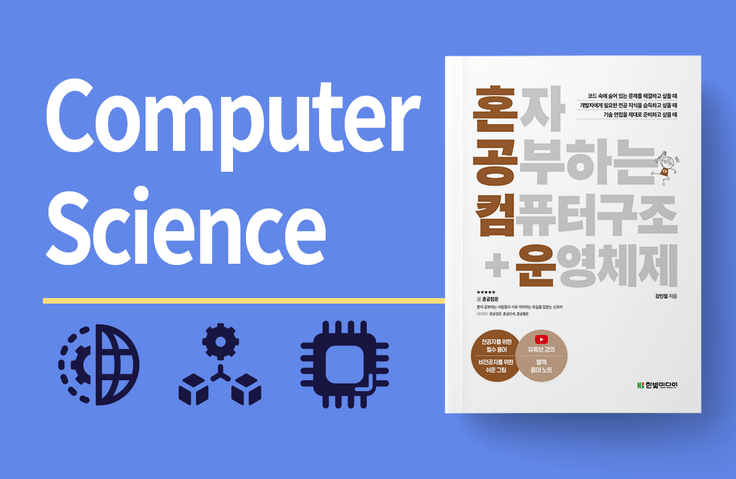
Computer Engineering for Developers 1: Computer Architecture + Operating Systems for Self-study
Bestseller 『Study Computer Architecture + Operating Systems on Your Own』 author's free lecture. A collection of computer architecture and operating systems books that developers must know.
I'm a CS major, and I purchased the book to review CS comprehensively for interview preparation during my job search, and I also took the course as a way to review the book since lectures were available.
The author has published three CS books: Computer Architecture + Operating Systems, Networks, and CS for Interview Preparation, and I plan to take all of them.
First, regarding opinions that the lectures are just reading the book, I agree, but I think for a free lecture, this quality is quite good.
I think it would be even more effective to read the book first, then review and organize while listening to the lectures.
Even though I'm from a university in Seoul, Computer Architecture and Operating Systems aren't subjects that are studied in great depth. Especially for Operating Systems, even when taught with the dinosaur book, each section goes so deep that it's hard to understand all at once, and since you have to rush through the material in one semester, you forget everything after it's over lol
Universities usually start from logic circuits and teach Linux too, but even when taught and learned with English materials, professors lecture on peripheral details, so it's hard to understand all at once.
However, this book and lecture exclude those peripheral details and teach exactly what's needed with an introductory feel, kind of like a sophomore-level course.
I think it's efficient to use what you learn here as a foundation, then study only the parts that will appear in actual interviews while looking at CS interview books.
Lastly, I think my college life would have been a bit easier if I had known about the author's books and lectures when I was in university..ㅜㅜ
Not all professors have good teaching skills.
Great lectures, thank you
5.0
전인호
93% enrolled
Now I'm writing a review. As a non-major who studied 5 months ago, it was so helpful.
For those who are taking this course, it seems like it's important to buy the book unconditionally.
Honestly, I think you could sell the course separately from the book.. ㅎㅎ
When I bought the book, there were short summary notes between the books~ Especially, the notebook I received was so cute that I used it well.
Now, I'm writing a review after stopping by to review because I'm starting to feel a little lost..
I highly recommend it to non-majors! And thank you for the great lecture.
Lastly, if I want to learn more about advanced learning, would it be good to look at something like a dinosaur book on operating systems? I want to learn more about advanced learning.. If you could tell me how to learn advanced learning about computer architecture, I would appreciate it. (I think you talked about advanced learning in the lecture.. I don't remember because it was 5 months ago.. I'm sorry if you talked about it in the lecture..)
5.0
무커
50% enrolled
I was finally able to understand the terms and names that I usually overlooked accurately thanks to the explanations. Thank you so much for providing such a high-quality lecture for free🙇🏻♂️
What you will gain after the course
Computer Engineering
CS knowledge
Computer Architecture
Operating system
Developer Background Knowledge
Essential Knowledge for Developers: Computer Architecture and Operating Systems All in one lecture! 😎
What developers must know A complete guide to computer architecture and operating systems 🙆
✔️ Core computer concepts that are difficult to learn with libraries alone
Learning programming language grammar and frameworks isn't everything 📖
Most error messages developers encounter and resolve stem from the operating system. Furthermore, the computer components and operating system are also responsible for executing the code developers write. Therefore, a thorough understanding of computer architecture and operating systems is essential for developers to deeply understand their code. This is why knowledge of computer architecture and operating systems is tested in various technical interviews.
CS knowledge is not a subject about memorizing keywords.
Memorizing keywords alone won't prepare you for the in-depth technical interview questions or translate your CS knowledge into code. This course is based on "understanding the principles," carefully selecting the essential content for developers from all available textbooks commonly used in universities. The content has been reviewed by professors and experienced developers.
Verified content, tons of recommendations 📖
Unlike other books that delve into the fundamentals of computer operation, typically requiring a thorough understanding of digital logic and a solid grasp of computer language, this book provides a comprehensive and accessible explanation of the operating system's functions, including the CPU, memory, auxiliary storage, input/output devices, scheduler, virtual memory, and file system, all with easy-to-understand illustrations. I highly recommend this book to anyone aspiring to become a software developer .
Lee Min-seok (currently a professor in the Department of Software at Kookmin University, former dean of the Innovation Academy)
Many books on computer engineering these days focus solely on programming, which has led me to worry that readers may lack a thorough understanding of the fundamental operating principles and architecture of computers. While this approach necessitates an introductory book on computer architecture, most existing books delve into the subject in a deeply academic manner, making them difficult to understand. This book offers a relatively accessible explanation of computer architecture, from the very basics to the in-depth understanding of CPU and hardware operating principles . I highly recommend this book to anyone aspiring to become an IT engineer, as it will help build a solid foundation.
Daehyeop Cho (Google Cloud Engineer)
I recommend this book to anyone new to programming, aspiring programmers looking to advance, or anyone with a genuine interest in computers. It explains the complex subject of computer architecture from the very basics, making it accessible even to beginners. Even non-programmers will find it easy to grasp.
Lee Sang-jun (CTO of Cloudbrick)
and many others
What you'll learn 📚
This lecture is largely divided into two parts: computer architecture and operating system .
The computer architecture section covers the four core components of a computer, while the operating system section covers what an operating system is and its role. This section provides explanations using a variety of diagrams and examples to ensure easy understanding for everyone .
Target Audience 🔑
Developers (or aspiring developers) who want to understand the principles of computers
Developers (and aspiring developers) who want to prepare for technical interviews
Developers (aspiring students) who want to learn CS knowledge/specialization knowledge
Developers (or aspiring developers) who want to learn computer architecture and operating systems
Things to note before taking the course 📢
Not much player knowledge is required.
However, if you have learned a programming language (Python, C/C++, Java, etc.), you will get even greater help.
Expected Questions Q&A 💬
Q. Since it is a free lecture, isn't the quality of the lecture low?
This course is of the same quality as any paid course.Despite providing essential background knowledge that all developers (and aspiring developers) should know, we've created it free for those who feel burdened by the exorbitant tuition fees.
Q. Do I need to have the book?
This is optional.However, this course is based on the book and does not provide any additional study materials.Therefore, if you would like study/review materials, we recommend purchasing the book from the link below.
I was finally able to understand the terms and names that I usually overlooked accurately thanks to the explanations. Thank you so much for providing such a high-quality lecture for free🙇🏻♂️
It's hard to believe that this is a free lecture, but it's of such high quality. I'm a non-major developer who feels like I lack basic skills, but it's really helpful that you explain things in an easy-to-understand way. T_T Thank you for the great lecture!!
Now I'm writing a review. As a non-major who studied 5 months ago, it was so helpful.
For those who are taking this course, it seems like it's important to buy the book unconditionally.
Honestly, I think you could sell the course separately from the book.. ㅎㅎ
When I bought the book, there were short summary notes between the books~ Especially, the notebook I received was so cute that I used it well.
Now, I'm writing a review after stopping by to review because I'm starting to feel a little lost..
I highly recommend it to non-majors! And thank you for the great lecture.
Lastly, if I want to learn more about advanced learning, would it be good to look at something like a dinosaur book on operating systems? I want to learn more about advanced learning.. If you could tell me how to learn advanced learning about computer architecture, I would appreciate it. (I think you talked about advanced learning in the lecture.. I don't remember because it was 5 months ago.. I'm sorry if you talked about it in the lecture..)
Thank you so much for your kind words..! If you want to study computer architecture in depth, you can look up the registers or instructions of a specific CPU (I uploaded it to the in-depth study repository), or you can look up the specifications of actual computer parts. If you want to study operating systems in depth, you can learn a programming language and then write a multi-threaded, multi-process program, or you can install a Linux operating system and learn through practice using various commands (profiling tools, etc.) that can check the internal operation of the operating system. Thank you again for listening.
I'm a CS major, and I purchased the book to review CS comprehensively for interview preparation during my job search, and I also took the course as a way to review the book since lectures were available.
The author has published three CS books: Computer Architecture + Operating Systems, Networks, and CS for Interview Preparation, and I plan to take all of them.
First, regarding opinions that the lectures are just reading the book, I agree, but I think for a free lecture, this quality is quite good.
I think it would be even more effective to read the book first, then review and organize while listening to the lectures.
Even though I'm from a university in Seoul, Computer Architecture and Operating Systems aren't subjects that are studied in great depth. Especially for Operating Systems, even when taught with the dinosaur book, each section goes so deep that it's hard to understand all at once, and since you have to rush through the material in one semester, you forget everything after it's over lol
Universities usually start from logic circuits and teach Linux too, but even when taught and learned with English materials, professors lecture on peripheral details, so it's hard to understand all at once.
However, this book and lecture exclude those peripheral details and teach exactly what's needed with an introductory feel, kind of like a sophomore-level course.
I think it's efficient to use what you learn here as a foundation, then study only the parts that will appear in actual interviews while looking at CS interview books.
Lastly, I think my college life would have been a bit easier if I had known about the author's books and lectures when I was in university..ㅜㅜ
Not all professors have good teaching skills.
Great lectures, thank you














![Structure and Principles of the Linux Kernel: Interrupt Bottom Halves [Author's Lecture Part 1-6]Course Thumbnail](https://cdn.inflearn.com/public/courses/333195/cover/3b8c8cd2-44b0-43b7-a441-b950ba367717/333195.png?w=420)

![Structure and Principles of the Linux Kernel: Interrupts [Author's Lecture Part 1-5]Course Thumbnail](https://cdn.inflearn.com/public/courses/333194/cover/79593ea5-0a6d-453a-8ead-a54103462943/333194.png?w=420)

![Learning Analog Circuits Through Flow, Not Formulas: 6 Steps to Understanding Filters and OP-AMPs [Theory Edition]Course Thumbnail](https://cdn.inflearn.com/public/files/courses/339176/cover/ai/1/cd937379-04b7-474d-9b91-0035de94ea0d.png?w=420)

![Developer Interview Preparation with Previous Questions [CS Complete Conquest]Course Thumbnail](https://cdn.inflearn.com/public/courses/328355/cover/27e0ac74-bab8-4561-a18a-eeb11101027d/328355-eng-resize.png?w=420)

![Structure and Principles of the Linux Kernel: Workqueues [Author's Lecture Part 1-7]Course Thumbnail](https://cdn.inflearn.com/public/files/courses/333196/cover/01k29sce7t2gm6wzc39gppy1cf?w=420)