



강의

멘토링

커뮤니티

Data Science

/

Data Analysis

Machine Learning + Deep Learning with Python (From machine learning using sklearn to deep learning development using TensorFlow and Keras)

From the basics of machine learning & deep learning! Creating and utilizing classification/regression/clustering/artificial neural networks with Python

(3.8) 8 reviews

220 learners

Level Basic

Course period 12 months

  • ilifo
Python
Python
sklearn
sklearn
Machine Learning(ML)
Deep Learning(DL)
Deep Learning(DL)
Keras
Keras
Python
Python
sklearn
sklearn
Machine Learning(ML)
Deep Learning(DL)
Deep Learning(DL)
Keras
Keras

What you will gain after the course

  • Concepts of machine learning and deep learning, main processes of machine learning

  • Methods to improve the performance of machine learning models: preprocessing, cross-validation, dimensionality reduction, early training termination

  • Various machine learning models such as regression/classification/clustering learned through practice

  • Characteristics, composition, and learning procedures of artificial neural networks

  • CNN and RNN, artificial neural networks for image and text processing

Let's properly utilize the artificial intelligence that I need.

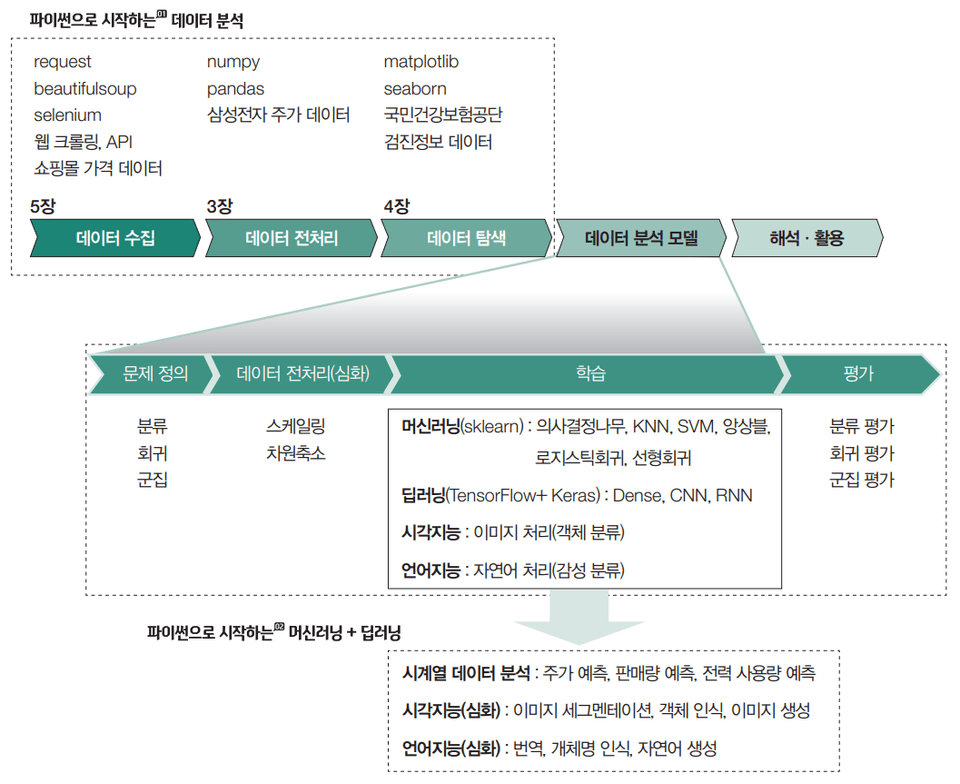
While data exploration using Pandas can be quite effective for understanding and analyzing data, data analysis models allow for more advanced mathematical and statistical algorithms to be applied for data analysis, yielding new insights that might not have been discovered through human experience or intuition. What we commonly refer to as machine learning and deep learning are data analysis models, and Scikit-learn , TensorFlow , and Keras are representative Python frameworks used to build data analysis models.

Data models are difficult to effectively utilize simply by understanding how to use packages. Understanding the process of creating data analysis models and the key features of algorithms is essential, as is understanding the process of designing models. In other words, a comprehensive understanding of the process of creating analysis models using various data types (numerical, categorical, image, text, etc.) is essential, along with a deep understanding of the algorithms that serve specific purposes.

This course covers the following machine learning and deep learning algorithms:

machine learning

  • Decision Tree,

  • KNN (K Nearest Neighbor)

  • SVM(Support Vector Machine)

  • Logistic Regressor

  • Random Forest

  • LightBGM

  • Linear Regressor

  • K-Means


Deep learning

  • Basic Neural Network (Dense)

  • Convolutional Neural Network (CNN)

  • Recurrent Neural Network (RNN)


We also cover the following elements for a well-running algorithm:

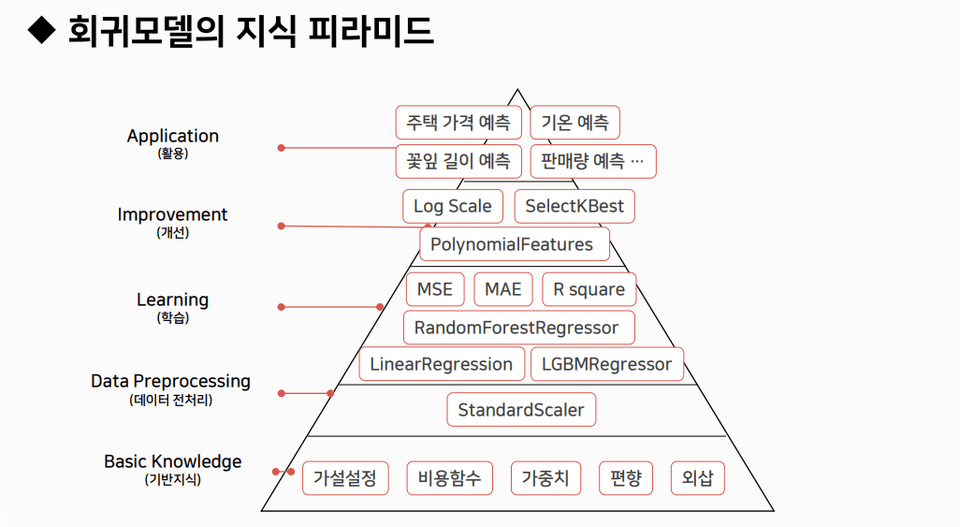
Model evaluation methods

  • Classification (accuracy, specificity, sensitivity, precision, ...)

  • Regression (MSE, RMSE, MAPE, coefficient of determination, ...)

  • Cluster (Silhouette Score)

Data-driven performance improvement methods

  • Cross-validation

  • Scaling

  • Dimension reduction


Model-based performance improvement methods

  • ensemble model

  • Hyperparameter tuning

  • Early termination of learning


Features of this course

📌 This is an introductory course for those who are new to machine learning and deep learning .

📌 You can quickly understand the overall modeling process with explanations based on the machine learning process .

📌 This is a practical Python course that will help you build a solid foundation in data modeling through various practical examples .

Machine learning and deep learning using scikit-learn, TensorFlow, and Keras

Before explaining machine learning and deep learning, this lecture will explain the algorithmic flow of each model based on the process . This will help you understand where the content you're learning fits into the overall process and why it's necessary, significantly reducing the time invested in understanding machine learning and deep learning models and grasping the overall flow. Starting with commonly used learning models for predictive and classification algorithms, you'll explore various machine learning and deep learning models, such as CNNs and RNNs, and hopefully gain confidence in utilizing artificial intelligence.

I recommend this to these people

NumPy and Pandas, what's next?
After completing the Python Basics course
I don't know what more I should learn
To those who have lost their way
A sneak peek into machine learning and deep learning

Those who dream of becoming data analysts
Such as prediction or classification models
From basic models to artificial neural networks,
For various analysis models
Based on a solid understanding
Be specific about your area of interest.

How can I easily use AI in my work?
Artificial intelligence is not a distant story.
Apply more advanced mathematical and statistical algorithms to conduct high-level data analysis.

Learn about these things.

Key concepts and processes of machine learning and deep learning

We will learn about the types of machine learning and the learning process, which will form the basis for future learning.

Practice with various machine learning algorithms

Learn how to create, evaluate, and improve various models, including regression, classification, and clustering, through hands-on practice.

Artificial Neural Network Configuration Practice

Learn about the characteristics of artificial neural networks, their learning process, and how to set them up for weight optimization.

RNN and CNN

Learn about CNNs, which excel at image processing, and RNN-based artificial neural networks for natural language and time-series data.

Based on the machine learning process, explanations are provided tailored to the characteristics of each model, making it easy for even unfamiliar models to understand and utilize what is required at each stage.

If you have laid the foundation for analysis with [Data Analysis with Python],

[Machine Learning + Deep Learning with Python] to utilize AI!

Things to note before taking the course

Practice environment

  • The training will be conducted based on Google Colab.

  • The machine learning example code in this lecture was written using Python Scikit-learn, and the deep learning example code was written using Keras + TensorFlow 2.8.0.

Recommended for
these people

Who is this course right for?

  • Those who have learned the basic grammar of Python but don't know what to do next

  • People who want to make their work easier with AI, which is a recent trend

  • Those who will become future AlphaGo developers

Hello
This is

282

Learners

18

Reviews

2

Answers

4.3

Rating

3

Courses

We are a data education company that develops and operates educational content in the fields of big data and artificial intelligence.

Instagram: https://www.instagram.com/ilifo0182/ YouTube: https://www.youtube.com/channel/UCYqYscK7l_1Z5AT1Of0KUkQ

Instagram: https://www.instagram.com/ilifo0182/

YouTube: https://www.youtube.com/channel/UCYqYscK7l_1Z5AT1Of0KUkQ

Curriculum

All

28 lectures ∙ (8hr 8min)

Course Materials:

Lecture resources
Published: 
Last updated: 

Reviews

All

8 reviews

3.8

8 reviews

  • youngjetak0889님의 프로필 이미지
    youngjetak0889

    Reviews 1

    Average Rating 5.0

    5

    100% enrolled

    It was helpful

    • dekman5505님의 프로필 이미지
      dekman5505

      Reviews 1

      Average Rating 5.0

      5

      61% enrolled

      It's so easy to organize your head.

      • whdrnr48736175님의 프로필 이미지
        whdrnr48736175

        Reviews 3

        Average Rating 5.0

        5

        32% enrolled

        • ruddms2229341님의 프로필 이미지
          ruddms2229341

          Reviews 1

          Average Rating 5.0

          5

          43% enrolled

          • yuhyunkim1884님의 프로필 이미지
            yuhyunkim1884

            Reviews 1

            Average Rating 3.0

            3

            100% enrolled

            $26.40

            ilifo's other courses

            Check out other courses by the instructor!

            Similar courses

            Explore other courses in the same field!