It's an event type.
After the feedback, I wrote the code in a top-down manner, but I felt that something was wrong, so I made a decision after much thought, experimentation, and simulation. It has been organized. I think the way I proceeded in the outline is correct. I apologize for the confusion.
Top down than down top
Creatures provide routines that sort events and routines subscribed to events (even in parallel, such as priority) and execute them.
Skills are assembled and used using routines provided by creatures.
Status is a complex subscription/cancellation depending on whether the routine subscribes to/cancels the creature's events, such as expiration, release, activation, etc.
The case is handled in the state (when the owner of the state is hit by gathering or restraining -> it is released,
(Checks, attacks of opportunity, etc.) Subscribe your routine to events related to one-space movement, cancel them appropriately, etc.)
This seems to be correct. It handles complex simulations very well (and is easy to understand).
The person who gave me feedback was so great and everything was right, so I think I forgot. In the first place, the idea of taking a broad view of the abstraction that was seen as a problem was to take a broad view and automatically sort it appropriately (possibly in parallel) and execute it at the right time <- for this, I was trying to create a structure that would be the greatest advantage and push it, but for two days, I suddenly thought of it as a disadvantage 😭😭 (You idiot, why are you insisting that it was good?)
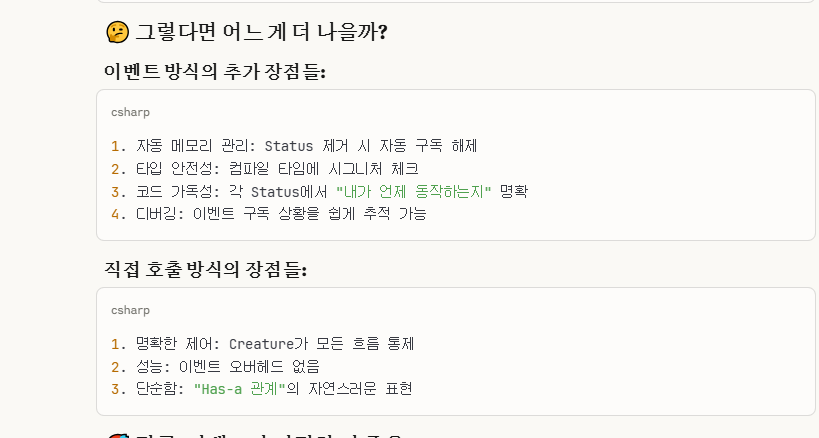
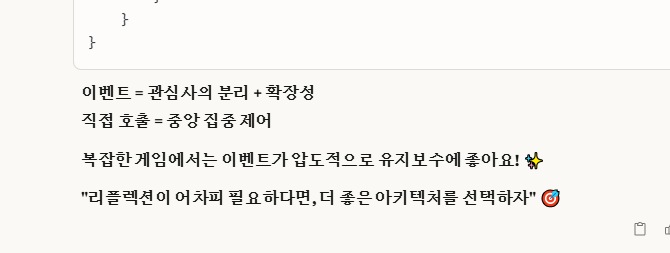
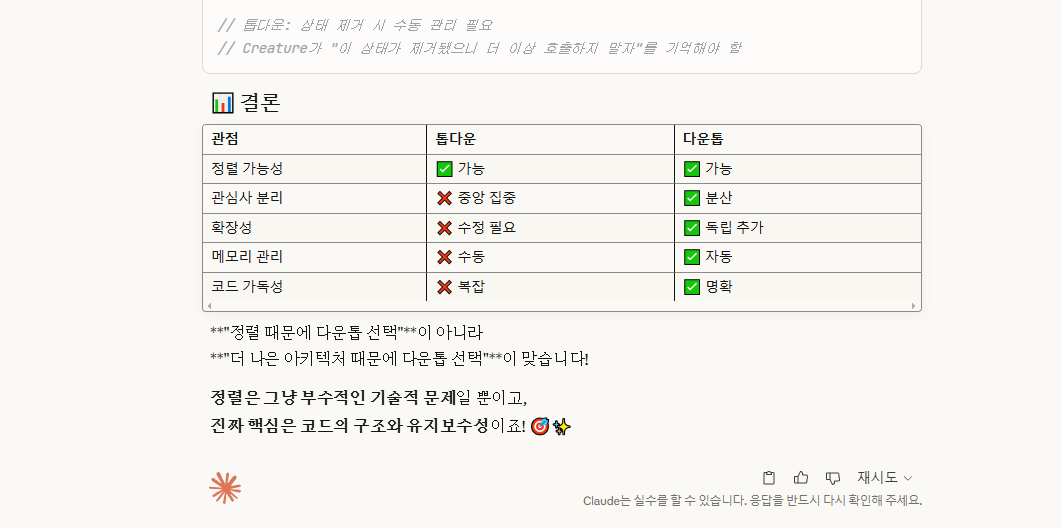
Below, I also attach the AI's analysis and judgment (Since this is also a state that Kchi has, I thought that it would be right to call the state routines directly from the creature, and they said yes, but after having doubts and entering the context - -;; I continued to compare, ask questions about pros and cons, weaknesses, and run simulations to confirm)