
Bitcoin Algorithm Trading Bot Development
Create your own revenue model with programming.
413 learners
Level Beginner
Course period Unlimited

News
3 articles
I previously created a Binance futures course, but due to various legal issues regarding foreign trading sites, I was unable to open the course. However, due to many requests for futures courses, I decided to upload it so that only the basic content can be referenced.
Currently, Binance does not support Korean, and the process for obtaining an authentication key has become more complicated than before. However, the rest of the content is the same as when the lecture was produced, so you should have no difficulty testing the Open API by watching the lecture.
The content uploaded this time is about the concept of futures and using Binance Open API. Those interested in futures trading can also develop a Binance futures trading bot by applying the Upbit trading bot.
We plan to reopen the entire course once Binance can be used domestically without legal issues.
The Binance Futures development environment setup is the same as Upbit, but you need to install the following additional packages:
pip install apscheduler
I wish all students the best of luck.
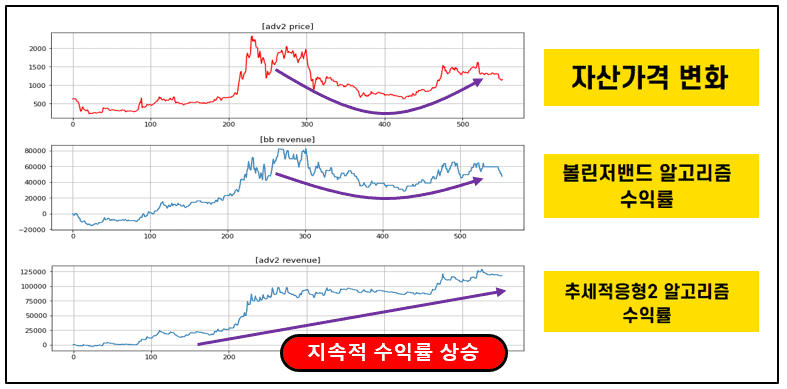
The basics of the trend-adaptive algorithm are the same as the Bollinger Bands algorithm.
The medium-term trend is determined by the 120-minute weighted moving average and the 480-minute weighted moving average.
The long-term trend is determined by the 702-minute weighted moving average and the 1440-minute weighted moving average.
The timing of purchase is determined based on the mid-term trend and the lower Bollinger Band, and the maximum number of purchases, profit-cut ratio, and loss-cut ratio are determined based on the long-term trend.
As a result of backtesting with 400,000 data, we were able to confirm that it is superior to the Bollinger Band algorithm in performance.
*2021.09.29: Modified robobits_adv2.py file
I couldn't create a 1440 minute moving average with 3 minute data, so I modified it to 5 minute data.
base_candle_url5 = "https://crix-api-cdn.upbit.com/v1/crix/candles/minutes/5?code=CRIX.UPBIT.{}&count=400" .format(coin_name)df5 = util.get_web_1m_data(base_candle_url5)
df[ 'wma120' ] = calc.get_wma(df[ 'c' ], 120 )
df[ 'wma480' ] = calc.get_wma(df5[ 'c' ], 96 ) #96*5=480
df[ 'wma720' ] = calc.get_wma(df5[ 'c' ], 144 ) #144*5=720
df[ 'wma1440' ] = calc.get_wma(df5[ 'c' ], 288 ) #288*5=1440We implemented a trend-following strategy using Bollinger Bands and conducted backtesting using approximately 400,000 data points.
Backtesting has shown a return of about 70% over 9 months, but in real life, losses may occur, so we recommend that you conduct sufficient testing before applying it to full-scale trading.
I've added a simple guide on how to choose an investment coin, how to use charts provided by exchanges, and how to interpret backtest logs.
We will implement and upload more algorithms in the future.
thank you

