If you want to know ERD, this seems like a good course.
It briefly explains how to use the workbench with examples.
I think it would be good if you think of it as a beginner level course.
5.0
이태곤
100% enrolled
It was a useful lecture
5.0
류재안
100% enrolled
Thank you for your hard work. These are the contents I really wanted to hear. The view part in DB is something I've never seen before, so I'll have to look it up later. I'm trying to implement a web app, but there aren't many lectures on DB design, so it's not easy to do it alone. Is there anything else I should listen to?
What you will gain after the course
Basic knowledge and examples for drawing ER models using a workbench
Detailed usage of I/E notation and modeling tools provided by Workbench
Forward Engineer feature to create tables from models
Deploying a model with data
Drawing ERDs with Workbench Getting closer to real-world practice! 🐬
MySQL Workbench?
MySQL Workbench is an application with ERD creation functionality that defines tables and relationships between tables in a database. It is utilized during the database design phase when implementing user services and defines collections of data (tables) and their relationships with each other (foreign keys).
Lecture Topic 📖
The data field should be approached from the perspective of 'sets' and 'relationships'. It is often said that 'the data field is something you only become interested in after experiencing several failures through projects such as building external systems'. This also means that the data analysis/design stage related to initial work is that important.
One of the tools that helps us view data from the perspective of sets and relationships during these analysis/design phases is ERD, and I happened to discover Workbench, an ER modeling tool provided by MySQL, which I'd like to introduce. In this course, we will teach you the overall knowledge and information needed for the process of drawing ERDs based on MySQL and then creating physical tables.
Broaden your perspective on other fields by applying data sets and relationships through the course. You'll be able to communicate with colleagues or clients through ERDs with sufficient design time. Additionally, you'll be able to predict and prepare countermeasures in advance even when data occurs in exceptional situations or there are errors in field data.
Have you ever had these concerns?
🥲 I thought the design was complete, but change requests keep coming in constantly.
🧐 Data modifications occur frequently in the service I'm operating. I don't know where to start looking for the cause.
🥺 I'm looking to start fresh in the data field, but I don't know what I should study first.
Join us with MySQL Workbench!
Through the process of drawing ERDs with Workbench, we emphasize the importance of 'data sets' and 'relationships' rather than just data.
Draw ERDs more easily with basic examples and systematic steps.
We chose MySQL database, which has a large user base, to provide an environment where you can easily transition to practical work.
You can explore the relationships between various data sets through one practical service ERD and six case-specific examples.
📢 Please make sure to check!
Some videos from the course can be watched for free on Youtube ("SQL Bank"). (After November 2025)
If you watch on Inflearn, you'll get an ad-free environment + course materials with usable source code + practice scripts, etc. Please keep this in mind when purchasing the course.
Recommended for these people 🙋
Someone who needs to draw and implement an ERD using MySQL Workbench
A student who wants to learn ERD concepts and databases together
Those who dream of new challenges using IT and data fields as stepping stones
Course Features ✨
Theory and practice are composed in a 5:5 ratio
Utilizing mind map format teaching materials
Practical MySQL Selection Easy to Apply in Real Work
Learning Content 📚
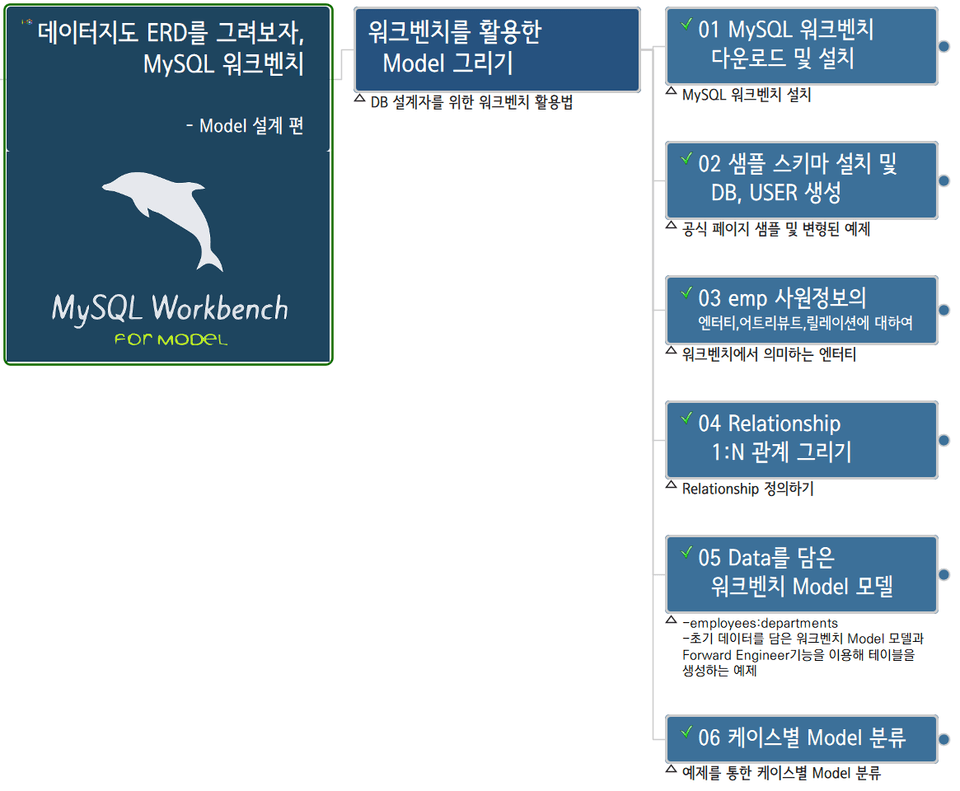
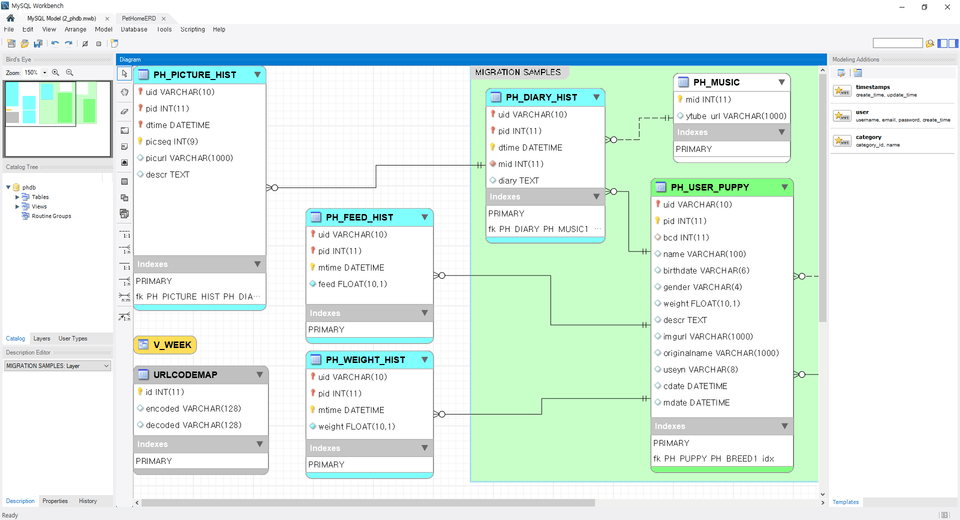
It consists of a total of six lectures and provides detailed explanations of the ER modeling features provided by MySQL Workbench, as shown in the diagram.
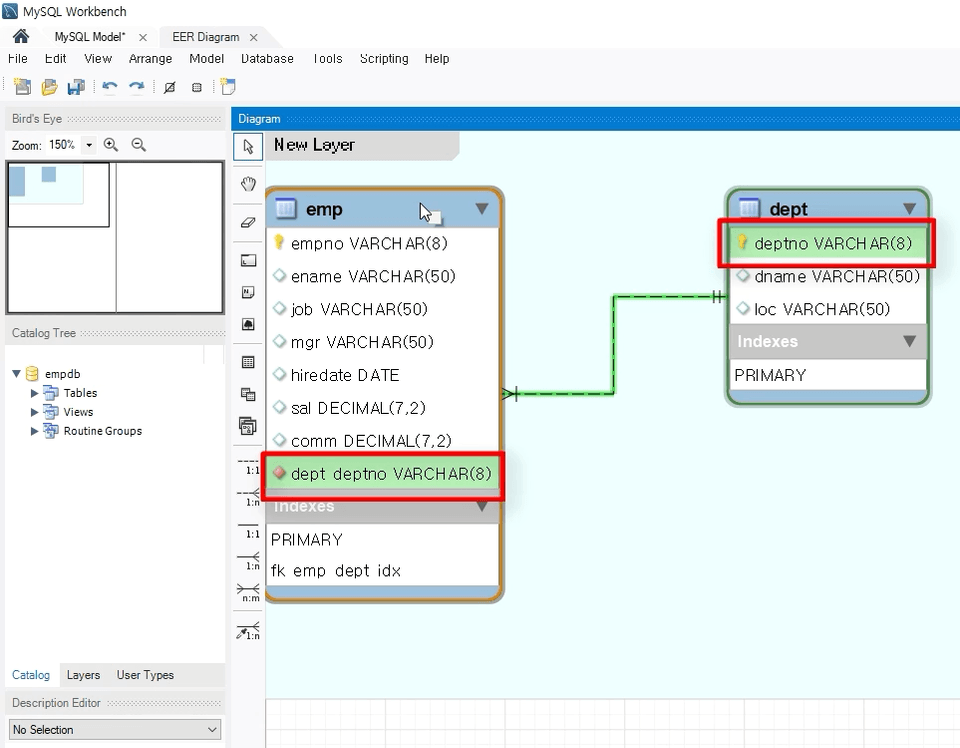
Create the simplest emp employee : dept department entities respectively and draw the relationship line between them.
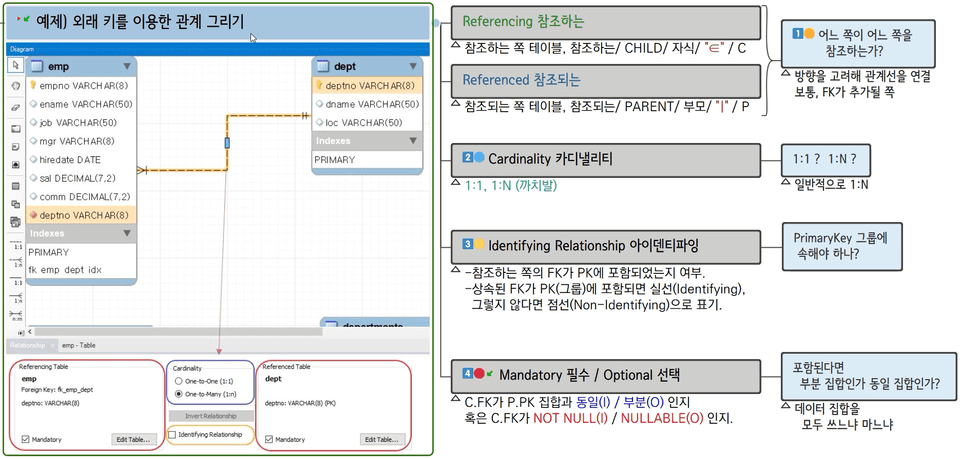
At this time, through the relationship line's detailed information window, you define the relationship in detail by defining 1) the Referencing side and the Referenced side, 2) Cardinality, and 3) Identifying Relationship. You draw step by step according to the systematic order provided in the figure below.
We will examine the screen design of the 'Pet Diary' app system (created with Kakao's UI/UX tool OVEN) and the ERD created with MySQL Workbench.
We also examine in detail the models divided into six other cases.
📢 Please check before taking the course!
The lecture audio may seem quiet. Please check the volume through the preview lecture before enrolling.
Practice Environment
Windows environment, minimum 4GB memory/recommended 6GB
Learning Materials
Reference the PDF and workbench sample files provided for each course
Expected Questions Q&A 💬
Q. Why should I learn it?
This is because you can view and read the ERD, which is the fundamental data blueprint of the system.
Q. What kind of work can I do after learning this?
You can better utilize the time spent communicating with customers and it becomes easier to identify missing data or exceptional situations from a data perspective.
Q. Can non-majors also take this course?
If you want to work in the data field, you must know this.
Q. Is there anything I need to prepare before taking the course?
Basic knowledge of databases and ERD is required.
Q. What level of content does the class cover?
We will examine the ER modeling feature among MySQL Workbench functions in detail. We are covering ERD examples that are written as simply as possible.
Q. Are there any considerations related to taking the course (required environment, other precautions, etc.)?
For additional topics not covered due to length constraints (error resolution, troubleshooting, etc.), please refer to my personal YouTube channel (Software Reminder).
Recommended for these people
Who is this course right for?
Those who need to draw and implement ERD using MySQL workbench
Students who want to learn about ERD concepts and databases together
Those who dream of new challenges using IT and data as a stepping stone
Hello, this is Software Notice. I have accumulated experience in database and middleware application development and various application fields, and I am creating tutorials utilizing SQL based on MySQL and MariaDB. I am running the YouTube channel "SQL BANK".
Hello, this is "SQL BANK". I have accumulated experience in developing database and middleware applications and in various application fields. I create tutorials utilizing SQL based on MySQL and MariaDB. I also run a YouTube channel called "SQL BANK".
I felt that the lecture pace was appropriate and the lecture materials were sufficient. I think it covers almost everything that juniors need to know to read and write ERD.
Thank you for your hard work. These are the contents I really wanted to hear. The view part in DB is something I've never seen before, so I'll have to look it up later. I'm trying to implement a web app, but there aren't many lectures on DB design, so it's not easy to do it alone. Is there anything else I should listen to?
I'm glad it was helpful. Thank you for your hard work studying. I also appreciate it.
You're trying to implement a web app, and you're doing it alone. It's not easy, but I think it's a big challenge.
If I talk about DB, I think design, implementation, and the test data environment that is the target during development are important.
When developing, creating 'plausible' development data is also a very important part, and the more diverse the development data that can be tested, the less additional modifications and supplements will occur in the business logic part such as HTML, Java, and Node.js later.
Likewise, when developing by team, the integration test or deadline schedule is significantly affected depending on how many sufficient and diverse cases (expected user input format, data consistency check upon input, appropriateness of time or date, etc.) are included in the development data.
Please visit my YouTube channel or Infraon, where related courses are registered, so it would be good to refer to them.
I'll leave the URL below. https://www.youtube.com/playlist?list=PL_RECGqDS3icOhnWgOTFF5-CBto3OXj4l
Thank you for asking many questions and cross-checking, which is not easy for a student.
If you want to know ERD, this seems like a good course.
It briefly explains how to use the workbench with examples.
I think it would be good if you think of it as a beginner level course.
Thank you for the precious perfect rating! I'm glad that my lectures are helping with cio headnurse's learning journey. If you have any questions while studying, please feel free to visit the Q&A board anytime. Keep up the great work until the end!























![Project Structure and Database Handling for Backend Employment [MySQL, Mongo]Course Thumbnail](https://cdn.inflearn.com/public/courses/332866/cover/002e90d9-1412-4a10-a9c6-39aa22d99671/332866.png?w=420)