All-in-One Developer Employment Guide for Non-Majors [Learning Edition]
This book contains all the know-how of a person who majored in physical education and started studying development at the age of 29, becoming a top-tier developer at a company with a salary of 40 million won at the age of 30, 60 million won at the age of 31, and more than x million won at the age of 32!
It was very helpful. I could see that you were thoughtful and your intuitive explanations were helpful.
5.0
최준성
100% enrolled
It was very helpful. Thank you.
5.0
sumni010405
44% enrolled
I am a sophomore in computer science. However, since I am not interested in this field, I was at a loss as to which path to take. Through this lecture, I learned about various career paths and decided which language to choose to do what I want to do. This lecture is useful not only for non-majors but also for majors who are at a loss as to what to study and how to study.
What you will gain after the course
Job and career change strategies to become a top-tier company developer within 3 years
Practice creating a developer portfolio (web portfolio, GitHub portfolio)
More than 150 must-see references (links) provided
Reviews of academies supported by the national government and academies recommended by developers
Recommended developer growth direction and know-how after employment
Want to start your career as a developer? We will teach you how to choose the right field and study know-how.
Please check before taking the class!
This lecture is an all-in-one guide to developer employment for non-majors [Study] lecture. (Part 1, 10 hours long) In addition, [Employment] (Part 2) / [Integrated] (Part 1+2) lectures are available, so please refer to them!
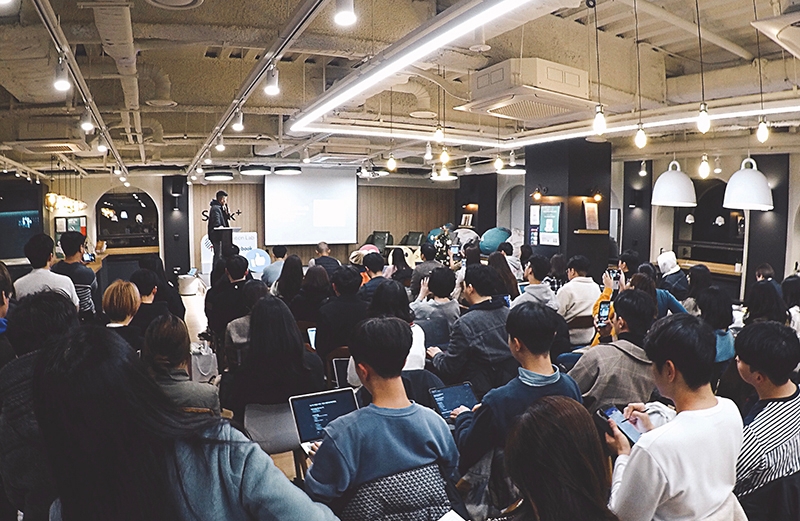
Facebook Innovation Lab - Developer Career Seminar Announcement
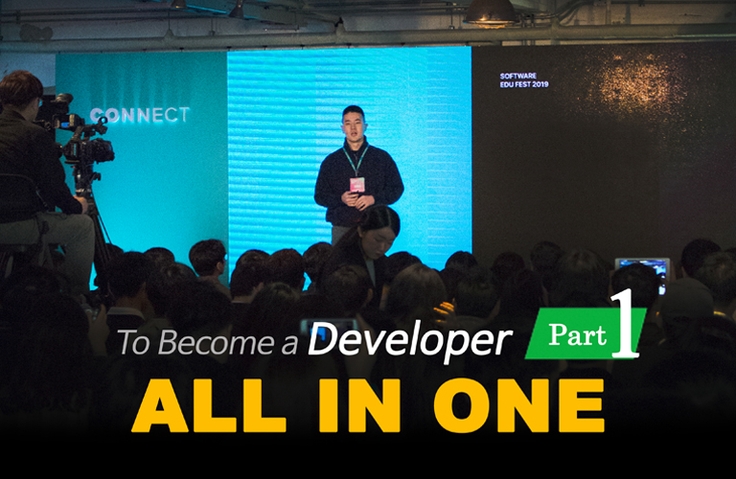
Software Edu Fest 2019 - Developer Career Session Announcement
📚 Course Introduction
Anyone can become a developer by attending an academy for 6 months, but it is not easy to become a developer at a good company . This lecture is full of experiences and tips for non-majors who want to become developers at a good company!
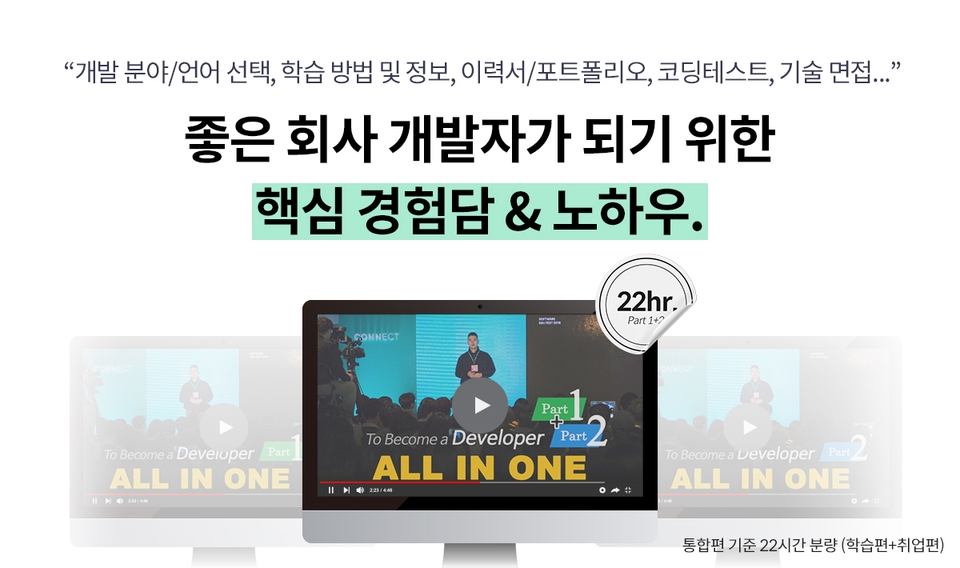
The course consists of a learning section (10 hours) , an employment section (12 hours) , and an integrated section (22 hours) . This is a truly unique lecture that provides unique know-how that cannot be found in any other lecture. Contains over 150 must-read references related to each chapter's topic. Take the course when you are ready to absorb a torrent of information! :)
✏️ What does it contain?
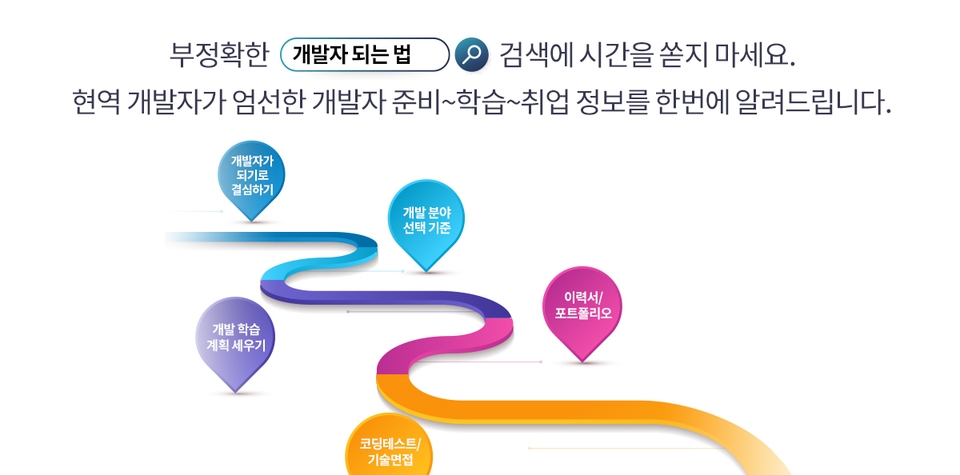
It contains all the experiences and know-how from deciding to become a developer to moving to a top-tier company !
By watching this lecture, you can save more than 90% of the time you spend searching for ways to become a developer. Don't be fooled by the inaccurate information and advertisements you get from searching, start with the real information contained in this course.
The links I have added for reference are a selection of content I have seen over the past two years running the {High-Quality Development Content Collection} repository. I highly recommend that you read them all, even though they are quite extensive.
📖 Lecture Structure
This lecture is structured into the parts ofPreparation-Study-Job Hunting , and an appendix has been added. ( The table of contents only lists the lecture titles . It is too extensive to include detailed topics, so I omitted them.)
🙋🏻♂️ Expected Questions Q&A
Q. What is the difference between the study, employment, and integrated courses, and which course should I take?
A. This course is structured as [Preparation - Study - Employment - Appendix] . Because the integrated course(Preparation + Study + Employment + Appendix) has a long lecture time of 22 hours, Even those who have already completed a considerable amount of development training can take only the necessary parts. Added the Study section(Prepare + Study) and the Employment section(Get a job + Appendix) !
I'm just starting out on the path to becoming a developer →Integrated version
I have already done quite a bit of development learning (graduated from school or already employed) → Employment section
I'm just starting out on the path to becoming a developer, but I have doubts about the quality of this course → After taking the learning course, I took the employment course
Q. How is it different from other job training courses for non-major developers ?
A. While other lectures are only 3 to 5 hours long, this lecture is over 22 hours long, despite only covering the necessary content . I was somewhat indignant that the developer job courses sold on Inflearn and other lecture platforms did not provide sufficient content, so I created this lecture over the course of 8 months with the thought of ‘let’s make a really good lecture.’
If you just look at the table of contents for this lecture, you will feel that it is different from other lectures . However, the titles written in the table of contents are only the actual lecture titles. In other words, unlike other lectures, the table of contents does not include detailed lecture topics. If the table of contents includes detailed topics for this lecture, the table of contents would be too long!
Also,consider how much the instructor who created the course has grown as a developer . If the students taking the course are not going to work as developers for 1-2 years and quit, they should also know how and in what direction they will grow after getting a job as a developer. This course is a lecture where a non-major instructor directly shares all the know-how he has accumulated while getting a job as a developer at a top-tier company and changing jobs.
Q. Can I become a developer just by watching this lecture?
A. No! Just like learning how to become a soccer player doesn't make you a soccer player right away, this course will teach you the know-how to become a developer in great detail, but actual development learning and practice are your own responsibility. This course will serve as a great coach in the process of becoming a developer :)
Q. How can I trust the information provided in this course?
A. Of course, there is no right way to become a developer! However, there are methods that many developers recommend. While operating a Facebook page called {Reading Development on the Way to and from Work} and a GitHub repository called {Collection of High-Quality Development Content }, I have consumed a total of more than 3,000 development contents (blogs, videos, slides) over the past 2 years and 6 months. Therefore, rather than providing information based on my own thoughts like a frog in a well, I created the lectures while recognizing what developers consider right.
Recommended for these people
Who is this course right for?
Those who want to become developers as efficiently as possible
Non-major who wants to become a top-tier company developer, not just a developer
If you want to become a developer but are worried about your age
Those who want to learn the know-how first and then enter the developer's path
Those who have no developers around them to ask for advice
Those who want to quickly and stably transition to a developer
If you know how to become a developer and have the will to work hard
🏄♂ I majored in physical education and worked in the shipping industry, 🧑💻 then started studying development at 29 and became a developer at 30. 🇺🇸 I have been living in the U.S. since 2023, 👨👩👧👦 and I am a father of two children (born in '20 and '22).
I am a sophomore in computer science. However, since I am not interested in this field, I was at a loss as to which path to take. Through this lecture, I learned about various career paths and decided which language to choose to do what I want to do. This lecture is useful not only for non-majors but also for majors who are at a loss as to what to study and how to study.
I am a 4-year university computer science major and a 4th year student. My dream is to be a developer, but I couldn't decide between backend and frontend, and I didn't know what I needed to prepare to become a developer. However, after taking this course, I learned what I needed to prepare to become a developer and I was able to figure out a direction to some extent. I was able to get a lot of information from this course and it was a huge help to me as I am about to graduate! Thank you.
I think this is a well-organized lecture that gives me a good idea of how to start when I was at a loss as a non-major. I will refer to it a lot and try to become a good developer myself. Thank you for the great lecture.


.jpg?w=960)






![All-in-One Guide to Developer Employment for Non-Majors [Employment Edition]Course Thumbnail](https://cdn.inflearn.com/public/courses/326469/cover/e2cf0ffa-536d-4072-9eb6-5373b45bdfb6?w=420)
![All-in-One Developer Employment Guide for Non-Majors [Integrated Edition]Course Thumbnail](https://cdn.inflearn.com/public/courses/326354/cover/1d6f78c0-86a5-4585-b7f5-49d57582e964?w=420)
![[Book Included] UX Employment Guide by a Current 11th-Year UX Designer at a Major CorporationCourse Thumbnail](https://cdn.inflearn.com/public/courses/329206/cover/d874cd01-11e9-45fd-89f4-f2293a89ca44/329206-eng.png?w=420)