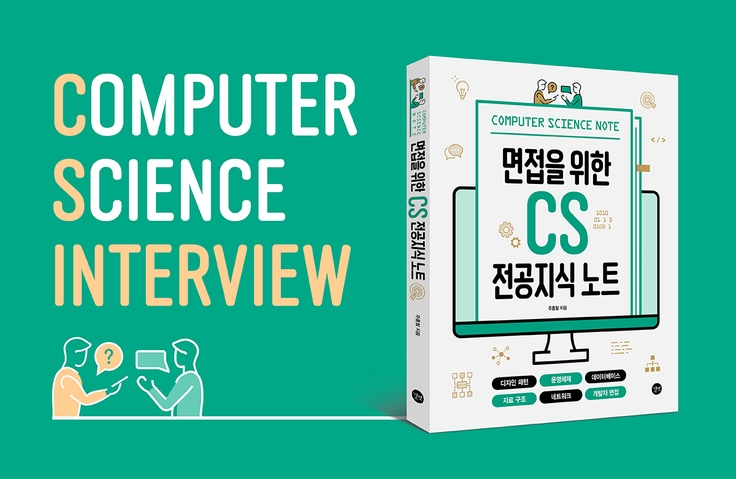
The Basics of CS Knowledge | Design Patterns Network Operating System Database Data Structure
CS knowledge lectures on design patterns, networks, operating systems, databases, etc. from the author of the #1 book in Korea, "CS Major Knowledge Notes for Interviews"! Covers all the concepts needed for CS interviews and the latest past questions!
4,046 learners
Level Basic
Course period Unlimited

News
4 articles
Hello students, haha
This is instructor Daedol.
This time, we performed a large-scale update.
The total lecture time has increased from 20 hours to 23 hours, and a total of more than 100 lectures have been updated.
The main focus of this update is that all lectures except the database have been updated.
1. Cleanliness: We removed unnecessary flow to make the lecture itself feel clean.
2. Detail: It has become more detailed. For example, in the case of the hash table lecture, the existing 3-minute lecture has been extended to 23 minutes.
3. Three-dimensional: We made the lecture itself feel more three-dimensional. When explaining a concept, we made it a little easier to understand and memorize through text, pictures, and simple exercises with adjusted difficulty levels.
4. Reflection of the latest interview questions: Based on feedback received from my acquaintances and students, I have built this to reflect the latest CS interview questions.
5. Importance Marking: In fact, I would like you to study all the contents in this lecture, but for those who are cramming, I have marked the importance with stars. Based on the importance, you can now cram.
Actually, I was planning to update the database lecture, but I got into a car accident and my microphone broke, and the world was against me, so I couldn't do it. This part will be done later. (That doesn't mean the database lecture is terribly weird or anything. Haha, it's worth listening to.)
This course was created a long time ago, but it is being updated regularly.
I think that's the best I can do and a courtesy to my existing students.
I will make sure that you pass the CS interview with the best lectures.
If you have any questions, please feel free to ask.
Your good reviews and 5-star ratings are a great help to me. :)
thank you
Instructor lifts a big stone.
*Please share any CS-related questions you received during the interview that you were unable to answer. We will review them and reflect them in the lecture.
Hello, haha. I'm here to inform you about lecture and lesson material updates.
Lecture revisions and additions
Browser rendering
Memory and Pointers #1 Memory and Addresses
Memory and Pointers #2 Pointers
Memory and Pointers #3 Dereference Operator
Memory and Pointers #4 array to pointer decay
CS Knowledge Essentials Part 1 Lecture Notes Revised Version.23.02.23
Browser rendering 148p
CS Knowledge Essentials Part 2 Lecture Notes Revised Version.23.02.23
Memory and Pointers 87p
thank you
Hello, this is Big Stone. Haha
The size of my lecture notes is 340 pages.
I am doing this work in Google Word, converting it to PDF, and sending it to you.
There was a bug that prevented conversion to PDF because the file size was large.
So, I would like to divide the lesson into two parts.
Part 1: Essential IT knowledge for developers, design patterns, networks
Part 2: Operating Systems, Databases, Data Structures, Developer Interviews
It is divided into , and the latest version is 23.01.19.
This time, the only thing that has changed is the UDP figure section, so if you printed the lesson materials before the UDP figure update, you can just look at them as is. (Please only check the changed UDP figures.)
Hello, students. Haha.
As I mentioned before, we have conducted a large-scale update this time after collecting feedback from students.
After two whole months of updates, it is now complete. A total of 47 lectures have been added and revised, and the lecture materials have also increased to 340 pages.
Latest version of the lesson plan: v23.01.02
I will make sure that all students will be able to perfectly prepare for CS interviews with just this one lecture.
thank you
[Updates]
Essential knowledge for developers
[Special Lecture] 100% Passing in IT Major Companies
Design Pattern
MVC MVP MVVM pattern
Spring's MVC pattern application case
Dependency Injection and Dependency Inversion Principle
network
TCP/IP Layer 4 #2. MTU, MSS, and PMTUD
Cache in Web Browsers #1. The Concept of Local Storage
Cache in web browsers #2. Local storage and origin
Web Browser Cache #3. UX Improvement Using Local Storage
Web Browser Cache #4. Session Storage
HTTP header
Web Browser Cache #5. Cookies
Web Browser Cache #6. Similarities and Differences Between Local Storage, Session Storage, and Cookies
Login Implementation #1. Session-based Authentication Method: Concept
Login Implementation #2 Session-based Authentication Method: Practice
[Appendix] Why Developers Should Follow Conventions
Login implementation #3. Token-based authentication method (access token, refresh token) concept
Login implementation #4. Token-based authentication method (access token, refresh token) practice
DEEP DIVE: Serialization and Deserialization
HTTP status codes you must memorize
HTTP Method #1. Difference between GET and POST
HTTP Method #2. Difference between PUT and PATCH
Data Structure
Data Structure Basics
Time complexity
Big-O notation
Time complexity Q1 for practice with problem
Time complexity Q2 for practice with problem
Time complexity Q3 for practice with problem
Time complexity Q4 for practice with problem
Time complexity Q5 for practice with problem
Why Time Complexity is Needed
space complexity
static array
Dynamic array (vector)
Memory and Pointers
Linked List
Difference between array and linked list
stack
Queue
Fundamentals of Graph Theory (Graph, Vertex, Edge, Weight)
Tree (Tree Data Structure)
Binary tree and binary search tree
Adjacency matrix
Adjacency list
Difference between adjacency matrix and adjacency list
Map
Set
Time complexity of data structures that must be memorized