In the cloud field, we deliver the overall background of Microservice Architecture (MSA), a hot keyword, along with various architecture patterns, application types, and legacy conversion methods through real-world insights.
I run MSA services myself, but I'm only in charge of one or two small services, so I wanted to learn about MSA from a perspective of looking at the big forest, and this lecture satisfies that need.
5.0
Ray Kim
100% enrolled
It was good to be able to understand MSA in a concrete way, which I had only understood abstractly so far. Thank you.
5.0
bigcat0815
100% enrolled
I'll forget it tomorrow, but it's so good!! Thank you, teacher!!
What you will gain after the course
Microservices concept
Microservice Development Process
Conditions for Success in Microservices
MSA Inner Architecture, Outer Architecture
Hexagonal and Clean Architecture Concepts
MSA Pattern
Types of Application Modernization
Cloud Migration Strategy
The most notable thing in cloud infrastructure environment Learn about the application type, "microservices" 🕵️♀️
The forest is bigger than the trees Let's go through the process of figuring it out together🌳
Microservices require a wide range of knowledge from infrastructure construction to front-end application design, development, testing, and deployment. However, it is difficult to perform actual work with only a partial understanding of technology, so this lecture aims to provide a comprehensive understanding of the flow that cloud application developers need to know.
This course covers the background of the emergence of microservices, the concept of comparison with existing monolithic systems, and the various components, patterns, technologies, and development processes of MSA, providing a quick overview of the MSA knowledge system.
" I understand the general meaning of the MSA terms, but I don't think I know the exact meaning. "I don't know what knowledge to acquire first."
"We are trying to convert our existing system to a cloud application, "Should we definitely go with microservices ? I'm a bit scared."
"Our company is responding quickly to business like Netflix, Amazon, Uber, etc. "I want to make it an agile company , but I'm worried because the developers are not very confident."
What's special about this course 📗
The lectures are given with vivid field voices based on the experiences of practitioners.
We aim for the ideal of microservices, but present an approach that reflects reality.
This lecture is a purely spoon-fed lecture without any practical training! 😁
People like this will like it 🏃♀️
Cloud applications Legacy Developers Who Want to Develop
Suggest MSA related technology or Practitioners who want to plan
First time in a cloud environment Engineers who want to develop
Learning one by one Microservices 💻
Understanding the concept of microservices
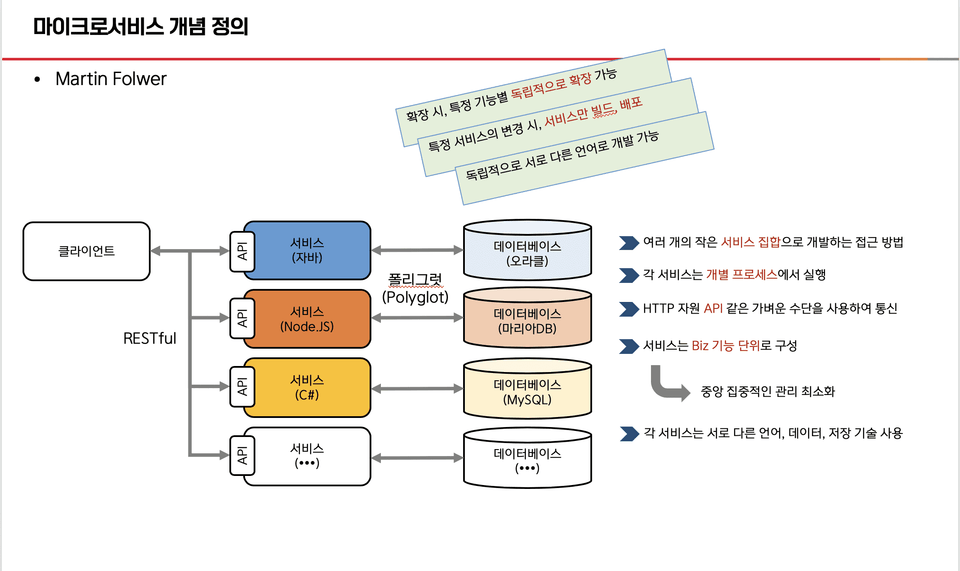
We define the concept of microservice systems and analyze their characteristics by comparing them to monolithic systems and microservices.
MSA is not a silver bullet.
We understand that the difficulty of building microservices and the level of building them must evolve over time, and we suggest a deployment plan based on the organization's capabilities.
Introduction to different architectural styles
Understand the changing trends of architectural styles and explore various architectural styles closely related to microservices.
Understanding the MSA Pattern for Microservice Architecture
Understand the various types of architectural patterns that make up microservice-based architecture and think about their relationships and application methods.
Microservice Internal Architecture
Learn about the hexagonal, clean architecture style, which is flexible and focuses on business logic, and is widely used as the internal architecture of microservices.
Microservices development process
We define a Scrum-based microservice development process and examine how to apply it.
Understanding Transition/Strategies by Cloud Application Type
We explore the different types of cloud applications and explore transition strategies that are appropriate for each type.
After listening to all the lectures Student's appearance 😎
You will be able to understand the overall scope, context, and relationship of MSA technology.
You can decide which unit skills to focus on and which ones to study first.
You will gain a perspective on MSA as a development culture that encompasses Agile, MSA, and Devops.
Understand the types of cloud applications and how to transition to them.
You will learn the pros and cons of microservices and what direction to take in your organization.
Q&A 💬
Q. Is this a course that covers both theory and practice?
This lecture focuses on concepts rather than practical training. From an engineer's perspective, it is very important to try it out right away, but you can learn the overall background knowledge and concepts in this lecture and learn about actual design and development in the lectures that will be prepared later.
Q. Can non-majors without practical experience also take the course?
Even if you don't have cloud experience, it's easy for developers with actual legacy experience to approach, but non-majors without practical experience may have difficulty with the terminology. However, even non-majors who have completed a boot camp should be fine.
Q. What level of content is covered in the class?
This course is designed to explain the relationships between the various technologies, techniques, and processes that make up MSA, and to help you understand their use. After taking this course, if you want to explore specific technologies further, you can take related courses.
24 year developer, This is Han Jeong-heon. 💁♂️
History
Current domestic SI company software engineer
Lectures on SW subjects at Myongji University and Seoul National University of Science and Technology, MSA course at Korea Information Technology Research Institute (KITRI)
Multicampus, Korea Standards Association, Korea Quality Association MSA Course Mentoring
Specialization: Development methodology, software architecture/design/development techniques
22 years, Wikibooks, "Domain-driven Microservice Development", author
National Institute for Lifelong Education, K-MOOC "Microservice Design and Implementation" Course Development and Lecture
Recommended for these people
Who is this course right for?
Developers who want to develop flexible and scalable software
Executive in charge of development who wants to grasp the concept of MSA
Leaders and CIOs who are promoting MSA
A developer with a strong interest in architecture and design.
Current domestic SI company software engineer (SA, AA)
Led development methodologies and design methods for numerous large-scale next-generation projects
Lectured on Cloud and SW subjects at Myongji University and Seoul National University of Science and Technology
Lectured on MSA courses at SK C&C, Korea Information Technology Research Institute (KITRI), and LG Electronics
Mentoring for MSA courses at Multicampus, Korean Standards Association, and Korea Management Association; mentoring for the web development course at Spharos Academy.
Areas of Expertise: Development Methodologies, Software Architecture/Design/Development Techniques
2022, Wikibooks "Microservices Development Starting with Domain-Driven Design", Author
Developed and lectured the "Microservice Design and Implementation" course for K-MOOC, National Institute for Lifelong Education.
I am a backend developer aspirant who is currently studying backend! Recently, I have been working on a team project with MSA, so I have become very interested in architects. Thank you for filling in the knowledge and parts I didn't know through this lecture! Please record many lectures!!
I run MSA services myself, but I'm only in charge of one or two small services, so I wanted to learn about MSA from a perspective of looking at the big forest, and this lecture satisfies that need.
It was great to be able to learn from the basics to the practical aspects of MSA. I had only heard through earshot that MSA operation management was difficult, and I thought it would be difficult to develop, but the best part was that I learned the process of doing it through the lecture! It was definitely difficult because I was awkward, but I think I learned a lot from the good lecture. Thank you!



















![[4-Week Completion] Clean Architecture with AI for Senior Developer AdvancementCourse Thumbnail](https://cdn.inflearn.com/public/files/courses/339355/cover/01k8ags08xj5tpgyrpv77hkj21?w=420)