This is a course for those starting with Vue 3, the latest version of Vue.js. Learn the fundamentals of how Vue.js works and the basic concepts you need to know for practical development.
I have used react before but this is my first time using vue. I am a beginner in vue. It was easier to understand because you didn't just teach me vue3 but compared it to vue2. I was able to concentrate better because the videos were short and concise, and the key points were explained so that it stuck in my head better. I think this is a must-watch lecture for those who are new to vue:-) I can't wait for the next lecture!
5.0
fourrah
84% enrolled
At the moment when I was worried about what to do because my company urgently needed to upgrade vue2 to vue3, this lecture opened,,!! It was really a ray of light for me!!! Thank you.
First of all, while listening to the lecture, the core concepts and functions of Vue 3 were explained well, so I was able to understand them quickly!! And I was able to apply them to the actual company project right awayㅠㅠ Thank you again.
In fact, these days, there are many lectures that focus on practice rather than concepts, so it is often difficult to understand why the code should be written like that,, Pangyo-nim explains the concepts first and then proceeds with the practice, and this method suited me so well that I could understand it easily!! I would be very grateful if you could upload the composition API lecture soon!
5.0
Jin J
100% enrolled
I listened to the lecture well.
Good points: The lectures were short and easy to understand. However, each one was explained thoroughly, making it easy to understand.
I understood the comparison between Vue2 and Vue3 well.
Request: The open source version will continue to be upgraded in the future, and new things will come out.
I would appreciate it if you could give lectures on the core parts at a low price, even if it is short, like this lecture. I don't want to study alone.
I look forward to the next composition lecture.
Thank you.
What you will gain after the course
Vue.js
Frontend development
Web Development
Vue.js core principles + the latest Vue 3 features, delivered clearly in one course!
Becoming the next-generation standard of Vue.js Getting Started with the Latest Vue 3
The "Vue.js Complete Guide - Age of Vue.js" chosen by over 8,250 people is back as a follow-up Vue 3 latest course! 😄 This "Getting Started with Vue 3" course is designed from a Vue.js beginner's perspective for those who are just starting with the front-end development framework Vue.js, and for those who are not yet familiar with Vue.js.
Provides additional syntax related to template expressions
Support for other new syntax
(Composition API, Reactivity Injection API...)
Are you starting a project with the latest Vue 3? Do you want to accurately understand how Vue.js works? Through this course, learn step by step about the differences between Vue 2 and Vue 3, focusing on the library's internal implementation perspective and syntactic features!
Recommended for these people.
Frontend beginners starting frontend development with Vue 3
Developers who need to upgrade from Vue 2 to Vue 3
Frontend developers starting their first Vue.js 3 project
Those who want to accurately understand Vue.js from its operating principles rather than just simple concepts
So, you can build a solid foundation in Vue.js basics!
✅ You will learn what the key concepts and syntax of Vue.js are.
✅ Understand Vue.js's philosophy by implementing Vue.js's internal workings yourself.
✅ You'll gain an understanding of knowledge that practical developers need to know, such as HTTP, networking, and servers.
Lecture materials provided for Vue.js learners 📖
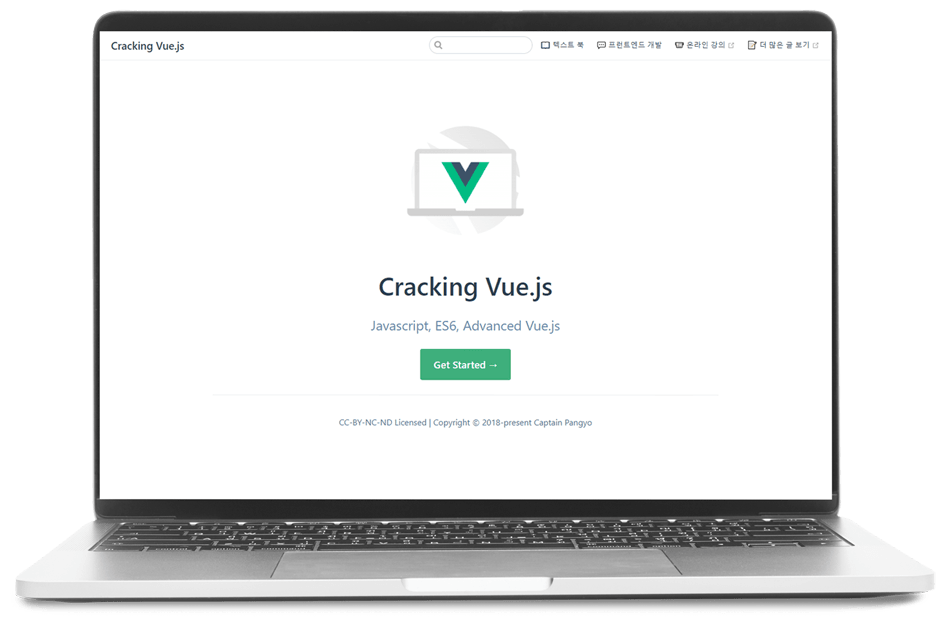
We provide an online textbook that compiles the knowledge needed to develop web services with Vue 2 and Vue 3.
Q. I'm not familiar with frontend development. Can I still take this course?
This course is best suited for those who have basic knowledge of HTML, CSS, and JavaScript. In particular, if you're unfamiliar with JavaScript variables, functions, control statements, objects, etc., we recommend learning JavaScript fundamentals first before taking this course.
Q. How is this different from the existing Vue.js Getting Started course?
The existing Vue.js Getting Started course is based on Vue.js version 2, which is currently the most widely used in production. This Vue 3 Getting Started course is designed from a beginner's perspective for those who are starting projects with Vue 3 and for those who find it difficult to follow along with the Vue 2 Getting Started course :)
Q. I already took the existing Vue.js Getting Started course - should I take this course as well?
If you've already built services with Vue.js multiple times in real-world projects and have experience with component design, reactivity principles, and complex state management, I don't recommend this course. That's because you'll be able to quickly understand the differences just by reading the Vue 3 official documentation a bit :) For those people, I recommend the Vue 3 Intermediate - Composition API course.
On the other hand, if you're not yet familiar with Vue.js and need to start a Vue 3 project, I highly recommend taking this course as well. Throughout the course, I explain the differences between Vue 2 and Vue 3 from various perspectives, including the library's internal implementation and syntactic features, so you can understand what has changed compared to the previous version when developing with Vue 3 :)
Q. What course should I take next after completing this course?
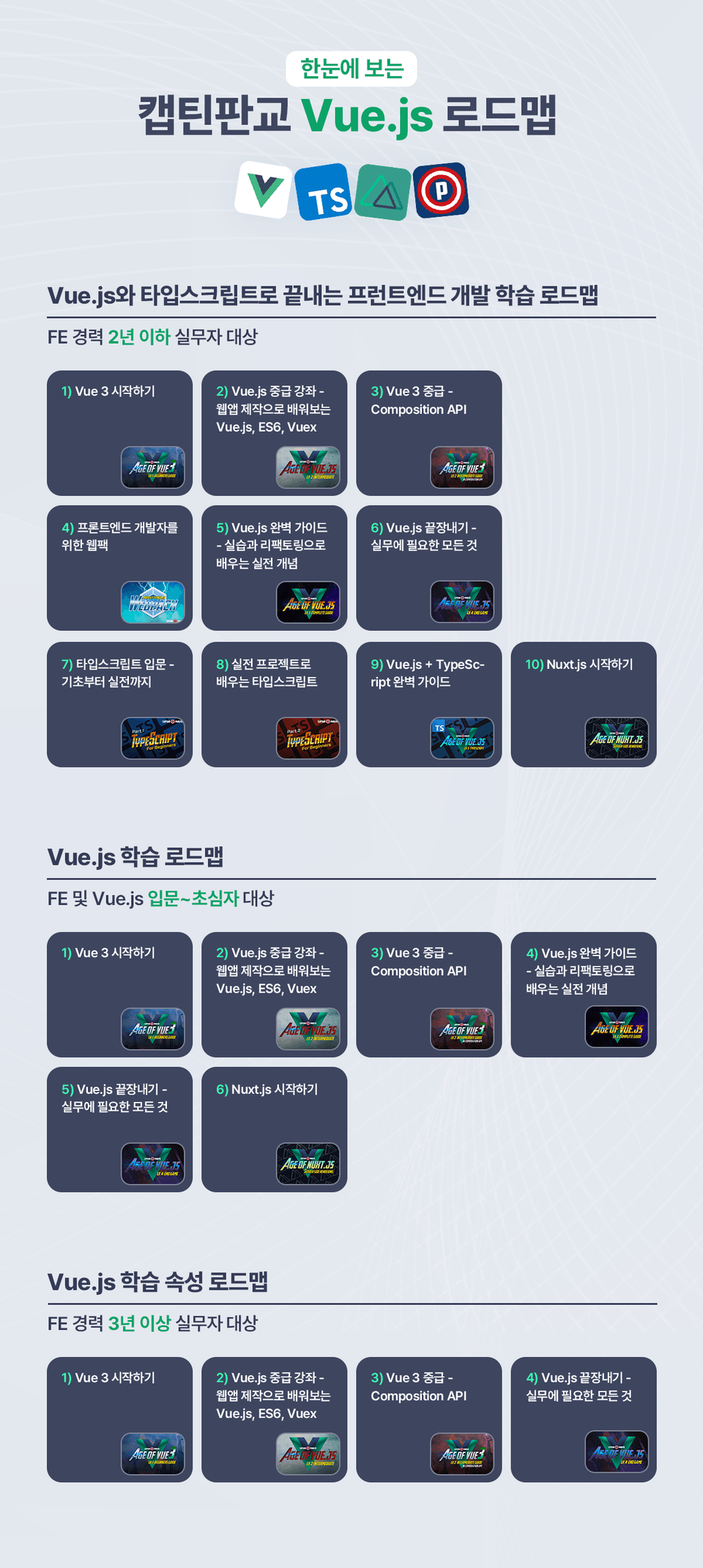
I recommend following the Vue.js Learning Roadmap. As you can see from this course, most of the existing Vue 2 content is utilized as-is in Vue 3. Therefore, if you faithfully follow the existing learning roadmap, you'll be able to become a frontend developer with higher Vue.js proficiency :)
A follow-up course for Vue 3 is currently in preparation. You'll be able to learn about new coding approaches and how to utilize the ecosystem in the follow-up course. It's scheduled to be released as early as November or by the end of the year at the latest :) The follow-up course has been released. Go to Vue 3 Intermediate - Composition API Course
"We support the Vue.js open source ecosystem with course revenue 😁"
Recommended for these people
Who is this course right for?
Someone starting frontend development with Vue.js
Frontend beginner
Developers who need to work on Vue 3 production projects
At the moment when I was worried about what to do because my company urgently needed to upgrade vue2 to vue3, this lecture opened,,!! It was really a ray of light for me!!! Thank you.
First of all, while listening to the lecture, the core concepts and functions of Vue 3 were explained well, so I was able to understand them quickly!! And I was able to apply them to the actual company project right awayㅠㅠ Thank you again.
In fact, these days, there are many lectures that focus on practice rather than concepts, so it is often difficult to understand why the code should be written like that,, Pangyo-nim explains the concepts first and then proceeds with the practice, and this method suited me so well that I could understand it easily!! I would be very grateful if you could upload the composition API lecture soon!
I listened to the lecture well.
Good points: The lectures were short and easy to understand. However, each one was explained thoroughly, making it easy to understand.
I understood the comparison between Vue2 and Vue3 well.
Request: The open source version will continue to be upgraded in the future, and new things will come out.
I would appreciate it if you could give lectures on the core parts at a low price, even if it is short, like this lecture. I don't want to study alone.
I look forward to the next composition lecture.
Thank you.
Thank you for writing in detail about the good points :) I will prepare the next lecture well with the price competitiveness and key contents you mentioned in mind. I will come back soon with the composition lecture :)
I have used react before but this is my first time using vue. I am a beginner in vue. It was easier to understand because you didn't just teach me vue3 but compared it to vue2. I was able to concentrate better because the videos were short and concise, and the key points were explained so that it stuck in my head better. I think this is a must-watch lecture for those who are new to vue:-) I can't wait for the next lecture!
I took this course to learn Vue3 properly after trying Vue2 at an academy.
At first, I tried to learn through the official documentation. It was really hard to understand, whether it was because I was not good at English or because I lacked knowledge of development. However, this course explained difficult concepts with easy examples, so I was able to build a solid foundation.
In particular, when I studied on my own, I had a hard time understanding Vue's proxy object for reactivity because I lacked JS concepts. The course explained the core with easy examples, so I was able to understand it.
This course explains that A goes through some internal process to perform B function, rather than A performing B function.
I recommend this course to people like me who don't know much about Vue or who still have difficulty understanding the official documentation. I hope the next course comes out soon!
















![[Web Development Full Stack Course] From Pure JavaScript Basics to PracticeCourse Thumbnail](https://cdn.inflearn.com/public/courses/330076/cover/e46f4bde-0146-42d6-a2fa-64d9bd510d27/vanila-javascript-1 (1).jpg?w=420)