inflearn logo

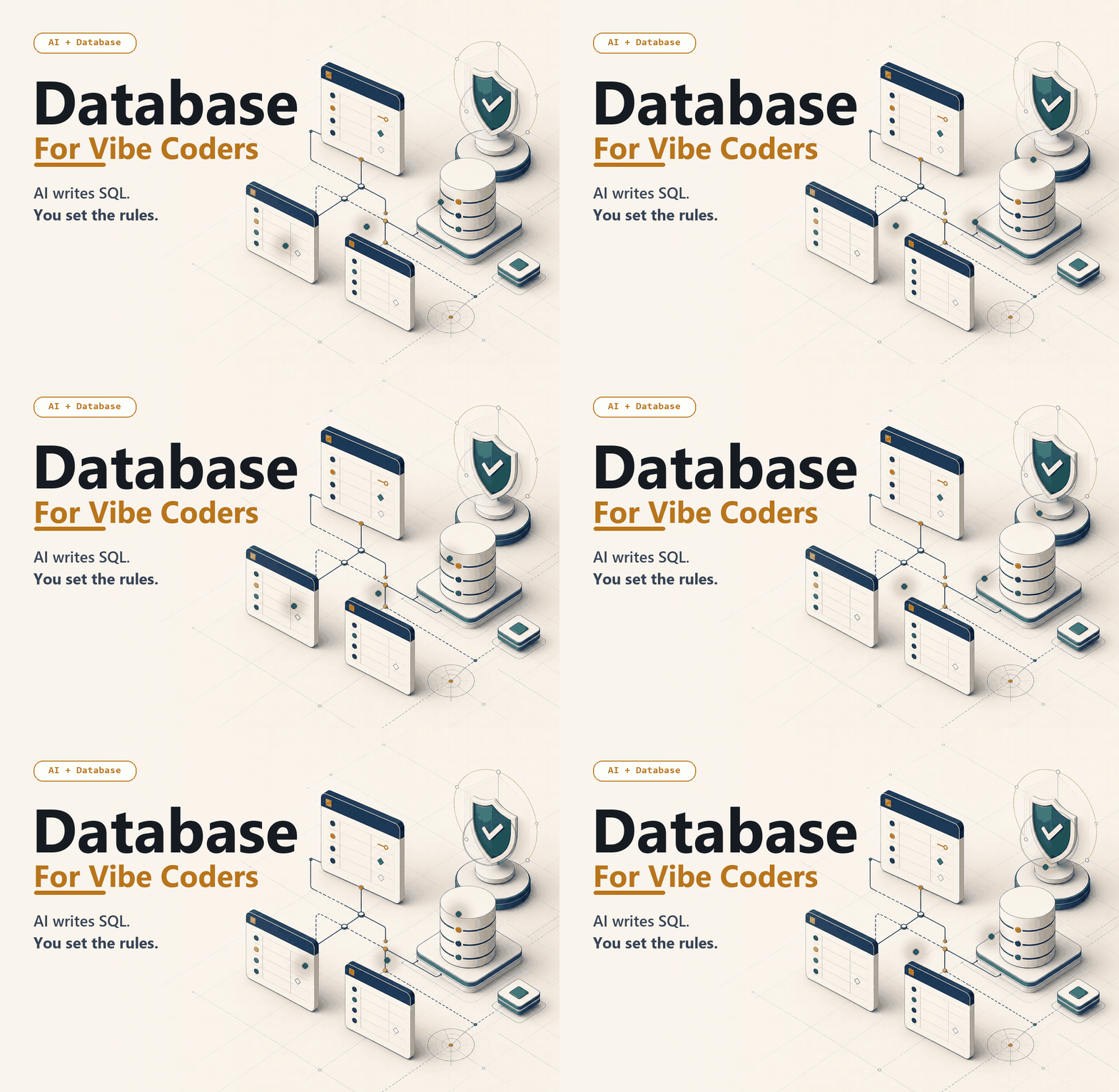
Databases in the Age of Vibe Coding: Essential Minimum Knowledge for Building Services with AI

Even if AI quickly generates SQL drafts, humans must still judge table structures, relationships, performance, and data consistency. Using MySQL and DBeaver, you will gain hands-on experience with tables, columns, data types, PK/FK, DDL, database modeling, SQL core concepts, indexes, EXPLAIN, and transactions to master the standards for reading and verifying AI-generated results.

3 learners are taking this course

Level Beginner

Course period Unlimited

SQL
SQL
MySQL
MySQL
ERD
ERD
database
database
dbeaver
dbeaver
SQL
SQL
MySQL
MySQL
ERD
ERD
database
database
dbeaver
dbeaver

What you will gain after the course

  • The ability to understand tables, columns, data types, PKs, and FKs, and to directly create and modify tables using DDL.

  • The ability to identify parent-child relationships and 1:1, 1:N, and N:M mappings from business requirements and design them into an ERD.

  • The ability to write core SQL directly and verify errors in JOIN and aggregation results generated by AI.

  • The ability to check query performance using indexes and EXPLAIN, and to maintain data consistency through transactions.

🚀 In an era where AI generates SQL,
you must understand databases to judge the results.

AI can quickly create screens and functions. However, if the database table structures and relationships are incorrect, JOIN results can be inflated, queries can become slow, and only parts of multiple operations may be reflected.

The problem is not the lack of tools to write SQL for you. It is the lack of standards to judge which data to store under what rules, how to connect them, and what to use to verify the results.

In this course, you will learn the fundamentals of databases—from table structures and modeling to SQL essentials, indexes, and transactions—by practicing directly with MySQL and DBeaver.

Understanding Tables → Relationship Design → SQL Verification → Performance Check → Data Reliability

The moment an AI-powered service falters due to data issues

Even features that worked perfectly on screen can reveal unexpected problems once actual data begins to accumulate.

  • After a JOIN, the number of rows increases, causing sales figures and counts to be inflated.

  • Invalid data is stored because essential values and foreign key rules are missing.

  • As the data increases, queries that used to work fine suddenly become slow.

  • The order was created, but the inventory deduction failed, causing the data to be inconsistent.

These problems can only be solved by understanding the table structure, relationships, performance, and units of work before learning a single line of syntax.


Rather than memorizing syntax, you will create and verify it yourself.

You will learn every topic through the flow of Why is it necessary → When to use it → How to configure it → How to check the results.

  • Execute directly with MySQL and DBeaver.

  • Check the structure and results using sample shopping mall data.

  • We also verify the AI's answers based on the execution results and data structure.

Related Skills: SQL, ERD, database, data-modelling, MySQL, dbeaver, Artificial Intelligence (AI)

Directly execute SQL using MySQL and dbeaver, design database structures through ERD and data-modelling, and verify the results generated by artificial intelligence (AI).

We train you not just to copy the code, but to be able to explain why these results were produced.

Recommended for these people

This course is for those who want to judge structures and results for themselves while building services or handling data with AI, rather than for those who simply know a lot of code.

🧠 Those who build services with AI but get stuck on databases

Those who have built the screens and functions but find it difficult to decide how to split tables, which keys to use for connections, or whether the SQL generated by AI is correct.

Vibe Coding Beginners / AI Tool Users

🧩 Those who want to query the data they need directly

Those who want to handle member, order, and sales data but often get stuck on table relationships, JOINs, and GROUP BY.

Planners / Marketers / Data Practitioners / Non-majors

Those who want to grasp the overall flow of the database

Those who know a bit of SQL syntax but struggle to connect table design, ERD, indexes, and transactions into a single cohesive concept.

Job Seekers / Junior Developers / Solo Founders

After taking this course, you will be able to make these kinds of judgments.

  • You can read tables, columns, data types, PK, and FK, and implement them directly using DDL.

  • You can identify parent-child relationships and 1:1, 1:N, and N:M mappings from business requirements and represent them as an ERD.

  • You can write core SQL such as SELECT, WHERE, GROUP BY, and JOIN, and verify the results.

  • You can identify JOIN fan-outs, NULL handling issues, and incorrect aggregation units.

  • You can identify index candidates and verify whether they are actually being used with EXPLAIN.

  • You can group tasks that must succeed together into a transaction and explain the flow of COMMIT and ROLLBACK.

From basics to verification, we connect in four steps.

Do not memorize isolated concepts. You will learn within a single flow that connects Table Structure → Relationships and SQL → Performance and Reliability → Self-Expanding Learning Methods.

01. Tables and DDL - The Structure Where Data is Stored

Understand tables, rows, columns, data types, NULL, and default values. Identify a single row using PK and connect tables with FK, then directly create and modify structures using CREATE TABLE and ALTER TABLE.

Column → Type → PK·FK → CREATE TABLE → ALTER TABLE

02. Modeling and SQL - How to Design Relationships and Retrieve Data

Distinguish between parent-child relationships and 1:1, 1:N, and N:M mappings, and read ERDs. Design requirements into tables, execute core SQL such as SELECT, WHERE, GROUP BY, and JOIN, and verify the results.

Understanding Relationships → ERD → Modeling → Core SQL → JOIN Verification

03. Indexes and Transactions - Fast and Secure Data

Find index candidates from WHERE, JOIN, and ORDER BY usage patterns and verify their application using EXPLAIN. Group tasks that must succeed together, such as order creation and stock deduction, into a transaction and verify ROLLBACK in case of errors.

Index Candidates → EXPLAIN → Transaction → COMMIT·ROLLBACK

04. Expansion of Knowledge - How to Solve Unknown Problems on Your Own

Specify the problem, check the schema, data, and errors, and then ask questions to documentation and AI. Learn the growth loop of experimenting with small data, verifying results, and recording them.

Problem Specification → Structure Verification → Small Experiment → Result Validation → Recording and Expansion

The person who created this course

Hello. I am Tani, a developer.

I have been developing web and mobile services for about 17 years and have performed data quality verification tasks across various projects. Currently, I serve as the CEO of DevPT, creating AI-based services and automation tools, and I share my experiences in development and AI utilization on the YouTube channel Tech Tani.

In an era where AI writes code rapidly, humans need the power to define what to create and judge whether the results are correct. Rather than listing difficult terminology, I will use hands-on practice to show you why problems occur in real-world data and the specific sequence I use to verify them.


Key Experience

  • Current) CEO of GaebalPT

  • Approximately 17 years of experience in web and mobile service development

  • Execution of data quality verification projects

  • AI automation tools and AI-based service creation

  • Operating TechTani, a YouTube channel for sharing development and AI utilization skills

Please check before taking the course

No prior experience in databases, SQL, or coding is required. We will guide you step-by-step, from installing MySQL to understanding table structures and core SQL.

However, this is not a course where you simply watch videos. You will actively participate by executing the provided SQL yourself, checking the results, and troubleshooting the causes when they differ from your expectations.

Practice Environment and Requirements

  • A Windows PC capable of hands-on practice and a modern web browser

  • MySQL - Guidance will be provided starting from the installation process.

  • DBeaver - We will use the free SQL client.

  • Sample shopping mall data provided in the lecture

  • Generative AI tools you normally use - specific products or paid plans are not required.

The installation videos and screen guides in this course are based on Windows, and no additional servers or development environments are required.

Online textbook to view alongside the videos

We provide a dedicated online textbook that allows you to review the lecture content and follow the practice flow.

  • Summary of core concepts for each lecture

  • SQL and DDL Examples

  • ERD, Relationships, Indexes, and Transaction Checkpoints

  • Supports mobile viewing and code copying

Go to the course-exclusive online textbook

Prerequisites

  • It is okay even if you have never learned about databases or SQL before.

  • No coding or ERD experience is required.

  • Basic PC skills, such as the ability to install programs and use a web browser, are sufficient.


Scope of this course

This is not a course for deeply memorizing the entire SQL syntax or developing a complete service using a specific backend framework. It also does not cover DBA-level server operation, advanced query tuning, or large-scale distributed databases.

We focus on the decision-making criteria for table structures, modeling, SQL core concepts, indexes, and transactions required when building services and handling data.

Grow from someone who simply uses AI-generated results as they are into someone who makes decisions based on data structures and execution results.

Recommended for
these people

Who is this course right for?

  • Vibe coding beginners who create apps and web services with AI but get stuck on data structures and relationship design.

  • Planning, marketing, and data professionals who want to directly query and verify data without relying on developers

  • Job seekers and junior developers who want to learn the basics of SQL and database modeling in a single, continuous flow.

  • Those who feel uneasy about executing AI-generated tables and SQL as-is and need criteria for judgment.

Need to know before starting?

  • No prior knowledge of SQL, databases, or coding is required.

  • Experience using generative AI chat tools such as ChatGPT, Claude, or Gemini is preferred but not required.

  • Basic PC skills, including the ability to install programs and use a web browser, are required.

  • The practice video is based on Windows and will guide you through the installation of MySQL and DBeaver.

  • You need to be prepared to execute SQL yourself and check the results while watching the lecture.

Hello
This is tani

Career Verified

👋 Hello. I am Techtani, a developer who wants to deliver practical knowledge in a simple and clear way.

I am a developer who has been developing and operating web/app services and various practical projects in the field for nearly 20 years.

Recently, I have been focusing on researching ways to plan, build, and improve services alone using AI tools. In particular, I am very interested in easily conveying the development sense that non-majors and solo entrepreneurs must know in the era of "Vibe Coding."

We have entered an era where AI writes code for us, but there are still essential elements required to build a service properly.

It is about identifying what data your service needs to store, how that data is interconnected, and how to view the structure so it doesn't collapse as features expand.

Rather than a lecture that simply makes you memorize grammar, I aim to create a lecture that conveys structural thinking and problem-solving skills that can be applied immediately when building actual services.

I will explain things in an easy-to-understand way without missing the core points, so that non-majors and beginners can follow along without feeling overwhelmed.

🎥 TechTani YouTube channel shares the process of solo developers and solo entrepreneurs creating their own services in the AI era. You can also check out the teaching style and various IT insights.

In an era where technology changes rapidly, it is more important to properly understand the essential core concepts rather than trying to memorize everything.

If you want to create your own service with AI, start your journey with Techtani. 🚀

More

Curriculum

All

43 lectures ∙ (1hr 22min)

Published: 
Last updated: 

Reviews

Not enough reviews.
Please write a valuable review that helps everyone!

Similar courses

Explore other courses in the same field!

Limited time deal ends in 7 days

$100,100.00

35%

$118.80