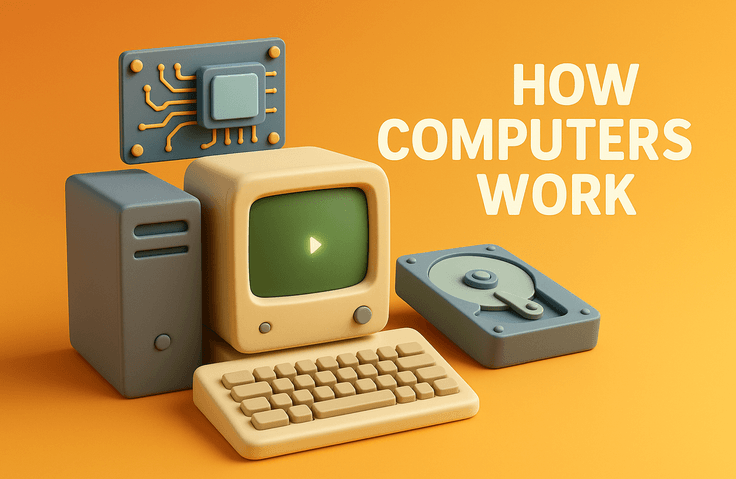
How Computers Work — From Hardware and Operating Systems to the Fundamentals of Servers

You will systematically learn the principles of how the CPU, memory, and disk collaborate, as well as how the operating system mediates resources. You will acquire practical foundational knowledge to read server specification sheets and identify performance bottlenecks, establishing a basis for learning about cloud and network technologies.

8 learners are taking this course

Level Beginner

Course period Unlimited

Computer Architecture
hardware
hardware
server-administration
operating-systems
operating-systems
optimizing
optimizing
Computer Architecture
hardware
hardware
server-administration
operating-systems
operating-systems
optimizing
optimizing

What you will gain after the course

  • Understanding the roles and speed hierarchy of CPU, memory, and disk

  • Explanation of the four resource mediation roles of an operating system

  • Interpreting server specifications and identifying the sequence for checking performance bottlenecks

Course Introduction

"The service is slow."

Let's say you received this one-line report. Where should you look?

Experienced professionals have a specific sequence. They look at the CPU, then the memory, then the disk, and then the network. But where did that sequence come from? It's not just a hunch. It's a sequence that arises because they know what each component does and how fast it is.

In Lesson 1, I mentioned that a single server consists of four layers: hardware, operating system, middleware, and application. At that time, we only went over their names.

This lecture delves into the bottom two layers.

This is important because a significant portion of the reasons why services slow down or crash lies within these bottom two layers. And there is one more thing. These layers rarely change. Even if programming languages change, frameworks go in and out of style, or you move to the cloud, the work that the CPU and memory do remains the same.

That is why the 30 minutes invested here will not be wasted.


Created for people like this

Target AudienceCurrent SituationNon-major IT job seekersI don't know what vCPU means even when looking at server spec sheets.New Operations StaffI feel lost on where to start looking even after receiving a report that things are slow.Aspiring DevelopersI still get confused between memory and disk.Planning/Operations RolesI can't judge whether the items in an infrastructure quote are appropriate.

After completing this course

  • You can explain what the CPU, memory, and disk each do.

  • Understand why speed differences determine performance and why caches exist.

  • You can understand what the operating system is actually doing.

  • You can read server specifications and determine the sequence of steps to check when performance slows down.


We created this for people like you.

Target Audience / Current Situation Non-major IT Job Seekers: I look at server spec sheets but don't know what vCPU means. New Operations Personnel: I feel lost on where to start looking when I receive reports that the system is slow. Aspiring Developers: I still get confused between memory and disk. Planning/Operations Roles: I can't judge whether the items in an infrastructure quote are appropriate.

After completing this course

  • You can explain what the CPU, memory, and disk each do.

  • Understand why speed differences determine performance and why caches exist.

  • You can understand what the operating system is actually doing.

  • You can read server specifications and determine the order of steps to check when it slows down.

Recommended for
these people

Who is this course right for?

  • A learner who is a non-IT major preparing for a job in the IT field and wants to understand server specification sheets and infrastructure terminology.

  • New operations managers and planners who are practitioners responsible for identifying the causes of system performance issues.

  • A learner who aspires to be a developer and wants to systematically learn the hardware architecture where programs are executed.

Need to know before starting?

  • Understanding of basic IT terminology (server, client, application, etc.)

  • Experience using a computer for work or study

  • Curiosity about IT systems and a willingness to learn the basics

Hello
This is jjangkbg7719

Career Verified

452

Learners

29

Reviews

2

Answers

4.8

Rating

17

Courses

Hello, I'm Frank.

I am an infrastructure engineer who has been wrestling with servers for over 20 years. Starting with Linux server operations, I am now in charge of the cloud infrastructure for a large-scale payment service. My daily life involves migrating from data centers to AWS, managing hundreds of instances, and tracing the causes of failures in the early hours of the morning.

The reason I created this course is simple.

I often received questions like these from those around me: "I managed to connect to the server, but I don't know what to do next." "There are so many instance types; which one should I choose?" These are the exact same points where I got stuck at first. However, when I looked for resources, I found that most of them were written for people who already knew what they were doing.

So I decided to create the course I wish I had when I first started learning.

My lectures are based on three principles.

First, I help you understand rather than memorize. Instead of just listing commands, I explain why we use them in the first place.

Second, I boldly omit unnecessary content. I do not increase the volume by including information that is useless to beginners right now.

Third, I also talk about what doesn't work. Instead of just listing the pros, I clearly point out cases where it might not be a good fit. For someone who has to make decisions in the field, that is more important.

If you feel a sense of "Ah, I should start from here" after listening to the lecture, then my goal has been achieved.

Please feel free to leave any questions you may have at any time.

More

Curriculum

All

7 lectures ∙ (28min)

Course Materials:

Lecture resources
Published: 
Last updated: 

Reviews

Not enough reviews.
Please write a valuable review that helps everyone!

jjangkbg7719's other courses

Check out other courses by the instructor!

Similar courses

Explore other courses in the same field!

Limited time deal

$3,300.00

70%

$8.80