Introduction to and use of Rust, an elegant, high-performance programming language
This course teaches Rust, a programming language that allows anyone to create robust, efficient, high-performance software. It is ideal because it allows for low-level programming while also having a wealth of high-level language features.
I am an office worker working as an app developer. I bought it to refresh myself after work and study Rust. The explanation is really neat and concise. I understand it really well. If I keep going like this... I might switch to being a Rust developer...? Thank you.
5.0
김민석
86% enrolled
Most of the domestic development lectures are a waste of money. This lecture is different.
I can see a lot of concerns in the lecture.
I would appreciate it if you could also provide intermediate and higher level Rust lectures.
Additionally, I think it would be good to brand yourself as an instructor.
You can also create an open chat room and write a book. ㅎㅎ
5.0
Halo
50% enrolled
I attended the session at Infcon and it was good, so I took the class right away.
The curriculum and class materials were organized neatly, so I listened well.
Thank you for the great lecture!
What you will gain after the course
Rust
WebAssembly
The introductory Rust course you've been looking for is here! Don't miss out and get started right away ⭐
Rust, the world's most beloved language!
Rust has been ranked the most popular language on Stack Overflow for seven consecutive years. Currently, 2.8 million developers worldwide use Rust, and companies like Discord and Cloudflare are also using Rust. Meet Rust, the world's favorite!
Efficient software production, With Rust
In this course, you'll learn Rust, a next-generation, high-performance programming language. If you need low-level programming but feel limited by the capabilities of languages like C/C++ or Go, you can leverage Rust, which supports low-level programming while also offering high-level language features! Throughout the course, you'll explore practical examples for backend applications and learn how to reliably build high-performance software with Rust.
Why should I use Rust?
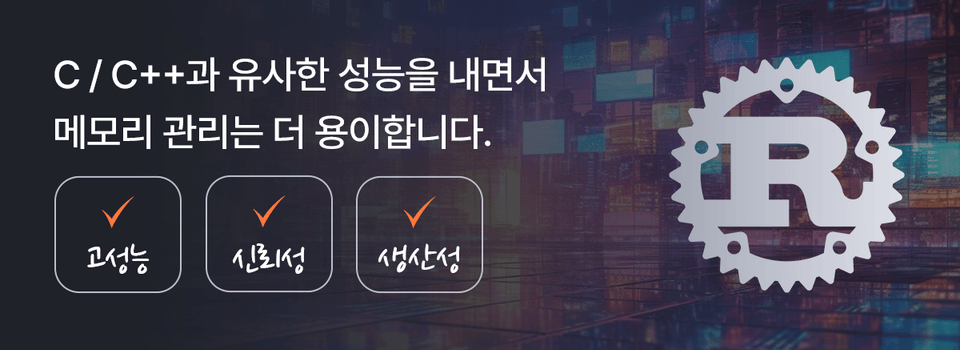
01 High performance
Rust is a fast and memory-efficient language. There's no separate runtime, such as an interpreter or virtual machine, and no garbage collector or GC. Because there's no memory reclamation, and memory management is done at compile time, Rust is a programming language that maximizes performance.
02 reliability
A powerful type system allows for type-safe programming.A well-established ownership model ensures safe use in memory and threaded environments.By preventing common compile-time issues, it significantly reduces runtime bugs.
03 Productivity
The documentation is well-written, making development incredibly convenient.The compiler is friendly, allowing you to quickly identify and resolve error messages. The package manager, build tools, and language environment, all integrated within the IDE, make many tasks easier.
I recommend this to these people
Anyone who wants to create a CLI tool that is lightweight, fast, and easy to deploy
Anyone who wants to use Rust for embedded systems or low-level programming
Anyone who wants to use Rust for WebAssembly output
Developers who need to create high-performance web services
Check out the learning content
✅ Along with the basics of the Rust language , we also kindly explain the ownership model and lease life, which can be difficult. ✅ After completing the basic grammar explanation, you will experience high practicality through an example of creating an AWS Lambda function in Rust .
1. Practice using the official Rust extension in the familiar VSCode.
2. A friendly explanation of Rust's unique memory management model, ownership.
3. Understand the ownership model based on the differences in stack memory and heap memory usage.
A word from knowledge sharer Daehyun Kim ✒️
I've worked as a backend developer and development team leader for many years at companies like Kakao (Daum), NHN, and Line+. I'm interested in a variety of programming languages, so I've worked on projects in various languages. I also studied Go, which is known for its high-performance capabilities, but I found it too low-level to be satisfactory.
I was worried that Rust might be a low-level language, as it requires manual memory management without even a garbage collector (GC), but my worries proved unfounded. I was so satisfied with Rust's functional language features that I even started working on a personal side project and even created a course.
Expected Questions Q&A 💬
Q. I have C/C++, so why should I learn Rust?
It allows for much more productive development because it can achieve C/C++ level performance without the burden of memory management.
Q. I heard it's much more difficult than Java, Python, and Go?
The memory ownership model may seem unfamiliar, but it's not difficult because the compiler handles much of it for you. If you understand the ownership model explained in this lecture, you'll be able to easily understand it at the level of other languages.
Q. Aren't low-level languages so low-level that it's difficult to create applications?
Rust is a low-level language, but its ease of use rivals that of modern functional programming languages. It's developer-friendly yet capable of system-level programming, making it an attractive language that's easy to learn. In fact, its well-equipped development tools and environment make it even more convenient.
Things to note before taking the course 📢
Practice environment
Operating System and Version (OS): This is based on macOS, but I expect there will be no issues with Windows or Linux as well.
Tools used: Demonstrated using the official Rust extension for VSCode.
PC specifications: No particularly high specs required.
I am a backend developer with a strong interest in functional programming. I have led development teams as a development team manager at Kakao, a principal engineer at NHN, and a lead at LINE+. I also worked as the head of the development team at an AI startup called Dnotitia, where I worked on projects using Rust.
I am an office worker working as an app developer. I bought it to refresh myself after work and study Rust. The explanation is really neat and concise. I understand it really well. If I keep going like this... I might switch to being a Rust developer...? Thank you.
Most of the domestic development lectures are a waste of money. This lecture is different.
I can see a lot of concerns in the lecture.
I would appreciate it if you could also provide intermediate and higher level Rust lectures.
Additionally, I think it would be good to brand yourself as an instructor.
You can also create an open chat room and write a book. ㅎㅎ
The pronunciation and intonation are good, so it's easy to listen to, and the explanation is clear and simple, and the examples are good, so it's easy to understand. In particular, I didn't really understand Rust's parameter rental value lifetime and hole quotation method, but after listening to this lecture, I understand it to some extent, although not 100%. Thank you.
I attended the session at Infcon and it was good, so I took the class right away.
The curriculum and class materials were organized neatly, so I listened well.
Thank you for the great lecture!


















.png?w=420)