

Model API과 Keras.Application API input_tensor와의 동작 관계에 대해서 궁금합니다
248
44 asked
안녕하세요. 토이 프로젝트로 이미지 안의 text를 감지하는 모델 중 하나인 EAST에 대해서 코드 수행을 하려고 했는데
누군가 짜놓은 코드 기반으로 하다보니, 코드 내부에서 모델 구성하는 부분에서 궁금한 점이 있어서요!
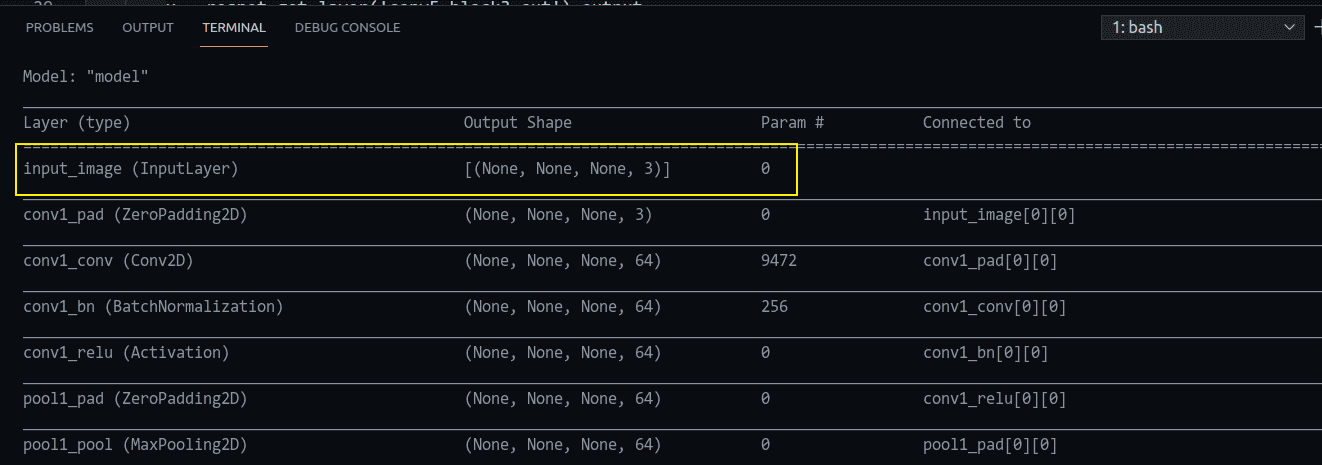
모델의 시작은 resnet50 입력부터 시작하는 것 같습니다. 실제 summary에서도 그렇게 나오고, 이 출력은 Unet 기반으로 피처를 concat 하는 형태로 가져가서 마지막에 regression을 하게 됩니다
모델 resnet50 입력에 input_tensor 파라미터를 통해서 input_image라고 지정을 하게 되어서 shape는 아래 캡쳐한 것처럼 (None, None, None, 3)라고 나온 것 같습니다
그런데 코드 마지막에 최종 모델 API에서는 입력에
overly_small_text_region_training_mask, text_region_boundary_training_mask, target_score_map
을 추가로 지정하는데, 해당 입력 텐서 3개는 전혀 모델 입력으로 들어가지 않는 것 아닌가요?
감사합니다
class EAST_model:
    def __init__(self, input_size=512):
        input_image = Input(shape=(None, None, 3), name='input_image')
        overly_small_text_region_training_mask = Input(shape=(None, None, 1), name='overly_small_text_region_training_mask')
        text_region_boundary_training_mask = Input(shape=(None, None, 1), name='text_region_boundary_training_mask')
        target_score_map = Input(shape=(None, None, 1), name='target_score_map')
        resnet = ResNet50(input_tensor=input_image, weights='imagenet', include_top=False, pooling=None)
        # print(resnet.summary())
        x = resnet.get_layer('conv5_block3_out').output

        x = Lambda(resize_bilinear, name='resize_1')(x)
        x = concatenate([x, resnet.get_layer('conv4_block6_out').output], axis=3)
        x = Conv2D(128, (1, 1), padding='same', kernel_regularizer=regularizers.l2(1e-5))(x)
        x = BatchNormalization(momentum=0.997, epsilon=1e-5, scale=True)(x)
        x = Activation('relu')(x)
        x = Conv2D(128, (3, 3), padding='same', kernel_regularizer=regularizers.l2(1e-5))(x)
        x = BatchNormalization(momentum=0.997, epsilon=1e-5, scale=True)(x)
        x = Activation('relu')(x)

        x = Lambda(resize_bilinear, name='resize_2')(x)
        x = concatenate([x, resnet.get_layer('conv3_block4_out').output], axis=3)
        x = Conv2D(64, (1, 1), padding='same', kernel_regularizer=regularizers.l2(1e-5))(x)
        x = BatchNormalization(momentum=0.997, epsilon=1e-5, scale=True)(x)
        x = Activation('relu')(x)
        x = Conv2D(64, (3, 3), padding='same', kernel_regularizer=regularizers.l2(1e-5))(x)
        x = BatchNormalization(momentum=0.997, epsilon=1e-5, scale=True)(x)
        x = Activation('relu')(x)

        x = Lambda(resize_bilinear, name='resize_3')(x)
        #x = concatenate([x, ZeroPadding2D(((1, 0),(1, 0)))(resnet.get_layer('conv2_block3_out').output)], axis=3)
        x = concatenate([x, resnet.get_layer('conv2_block3_out').output], axis=3)
        x = Conv2D(32, (1, 1), padding='same', kernel_regularizer=regularizers.l2(1e-5))(x)
        x = BatchNormalization(momentum=0.997, epsilon=1e-5, scale=True)(x)
        x = Activation('relu')(x)
        x = Conv2D(32, (3, 3), padding='same', kernel_regularizer=regularizers.l2(1e-5))(x)
        x = BatchNormalization(momentum=0.997, epsilon=1e-5, scale=True)(x)
        x = Activation('relu')(x)

        x = Conv2D(32, (3, 3), padding='same', kernel_regularizer=regularizers.l2(1e-5))(x)
        x = BatchNormalization(momentum=0.997, epsilon=1e-5, scale=True)(x)
        x = Activation('relu')(x)

        pred_score_map = Conv2D(1, (1, 1), activation=tf.nn.sigmoid, name='pred_score_map')(x)
        rbox_geo_map = Conv2D(4, (1, 1), activation=tf.nn.sigmoid, name='rbox_geo_map')(x)
        rbox_geo_map = Lambda(lambda x: x * input_size)(rbox_geo_map)
        angle_map = Conv2D(1, (1, 1), activation=tf.nn.sigmoid, name='rbox_angle_map')(x)
        angle_map = Lambda(lambda x: (x - 0.5) * np.pi / 2)(angle_map)
        pred_geo_map = concatenate([rbox_geo_map, angle_map], axis=3, name='pred_geo_map')

        model = Model(inputs=[input_image, overly_small_text_region_training_mask, text_region_boundary_training_mask, target_score_map], outputs=[pred_score_map, pred_geo_map])
Answer 1
0
아, 다시 코드를 보니 loss 정의에서 위 3개 텐서가 사용하더라구요
model.compile(loss=[dice_loss(east.overly_small_text_region_training_mask, east.text_region_boundary_training_mask, score_map_loss_weight, small_text_weight),
                                 rbox_loss(east.overly_small_text_region_training_mask, east.text_region_boundary_training_mask, small_text_weight, east.target_score_map)],
                           loss_weights=[1., 1.],
                           optimizer=opt)
각 배치마다 저 3개의 값이 다르고, 이를 loss 때 계산 용도로 사용하려고 전달하는 것 같습니다. 실제 모델에서 사용하지 않지만, 저렇게 다른 용도를 위해서 Model.input 파라미터 입력으로 전달해주는 경우도 종종 있나요?
감사합니다
resize 질문
0
95
1
20251212 Kaggle 런타임에 scikit-learn 설치 실패 트러블 슈팅
0
121
1
Loss와 매트릭 관계
0
121
2
Boston 코랩 실습
0
228
2
배치 정규화의 이해와 적용 2 강의 질문
0
195
2
Augmentation원본에 적용해서 데이터 갯수 자체를 늘리는 행위는 의미가있나요?
0
204
2
Conv함수 안에 activation 을 넣지 않는 이유가 뭔지 궁금합니다.
0
272
2
소프트맥스 관련 질문입니다
0
254
1
강의 관련 질문입니다
0
205
2
residual block과 identity block의 차이
0
260
2
옵티마이저와 경사하강법의 차이가 궁금합니다.
1
302
1
실습 환경
0
211
2
입력 이미지 크기
0
307
2
데이터 증강
0
254
2
albumentations ShiftScaleRotate
0
240
1
Model Input Size 관련
0
337
1
마지막에 bird -> frog 말고도 deer -> frog 도 잘못된것 아닌가요??
0
232
1
일반적인 질문 (kaggle notebook사용)
0
337
2
실무에서 Augmentation 적용 시
0
384
2
안녕하세요 교수님
0
265
1
가중치 초기화(Weight Initialization) 질문입니다.
0
377
1
테스트 데이터셋 predict의 'NoneType' object has no attribute 'shape' 오류
0
447
1
학습이 이상하게 됩니다.
2
1092
2
boston import가 안됩니다
0
259
1