
inflearn logo
Challenge
Ended

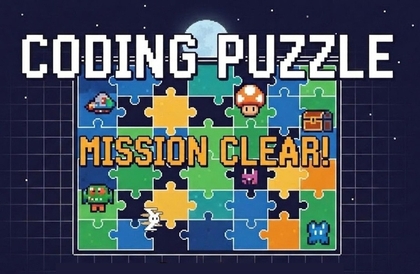
Coding Puzzle Mission Clear Challenge - Season 2

Based on Swift Playgrounds' "Learn to Code 1," the Code Puzzle Clear Challenge is a 4-week intensive training course focused on "computational thinking"—the process of giving commands to a computer to make it move exactly as you want. By solving puzzle missions in each session, participants naturally learn how to break down problems into smaller steps (problem decomposition), identify recurring rules to organize them into for-loops or functions (pattern recognition), and make logical judgments to change actions based on specific situations. Beyond simply finding the right answer, participants reach a level where they can explain and refine "why I solved it this way."

Python
Java
Swift
Algorithm

13개 수업 학습

12회 미션 수행

지식공유자와 멘토링 혜택!

무제한 복습, 내 것으로 만들어요.

같은 기수와 교류하고 함께 성장해요.

leeo님과 함께해요!

8,870

Learners

248

Reviews

7

Answers

4.9

Rating

30

Courses

Hello, I'm Leeio, a developer fishing for code in Pohang.

Co-instructor

Code Puzzle Clear Challenge: Building Computational Thinking with Swift Playgrounds

Through the Swift Playgrounds Learn to Code 1 puzzles, you will repeatedly practice problem decomposition → pattern recognition → logical judgment. Instead of "coding by memorizing syntax," you will train your thinking skills to command a computer to move exactly as you intend.


If you have these concerns, this course is right for you.

  • "I want to learn how to code, but I don't know what to do or how to start."

  • "I know a bit of grammar, but my mind goes blank whenever I face a problem."

  • "AI creates the code for me, but... I don't know what I need to fix."

  • "I want to do app development, but I feel like I lack the basic thinking skills."


What you will gain from taking this course

Description of Abilities Sense of commanding a computer: The power to transform desired actions into "command units" Problem decomposition skills: The habit of breaking down large problems into small steps to solve them Pattern recognition skills: The ability to find recurring rules and organize them into for-loops/functions Logical judgment skills: Thinking where choices change depending on the situation (conditions/exceptions/boundaries) Code reading power: The experience of interpreting correct code through "intention and flow" Failure recovery resilience (Debugging mindset): A routine of explaining why something is wrong and fixing it when an error occurs Self-directed learning routine: A foundation that remains unshaken no matter what language or framework you learn


Recommended for

  • Complete non-developers / Beginners — Those who want to understand what coding is "all about" first

  • Those who followed the tutorial but cannot solve the problems — Those who need the power to solve things on their own

  • Planners / Designers and other non-developer roles — Those who want to communicate more accurately with developers

  • Those who use AI coding but find it difficult to request modifications — Those who want to explain in words "how it needs to be changed"

  • Those whose goal is app development but feel their basic thinking skills are shaky — Those who want to build a foundation before moving on to SwiftUI/UIKit


This course is 'puzzle-based thinking skills training.'

This is not simply a "lecture that gives you the answer code." Every time we solve a puzzle, we repeat the routine below.

  1. Stating the goal in a single sentence

  2. Breaking down the solution process into 5–7 steps

  3. Finding repeating rules (patterns)

  4. Organizing and judging conditions/exceptions

  5. Execute with code, explain failures, and fix them

As a result, a more fundamental problem-solving mindset remains, rather than just "coding ability."


Curriculum

Each part proceeds in the structure of Explanation → Mission → Submission Template Creation → Improvement.

Part 1. How to speak to a computer (Instruction translation)

  • How to turn natural language into commands

  • "One-line action" unit decomposition

  • Submission: Natural Language → Step Decomposition → Code

Part 2. Building Problem Decomposition Muscles (Decomposition)

  • Training to always break it down into 7 steps

  • Rules for breaking down big problems into small problems

  • Submission: Decomposition Table + Code

Part 3. Pattern Recognition (Pattern)

  • Finding patterns in repetition

  • Reducing repetition with for loops

  • Submission: Repetition marker (🔁) + Before/After refactoring

Part 4. Abstraction (Naming with Functions)

  • How to group into functions by "meaningful units"

  • Criteria for good function names (Verb/Intention/Result)

  • Submission: Before/after functionalization + reason for name selection

Part 5. Logical Judgment (Decision)

  • How to organize conditions in words

  • Creating selection structures (branching tables / decision trees)

  • Submission: Branching Table + Code

Part 6. Turning Failure into Skill (Debug Thinking)

  • Failed Code Replay: Intention vs. Reality

  • Explaining the bug in "sentences" and fixing it

  • Submission: 5-line failure report template

Part 7. Final Mission: Creating a Puzzle Guidebook

  • Explaining my solution to others

  • Complete one set of "Problem Summary / Pattern / Conditions / Code / Advice"

  • Submission: 5 Explanatory Guides


How it works

  • After watching the lecture, perform the mission for each part

  • Organize using the provided submission template (Decomposition / Pattern / Judgment)

  • Fixing the thinking routine through repetitive training

It is designed to be "mission-centered" so that you don't just finish by watching the videos.


Requirements / Environment

  • iPad or Mac (Environment capable of running Swift Playgrounds)

  • Install Swift Playgrounds

  • Ready to proceed with "Learn to Code 1"


Pre-course Checklist

If two or more of the following apply to you, it's the perfect time to start.

  • [ ] I feel overwhelmed and don't know where to start when I see code

  • [ ] It is difficult to break down problems into small steps.

  • [ ] It is difficult to find and organize repetitions/rules.

  • [ ] It is difficult to make things behave differently depending on conditions (situations)

  • [ ] It is difficult to explain in words why it is wrong when an error occurs


Frequently Asked Questions (FAQ)

Q. Is it possible even for a complete beginner?Hỏi: Tôi thực sự là người mới bắt đầu hoàn toàn, liệu có thể tham gia được không?

It is possible. However, since this course focuses on building a problem-solving routine rather than memorizing syntax, it is important to have a mindset of "thinking and organizing" rather than just "typing along."

Q. Does it also cover SwiftUI / App Development?

Rather than app development itself, this course focuses on the problem-solving thinking that serves as the backbone of app development. Once you finish this course, it will become much clearer "what you need to do" when you move on to SwiftUI/UIKit.

Q. Can I use this with AI coding tools (like ChatGPT)?

In fact, I highly recommend it. However, this course focuses not on "copy-pasting code provided by AI," but on developing the ability to explain your intentions and make precise requests for corrections.


One-line course introduction

This is a course designed to build computational thinking from scratch, enabling you to make computers follow your commands by repeatedly training in 'problem decomposition – pattern recognition – logical judgment' through Swift Playgrounds puzzles.

4월

26일

챌린지 시작일

2026년 4월 26일 오후 03:00

챌린지 종료일

2026년 5월 24일 오후 02:30

챌린지 커리큘럼

All

25 lectures ∙ (3hr 14min)

Course Materials:

챌린지 전용 수업

챌린지에서 배워요

  • Instead of vaguely typing along with the code, you develop the power to transform your intended actions into precise commands.

  • Instead of getting stuck trying to solve a large problem all at once, you can move forward step-by-step by breaking it down into small, manageable tasks.

  • Learn "efficient thinking" by discovering patterns when the same actions are repeated and organizing them into structures like "for" loops.

  • A mindset of making the right choices by distinguishing between conditions and situations, such as "A in this case, B in that case," becomes established.

  • Instead of giving up when you are wrong, you practice a debugging mindset by explaining why you were wrong and making corrections.

Recommended for
these people

Who is this course right for?

  • Those who have just started coding, or those who started but gave up every time because they got stuck.

  • Someone who has looked at the code a bit but still doesn't have a sense of 'why it works this way'

  • People in non-development roles, such as planners and designers, who want to communicate better with developers

  • People who feel frustrated because they can't judge the results or request modifications even after receiving code from AI

  • Those who aim for app development but get stuck in practice after only following grammar and tutorials.

Reviews

Not enough reviews.
Please write a valuable review that helps everyone!

FAQs

취소 및 환불 규정
챌린지는 지식공유자가 설정한 수업 최소 정원이 충족되지 않을 경우, 폐강 안내가 고지되며 결제 내역이 자동취소됩니다.

leeo's other courses

Check out other courses by the instructor!

Free